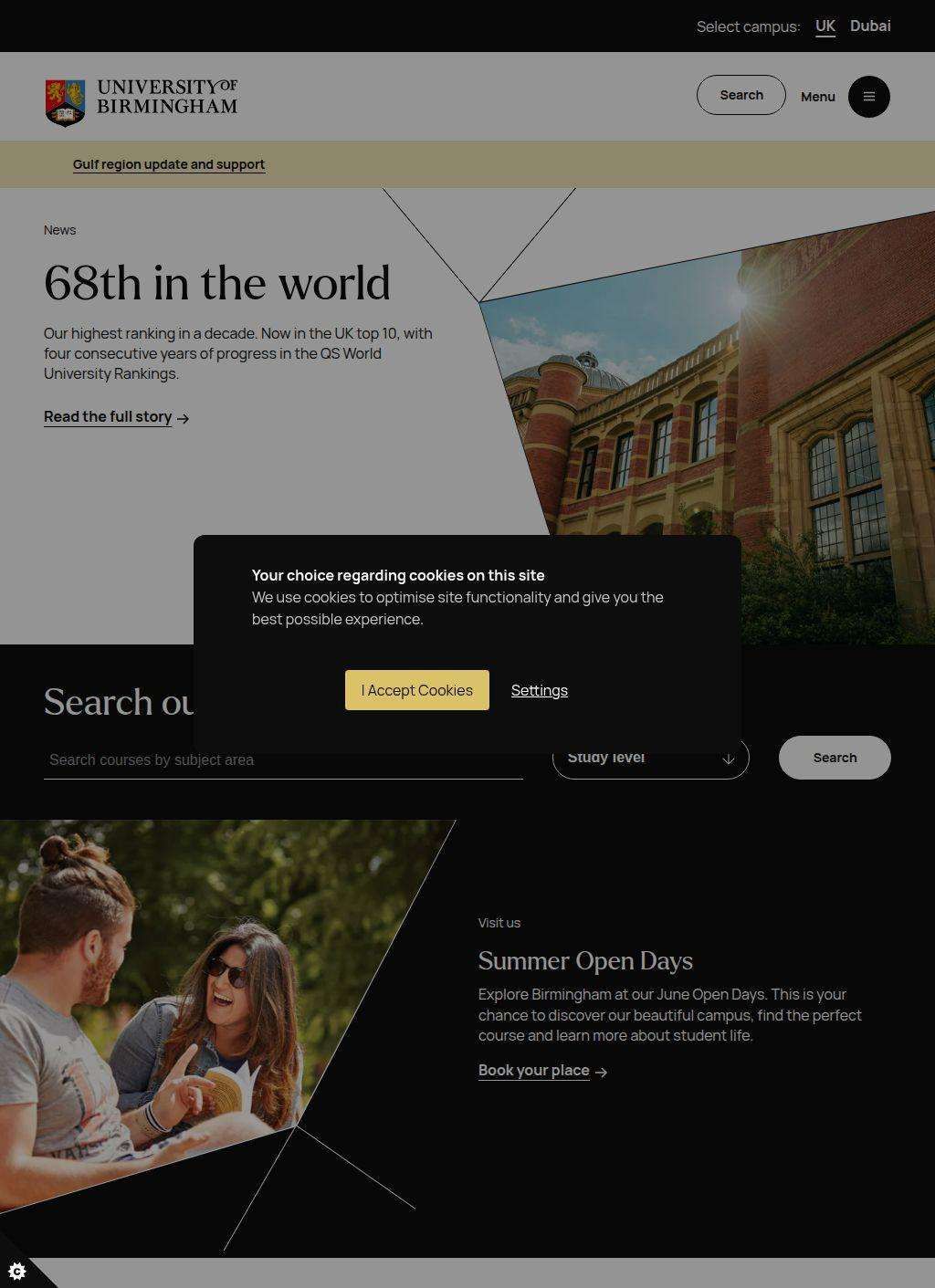
A course search engine sits front and centre on the homepage, filterable by study level, so a prospective applicant can move from a vague "I want to study something" to a concrete shortlist in a few clicks. That is the practical spine of the University of Birmingham site, and it says a lot about who the pages are built for: people deciding where to spend three or more years and a good deal of money. Undergraduate, postgraduate taught, and postgraduate research routes all feed into the same database, alongside shorter courses, and the filtering keeps the sprawl of a large institution readable.
Course search as the organizing spine
Sitting behind that search is the Edgbaston campus operation of a Russell Group research university, and the site treats admissions as its first job. Application deadlines are published in the open, down to specifics such as 17 July 2026 for international postgraduate-taught applicants who need a visa. Small thing, but a real one: an overseas student planning a move builds their timeline around exactly that kind of hard date, and burying it would create weeks of email back-and-forth. Publishing it plainly is the sort of administrative honesty that reads well.
Application deadlines and visa requirements
One feature that stands out from the usual admissions furniture is "Speak to a student", an ambassador scheme that connects people thinking about applying with students already enrolled. Prospectus prose is written by the marketing office; a current undergraduate answering a question about seminar workload or what the accommodation is genuinely like is a different, more useful kind of answer. The University of Birmingham putting that channel on the site reads as confidence that its own students will speak for it, which is worth more than another glossy paragraph would be.
From student ambassadors to research visibility
The site names specific research strengths instead of gesturing at excellence in the abstract, and food systems work on cutting supply chain waste is one it foregrounds. That is a concrete, checkable line of inquiry with obvious real-world stakes, and choosing to lead with it tells you the institution would rather point at a problem it is working on than recite adjectives about being world-leading. Broader activity runs across the schools, institutes and departments, which the homepage does not try to list one by one, and that restraint is sensible given how much a university of this size actually runs.
Rankings and institutional progress
Institutional standing gets stated through rankings, with the University of Birmingham placed 68th in the world on the QS World University Rankings and four consecutive years of upward movement noted. Numbers like these are marketing by nature, and any reader should treat a single ranking as one lens among many. Still, the trend line is more telling than the snapshot, and four years of steady progress is a harder thing to stage than a lucky single-year jump. It is a fair claim to make, presented without much inflation.
What the research promotion does well is stay legible to an outsider. A prospective PhD student, or a company scouting an academic partner, can see the areas the University of Birmingham wants to be known for without wading through internal jargon. That does not replace the departmental deep-dives such a reader will eventually need, but as a front door it points people the right way.
Beyond the prospective-student audience, the site doubles as the operational hub for people already inside the institution. There is a Canvas-based learning management system, staff and student intranets, and a careers portal aimed at graduate employment. These are working tools used by current students and staff every single day, a heavier kind of use than the prospectus pages get. Combining both jobs on one domain is standard for a university but still worth noting when judging how much the site has to hold together.
The careers portal in particular shows that the University of Birmingham is thinking past graduation day. It treats employment outcomes as part of what it owes students, not as an afterthought once the degree is handed over. Whether the roles behind it are strong is not something the homepage can prove, but building the pathway into the core digital furniture is the correct instinct.
Student life gets real estate too, and the site leans on Birmingham the city to sell the experience: museums, cultural attractions, nightlife, parks, and botanical gardens near campus all get a mention. This is where a university site can drift into tourism-board writing, and there is a little of that flavour here. It is also legitimate. For an eighteen-year-old weighing offers, or a postgraduate relocating from abroad, what surrounds the campus genuinely shapes three years of life, so devoting space to it is not padding. The pull of a second city with that much on its doorstep is a fair card to play.
Taken together, the pages are trying to serve several very different visitors at once: the school-leaver comparing offers, the international applicant tracking visa deadlines, the researcher sizing up a collaboration, and the enrolled student logging in to Canvas between lectures. The University of Birmingham mostly keeps those audiences from colliding. The course database acts as the organising spine, and the rest branches off it. A site this size lives or dies on navigation, and the searchable, level-filtered structure is the right backbone for it.
If there is a limit to what the homepage reveals, it is the one every large institution's front page shares: the interesting substance lives one or two clicks deeper, in the individual school and department pages the homepage deliberately does not enumerate. That is a reasonable trade. Cramming every institute onto the homepage would wreck the clarity that makes the course search usable in the first place, and the University of Birmingham has clearly chosen the search-first path over the exhaustive-menu path.
For anyone weighing the University of Birmingham against other Russell Group options, the site gives them the raw material to do it: dated deadlines, a filterable catalogue of degrees at every level, named research strengths, a direct line to current students, and an honest account of the ranking trajectory. A person filtering degree options by study level, then messaging a current ambassador for a first-hand answer, could complete most of their real decision-making inside these pages. The deadline for visa-dependent postgraduate applicants is printed as 17 July 2026, and that specificity is the tone the whole site works in.
Business address
University of Birmingham
Edgbaston,
Birmingham,
West Midlands
B15 2TT
United Kingdom
Contact details
Phone: 0121 414 3344