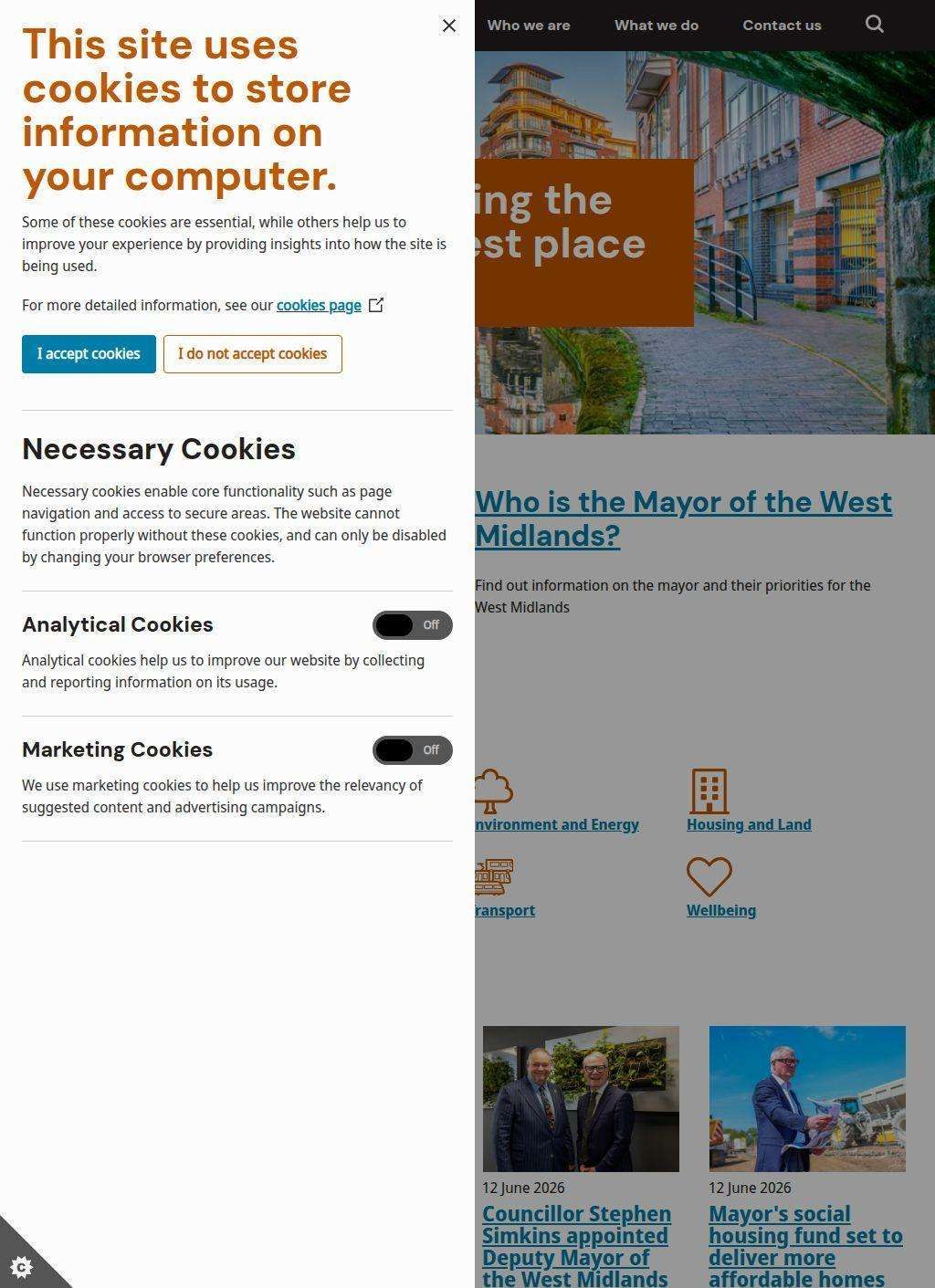
West Midlands Combined Authority is the statutory regional body for the West Midlands area of England, run with an elected Mayor of the West Midlands at its head. The site is the public face of that machinery, and it does a fair job of explaining what a combined authority is for: pooling money and decision-making across the constituent councils to fund things that no single council would tackle alone, while leaving those councils intact. The distinction is easy to miss, because the easiest thing to get wrong about a body like this is to assume it has swallowed local government. It has not. West Midlands Combined Authority coordinates and invests on top, and the homepage gets that relationship across without fuss.
Eight portfolios covering regional priorities
The work is organised into eight portfolios, and reading through them gives a clear picture of scope. Culture and Digital sits alongside Economy and Innovation, Environment and Energy, Housing and Land, Inclusive Communities, Employment and Skills, Transport, and Wellbeing. That is a wide brief, and the site mostly resists the temptation to pad each heading with slogans. You can move from a skills programme to a low-carbon energy initiative to an estate regeneration scheme without the language going soft on you. For a resident trying to work out who is responsible for what, that breadth is the point: this is where regional-scale ambitions get parked, funded, and tracked.
Transport network and metro expansion
Transport is plainly the heaviest portfolio, and West Midlands Combined Authority treats it that way. The headline is a transport network programme worth around 2.4 billion pounds, with the East Birmingham to North Solihull Metro tram extension singled out as a flagship. I spent a while reading the project material here because it is the kind of thing that determines whether a body like this is doing real work or just publishing intentions, and the detail held up: the strategic network is described as an integrated whole, with buses, trams, and rail meant to function together rather than as separate silos. Whether that integration is delivered on the ground is a question the documents cannot answer on their own, but the framing is honest about the scale of the undertaking.
Spending connected to specific schemes
What makes the transport pages useful is that they connect spending to specific schemes. A tram extension into East Birmingham and North Solihull is a concrete, mappable commitment, not a vague aspiration to improve connectivity. The site lets you follow the money from the headline figure down to named infrastructure, which is more than a lot of public bodies manage. If you live along that corridor, or run a business near it, the relevance is immediate, and you can see exactly where your area sits in the wider plan.
Affordable housing delivery with land development
The same logic carries into housing and land. West Midlands Combined Authority describes affordable housing delivery, land development, and estate regeneration as funded priorities, and it places those next to the transport work in a way that suggests the two are meant to reinforce each other. Building homes where the trams will run is the sort of joined-up thinking the combined-authority model was invented to enable, and the site at least sets out the intent plainly.
Governance records and public accountability
The part of the site that proves most genuinely valuable is the governance layer, and it is the part that separates a real authority from a publicity exercise. West Midlands Combined Authority publishes board meeting records, budgets, and strategic plans, treating the public as entitled to see them rather than as an audience to be managed. Board papers and meeting records are the documentary trail of how decisions actually get made: who voted, what was approved, what the money was earmarked for. Having them out in the open is the difference between an organisation that claims to be accountable and one that gives you the means to check.
Routes for resident and business engagement
Beyond the papers, there are routes for residents and businesses to engage directly. The site explains how to access funding opportunities, how to read the regional investment priorities, how to submit a freedom of information request, and how to take part in public consultations. Those are not glamorous features, but they are the ones that make a regional authority answerable. A consultation that is easy to find and respond to is worth more than a dozen polished mission statements, and West Midlands Combined Authority gives those mechanisms proper real estate and does not bury them.
Mayor's visible role in delivery work
The Mayor of the West Midlands has a visible presence across the site too, with the mayoral office, news releases, and updates on the flagship infrastructure and regeneration schemes all kept current. That coverage ties the political leadership to the delivery work, which is sensible: an elected mayor who is invisible on the authority's own site would be a strange thing. West Midlands Combined Authority keeps the office woven into the wider account of what is being funded, not isolated on a separate page of its own.
Can employment and skills drive regional growth?
The economic side of the brief is broad without being shallow. Economy and Innovation and Employment and Skills together cover the funding of training programmes and the steering of regional investment toward growth, and West Midlands Combined Authority frames skills as something it pays for and shapes, not merely talks about. For a region with the industrial history of the West Midlands, putting employment and skills on the same footing as transport and housing reads as a deliberate choice, not a box-ticking exercise.
Environment and Energy rounds this out with low-carbon energy initiatives, and again the value is in seeing it placed beside the harder infrastructure and not filed away under a sustainability label. The portfolios are presented as parts of one regional strategy, which is the honest way to present them, because in practice transport decisions are energy decisions and housing decisions are skills decisions. West Midlands Combined Authority does not oversell those connections, but it makes them available to anyone willing to read across the sections. A reader who arrives looking only for bus information leaves with a sense of how the buses, the homes, the carbon targets, and the training money all pull on one another.
On the question of outside reputation, West Midlands Combined Authority carries no significant user review record on platforms like Google or Trustpilot. That is entirely typical for a statutory regional body: the accountability layer comes from board papers and consultation responses, and those are precisely what the site makes available. The governance documents are the public record here, and they are more informative than any star rating would be.
If there is a limitation, it is the one inherent to any body of this kind: a site can document intent and funding with great clarity and still leave you unable to judge delivery from the page alone. West Midlands Combined Authority is upfront about what it has committed to and how the governance works, which is the most a public-facing site can reasonably do. The trams either get built or they do not, and that verdict will live in the region, not in the publication.
As a reference, this is a substantial and well-ordered resource. The structure is genuinely clarifying, from the eight portfolios down to the board papers that record each decision, and West Midlands Combined Authority has organised it in a way that rewards both the curious reader and the one who is looking for something specific to hold the authority to account. What no document can settle is delivery, and the region will eventually produce its own answer to that.
Business address
West Midlands Combined Authority
16 Summer Lane,
Birmingham,
West Midlands
B19 3SD
United Kingdom
Contact details
Phone: 0121 200 2787