Origins and campus
The University of Warwick is a research university founded in 1965, one of the new institutions created during the rapid expansion of British higher education in that decade. Despite its name, the campus sits on the southern edge of Coventry, about three miles from the city centre, on land that straddles the boundary between the city and Warwickshire. The name reflected the involvement of both the city and the county in establishing the university. Jack Butterworth, the first Vice-Chancellor, led the institution from its foundation until 1985 and oversaw its growth from a few hundred students to a major university. The royal charter was granted in 1965, and the first intake that October numbered around 450 undergraduates.
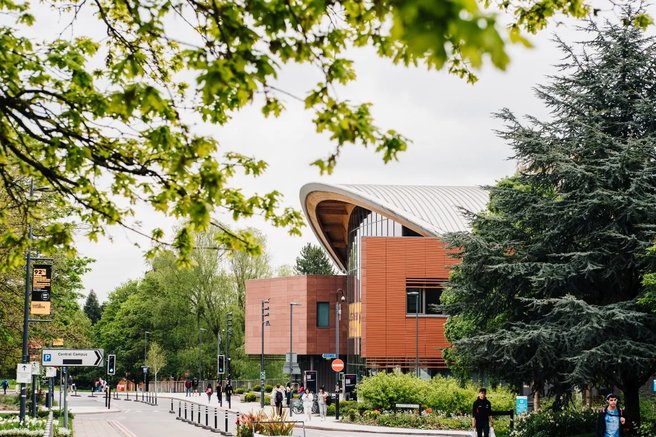
The main site covers around 720 acres. What began as a small cluster of buildings in open farmland has become a campus with academic departments, halls of residence, shops, banks, places of worship and health services.
Campus areas
Three linked areas make up the estate. Central Campus contains the main library, the Students' Union, the Oculus teaching building and most academic departments. Gibbet Hill Campus, a short walk away, houses medicine and the life sciences. Westwood Campus has further teaching buildings, sports pitches and student accommodation. Frequent buses connect the university with Coventry, Kenilworth and Leamington Spa, and the nearest railway stations are Canley, Tile Hill and Coventry, all on the line between Birmingham and London Euston.
Academic profile
Warwick is a member of the Russell Group of research intensive universities. Around 29,000 students are enrolled, roughly a third of them postgraduates, drawn from more than 140 countries. Teaching and research are organised in three faculties: Arts; Science, Engineering and Medicine; and Social Sciences.
Several departments carry national and international reputations. The Mathematics Institute, established at the university's opening by Christopher Zeeman, remains one of the strongest centres for the subject in the country. The Department of Economics and the degree in philosophy, politics and economics attract heavy competition for places. Warwick Business School, established in 1967, is among the largest university business schools in Britain and teaches undergraduates, doctoral researchers, MBA candidates and practising executives.
Research and industry links
WMG, founded as the Warwick Manufacturing Group in 1980 by the engineer Kumar Bhattacharyya, works with manufacturers on applied research in fields such as electric vehicle batteries, lightweight materials and digital manufacturing. Its long association with the automotive industry, including companies based across the West Midlands, has shaped engineering education at Warwick, and it runs one of the largest degree apprenticeship programmes in the sector. Warwick Medical School admitted its first students in 2000 and concentrates on graduate entry medicine, health sciences and clinical research carried out with hospitals in Coventry and Warwickshire.
Doctoral training centres funded by the research councils prepare postgraduate researchers in disciplines from mathematics to the social sciences. Interdisciplinary institutes bring departments together on questions such as data science, sustainable materials and global health. The main library holds more than a million printed volumes alongside large digital collections, with study space spread over several floors. Next to it, the Modern Records Centre preserves the archives of British trade unions and employers organisations, a collection consulted by labour historians from around the world.
Student life and public facilities
The Students' Union runs more than two hundred societies and sports clubs, from debating and drama to mountaineering and esports. Student media include a campus radio station, a television station and a student newspaper, all based in the Students' Union building. Much of undergraduate life happens on campus: first year students are usually housed in university residences, and later years typically move to Leamington Spa, Coventry or Kenilworth, all within easy commuting distance.
Warwick Arts Centre, opened on campus in 1974, is among the largest arts complexes in the United Kingdom outside London. Its concert hall, theatres, cinema and gallery present a public programme of music, drama, film and visual art that draws audiences from across the region as well as from the university itself. Admission to the gallery is free, and the venue runs events for schools and families throughout the year.
The Sports and Wellness Hub, opened in 2019, includes a twelve lane swimming pool, climbing walls and one of the largest gyms in the university sector. Outdoor pitches, tennis courts and a running track sit alongside it on the western side of campus. Membership is open to the public as well as to staff and students.
Outside term time the campus operates as a conference venue, hosting academic meetings, summer schools and residential events through its dedicated conferences arm. The university is one of the largest employers in the Coventry and Warwickshire area, with several thousand staff working in teaching, research, administration and campus services. Open days are held several times a year, and self guided visitors can follow the interactive campus map to explore the grounds, sculpture trail and lakes.

Business address
University of Warwick
Gibbet Hill Road,
Coventry,
Warwickshire
CV4 7AL
United Kingdom
Contact details
Phone: 024 7652 3523