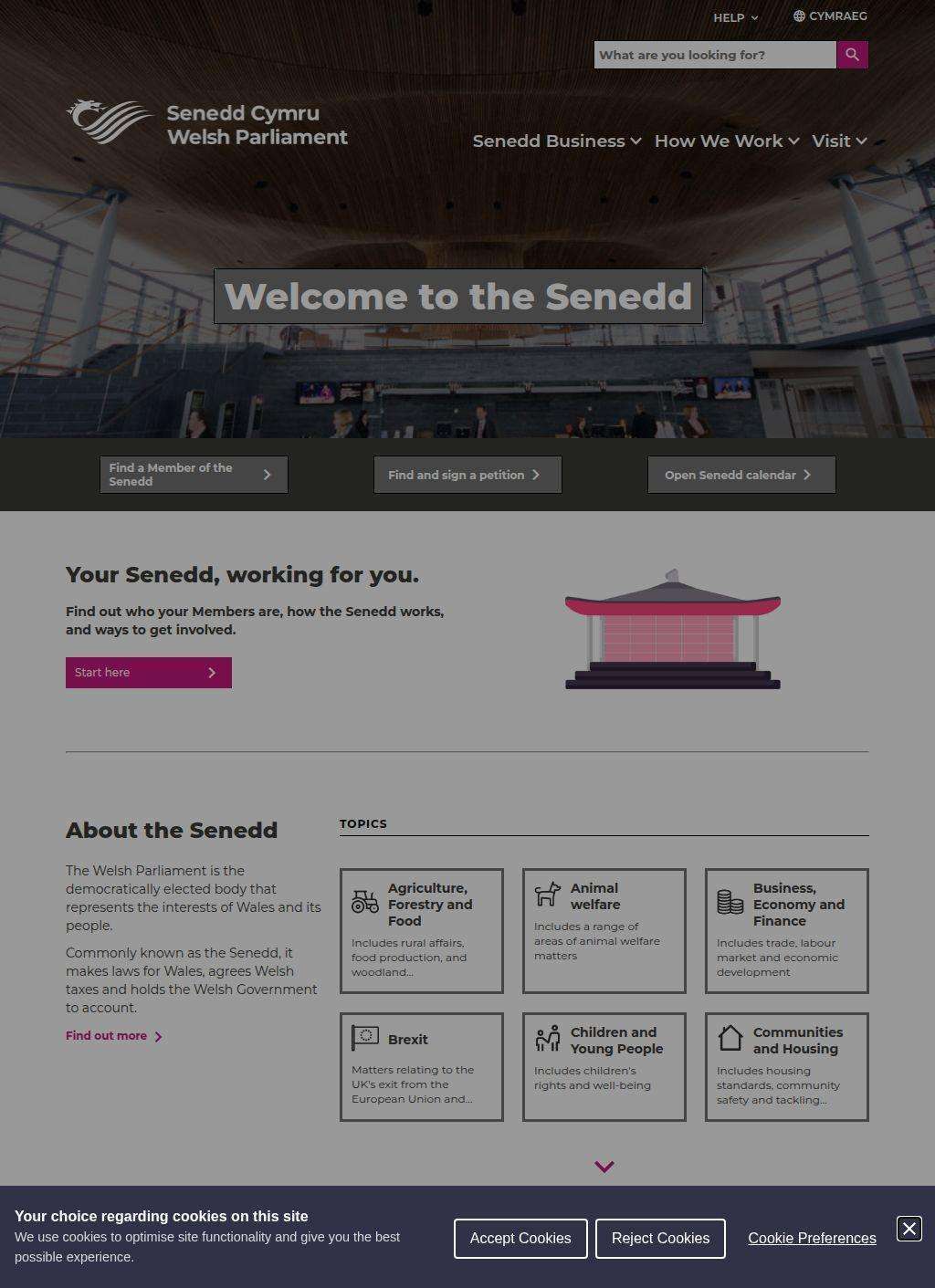
Every word on this site exists twice, in Welsh and in English, and that bilingual mirroring is the working condition of the whole institution, not a cosmetic afterthought. Senedd Cymru (Welsh Parliament) is the devolved legislature of Wales, sitting in Cardiff Bay, and its website is built to let an ordinary person watch it govern in real time. That sounds like a small thing until you start clicking and realise how much of the machinery is laid open: debates as they happen, the text of bills as they change, the names and votes of the people doing the changing. The whole site of Senedd Cymru (Welsh Parliament) reads as a deliberate effort to make a parliament legible to the people it answers to.
Watching debates live on Senedd TV
The centrepiece for most visitors will be Senedd TV. Plenary sessions in the Siambr, the chamber, stream live and sit in an archive afterwards, and committee meetings get the same treatment. A person who has never set foot in Cardiff Bay can watch a scrutiny session unfold, then go back a week later and find it still there. That permanence is what separates a serious parliamentary record from a news clip. The site does not present these recordings as highlights to be admired; they are simply the proceedings, available because the proceedings are public. It is one of the more open broadcast records any legislature offers, and Senedd Cymru (Welsh Parliament) treats that openness as ordinary rather than as something to advertise.
Legislation tracking process
Legislation is tracked with a thoroughness that rewards patience. Each bill is followed through every stage, with amendments and voting records attached, so a reader can see how a law was argued over and reshaped along the way, well beyond the final vote count. Committee work runs in parallel: open calls for evidence, published inquiry reports, and lists of who sits on what. For anyone trying to understand how a Welsh law actually came to exist, the trail is here, and it is the kind of material that journalists, students, and campaigners return to repeatedly.
Submitting and tracking public petitions
A fair amount of back-and-forth is possible through this site. The petitions system lets members of the public submit a petition and then track what happens to it, which closes the loop between raising an issue and watching it get a formal response. This is one of the clearer signs that the site is meant to be used actively. Senedd Cymru (Welsh Parliament) also publishes routes for participation that go beyond the screen: visiting the Siambr, sitting in the public gallery, and joining engagement programmes. These are presented as standing invitations, plainly listed.
That participatory streak is what gives the whole platform its character. Senedd Cymru (Welsh Parliament) could have settled for being a broadcaster of its own debates and a filing cabinet for its own documents. Instead the petitions mechanism, the published member contacts, and the visiting arrangements together make it a two-way channel, and that changes how a citizen relates to the institution behind it.
Profiles of Senedd members
Profiles for all sixty Members of the Senedd carry their contact details, voting records, and declared interests. Putting the declared interests next to the voting record is a quiet piece of transparency, since it lets a constituent judge a representative on more than a party label. The boundary and election-results material adds the other half of that picture, showing who was chosen and from where. None of it sits behind logins or gets summarised into vagueness.
Research papers and library briefings
The research and library resources deserve their own mention. Briefing papers and statistical analyses sit alongside the raw proceedings, which means the site offers both the evidence and a considered reading of it. A researcher can pull a committee report and find a library briefing that frames the wider context; the combination adds up to more than either alone. This is the part of Senedd Cymru (Welsh Parliament) that most resembles a standing reference, and it is genuinely useful well beyond Wales.
Educational resources and historical context
Education is handled as a distinct strand. There are resources aimed at schools and engagement programmes meant to bring people into the workings of the institution, which fits a legislature that treats civic understanding as part of its job. The history section explains the Senedd's role and powers under the Government of Wales Act, so a visitor who arrives knowing nothing about devolution can leave with a working grasp of what this body can and cannot do. The powers of a devolved parliament are easy to misjudge from the outside, and Senedd Cymru (Welsh Parliament) does not assume the visitor already knows where its remit ends.
Behind the public-facing parliament, the site is candid about its own administration. The Presiding Officer's office and the Senedd Commission, the corporate body that runs the institution, each get their own space. Setting out who chairs proceedings and who manages the place as an organisation is the sort of structural honesty that an official body owes its public, and Senedd Cymru (Welsh Parliament) provides it without making a fuss. The calendar of plenary and committee sessions ties everything to dates, so a reader can plan to watch something specific.
How does the site handle accessibility?
Accessibility and equality information runs through the site as well, consistent with the bilingual commitment. A parliament that publishes everything in two languages and then attends to accessibility is taking its duty to be reachable seriously, and that shows in how the material is organised. News and press releases keep the whole thing current, so the live proceedings and the standing reference do not drift apart. In this respect Senedd Cymru (Welsh Parliament) holds two roles at once, daily record and long-term archive, without letting either crowd out the other.
On outside reputation, Senedd Cymru (Welsh Parliament) is a public institution rather than a commercial service, so the usual review platforms do not apply. A search turns up no aggregated ratings, which is exactly what you would expect. The credibility here rests entirely on the published record, and that record is extensive enough to assess directly without needing third-party commentary to validate it.
Weighing the site's density
If there is a limit to all this, it is the sheer volume. The site asks something of the visitor, because the depth that makes it valuable also makes it dense, and a casual browser may need a few minutes to find their footing among the bills, committees, and archives. That is the price of completeness, and the structure does reward a second visit; what looks overwhelming on day one starts to make sense once the shape of the institution is clear. Senedd Cymru (Welsh Parliament) has chosen breadth over hand-holding, and for its core audience that is a reasonable trade.
Set against the UK Parliament's own website at Westminster, which covers a far larger institution and inevitably dilutes its focus, Senedd Cymru (Welsh Parliament) has the advantage of focus. A reader who specifically wants to follow Welsh law, watch the sixty MSs at work, or petition a body that will track the response will find a tighter, more navigable account here than in the larger national equivalent. This is the primary source for Welsh legislative affairs, and it does the job by simply showing the work.
Business address
Senedd Cymru / Welsh Parliament
Cardiff Bay,
Cardiff,
Cardiff
CF99 1SN
United Kingdom
Contact details
Phone: 0300 200 6565