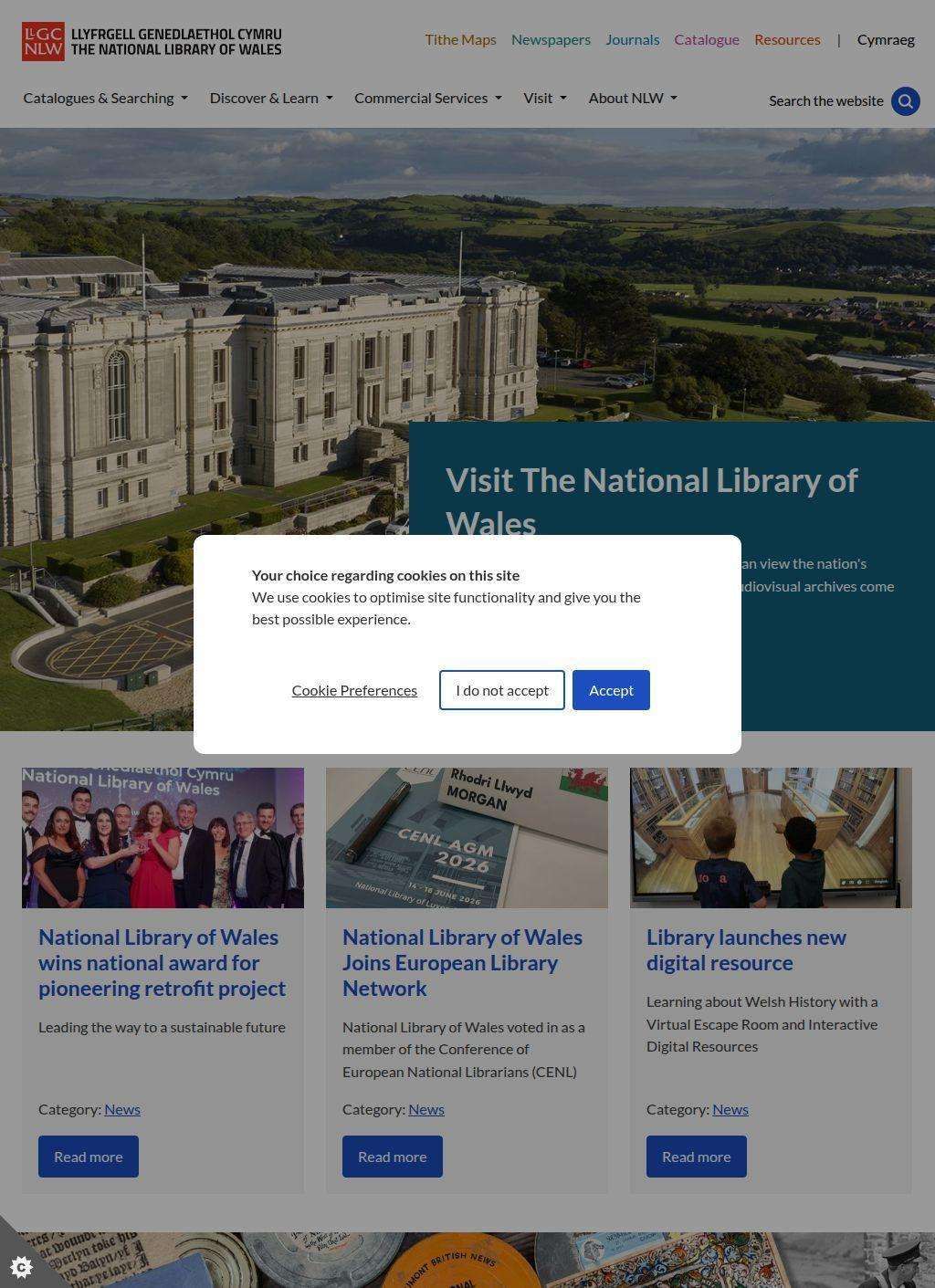
Holding the 1921 Census for family historians, the Wales Broadcast Archive, tithe maps drawn parish by parish, and a wedding venue you can book for your own ceremony, the National Library of Wales (Llyfrgell Genedlaethol Cymru) packs an unusual range behind one front door. The breadth is the first thing that lands when you start clicking through what it does. Sited in Aberystwyth on the Ceredigion coast, it carries one of the largest collections in the UK across manuscripts, printed books, maps, pictures, photographs, music, and audiovisual material.
Searching the online catalogue
The collection is only useful if you can find your way into it, and the route in is the online catalogue at discover.library.wales. You search the holdings there, then order the physical item to consult in the Reading Room. That two-step setup tells you something honest about the place. Plenty of the material is rare or fragile enough that it stays on site, so the digital catalogue works as a finding aid, not a full download library. For a researcher planning a trip to Aberystwyth, knowing in advance what is held and orderable is worth a great deal.
Specialist platforms for newspapers and maps
Around that core catalogue the National Library of Wales (Llyfrgell Genedlaethol Cymru) runs a set of specialist platforms that each do one job well. The tithe maps live on their own site at places.library.wales, pinning nineteenth-century landholding to specific plots and names. Historical Welsh newspapers and journals are searchable separately. The Wales Broadcast Archive and the Screen and Sound Archive cover the moving-image and recorded-sound side, material that quietly vanishes elsewhere because nobody thought to keep it. Splitting these into distinct, purpose-built tools is a sensible choice. A single bloated search box trying to cover newspapers, films, and cadastral maps at once would serve none of them well.
Tracing family history through records
Family history is where the National Library of Wales (Llyfrgell Genedlaethol Cymru) puts a lot of visible effort, and the access to the 1921 Census is the headline draw for anyone tracing Welsh ancestry. The research support around it reads as practical, aimed at people who arrive with a name and a vague county and need to turn that into a documented line. Combine the census with the tithe maps and the digitised newspapers and you have a fairly complete toolkit for reconstructing a family's place in a community.
School visits for young learners
Education is the other strong thread. The library runs school visits, workshops, and learning resources pitched at children, alongside digital exhibitions on Welsh history and literature and longer research programmes. The spread of audiences is genuinely wide: the same institution that hosts an academic research programme also builds something a primary-school class can use. That dual register is hard to pull off, and the fact that the National Library of Wales (Llyfrgell Genedlaethol Cymru) attempts both, without retreating into pure scholarship, says something about how it sees its public role.
Visiting the reading rooms
The in-person side fills out the picture for visitors who treat a trip as part of a day out. There are reading rooms for serious work, free public exhibitions for casual browsers, a cafe, and a gift shop. None of that is unusual for a major library, but the combination means a family with mixed interests can all find a reason to walk in. The exhibitions being free is the detail worth underlining, because it lowers the bar for someone curious about Welsh heritage but not yet committed to a research project.
Renting event space at the library
The commercial offering stretches further than expected. The National Library of Wales (Llyfrgell Genedlaethol Cymru) hires out space as a wedding venue and runs conference facilities, handles media licensing and filming permissions, and sells digitisation and reproduction of its material. There are even map services aimed at businesses. These are the activities institutions of this size increasingly lean on to fund the unglamorous work of preservation, and seeing them laid out openly is reassuring rather than off-putting. A film company that needs licensed footage from the broadcast archive, or a publisher wanting a high-resolution scan of a manuscript page, has a clear path to it.
If there is a coherent thread holding all of this together, it is custody of Welsh cultural memory in the broadest sense. The legal-deposit role means the National Library of Wales (Llyfrgell Genedlaethol Cymru) takes in published material as a matter of national record, which is why the collection keeps growing and why its remit feels less like a museum and more like a working archive of a nation. The catalogue, the specialist platforms, and the research support are all expressions of the same underlying job.
Public commentary about the National Library of Wales (Llyfrgell Genedlaethol Cymru) across consumer review platforms is sparse, which is unsurprising for a national institution of this kind. The work gets evaluated through academic and professional channels rather than star ratings, and a low public review count reflects nothing about the collection itself.
Choosing between catalogue and reading room
A student writing on Welsh literature, a genealogist chasing a great-grandparent through Cardiganshire, a teacher building a lesson, a documentary maker hunting archival footage: all of them will find that the National Library of Wales (Llyfrgell Genedlaethol Cymru) is among the first places that should come to mind, and probably the deepest single well of Welsh material anywhere. The depth of the holdings is not in doubt. Whether your specific sources live in the catalogue you can search from a laptop, or in the Reading Room boxes that require the journey to Aberystwyth, is a practical question the site itself helps you answer before you travel.
Business address
National Library of Wales
Penglais Hill,
Aberystwyth,
Ceredigion
SY23 3BU
United Kingdom
Contact details
Phone: 01970 632 800