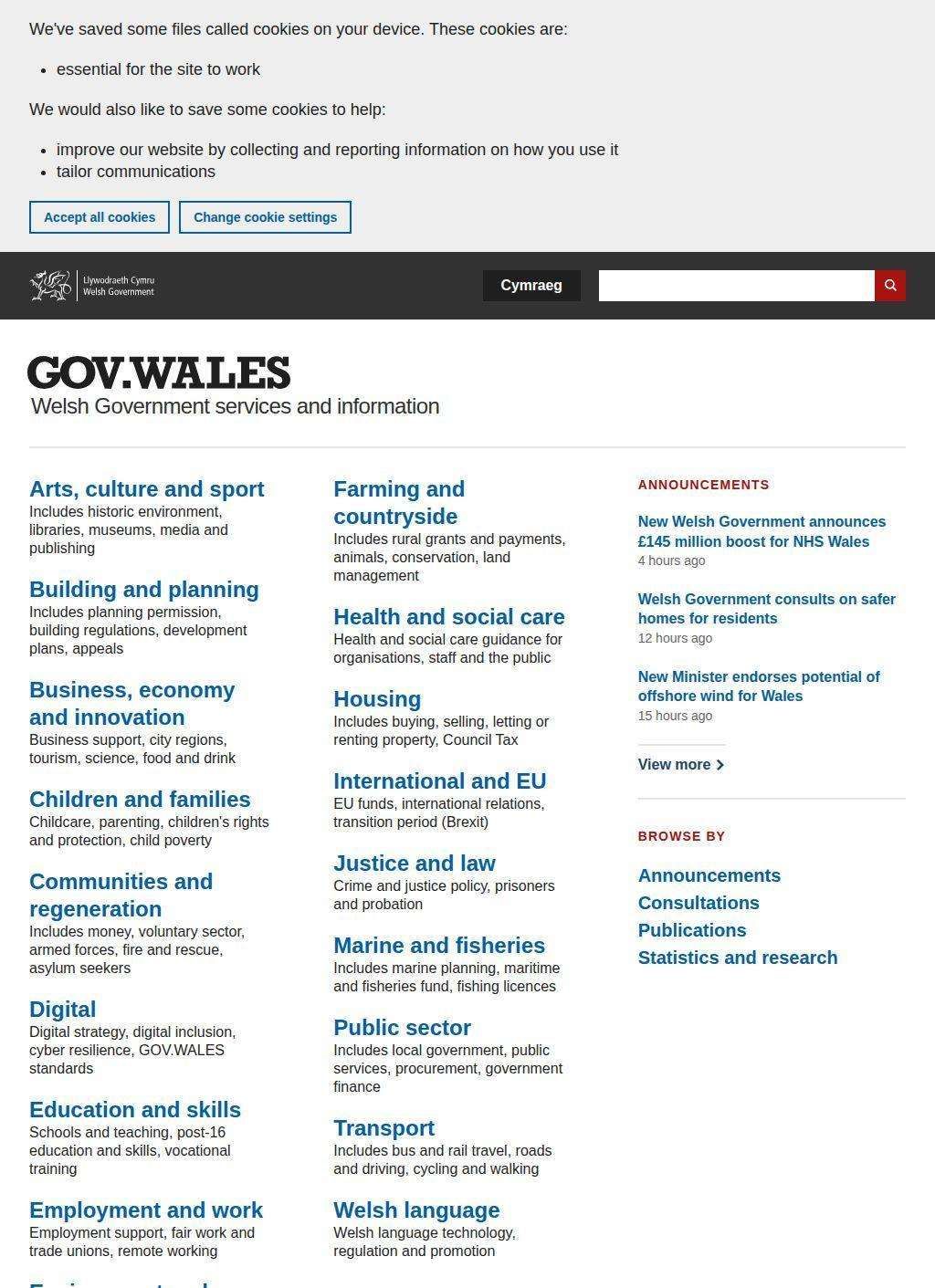
Say a parent in Swansea needs to know whether their child qualifies for free school transport, or a small firm in Wrexham wants to find a grant before the deadline. The frustrating part is usually not the rule itself but tracking down the official version of it, the one that actually applies in Wales and not somewhere else. This is the gap that the Welsh Government (Llywodraeth Cymru) site fills. It is the single digital front door for the Welsh Government (Llywodraeth Cymru), the devolved executive led by the First Minister, and it gathers policy, guidance, legislation and live public services into one place that residents can search instead of guessing.
Devolved policy areas
What makes the Welsh Government (Llywodraeth Cymru) site useful is breadth that maps to how Wales is actually governed. The devolved areas all have a home here: health and NHS Wales, education and schools, economic development and business support, transport, housing, social services, planning, local government, and the environment, including a separate climateaction.gov.wales for climate work. The Welsh Government (Llywodraeth Cymru) publishes its child poverty strategy alongside the dry but essential material that most people never see until they need it, the consultations, impact assessments, statistics and research papers that sit behind a decision. I find that mix genuinely valuable, because it lets someone read both the headline and the working underneath it.
Welsh language publication standard
Promotion of the Welsh language runs through the whole thing, and not as decoration. On the Welsh Government (Llywodraeth Cymru) site, Cymraeg has its own policy space, and every page is published in English and Welsh, so a Welsh-speaking user is reading the same authoritative text, not a thinner translation tacked on afterwards. For an institution whose remit includes keeping the language alive, publishing the full site in both languages is the expected standard, and the Welsh Government (Llywodraeth Cymru) meets it without the usual asterisks.
Practical finders for households
Beyond documents, the Welsh Government (Llywodraeth Cymru) site carries practical finders that answer concrete questions. There is a benefits and grants finder, school transport guidance, and the Healthcare Travel Costs Scheme that helps low-income patients recover the cost of getting to appointments. These are the bits that turn a policy site into something a household can use on a hard week. The grants finder in particular cuts across business support and economic development, so a sole trader does not have to read three separate policy sections to learn what is open to them. Public health resources sit nearby, and the structure assumes a reader who arrives with a problem, not one browsing for interest. That orientation is easy to underrate until you have spent an afternoon on a less disciplined public site.
Government structure and announcements
The site also functions as a directory of the state itself. The Welsh Government (Llywodraeth Cymru) lists its public bodies, advisory groups and associated companies, with five agencies and public bodies operating under its support, so anyone trying to work out which arm of government owns a given function can trace it from here.
That is genuinely handy for a researcher or a contractor who needs to address the right body instead of guessing. News releases, ministerial statements and speeches are posted as they happen, and journalists, councils and charities that need the official wording rather than a second-hand summary have a reliable place to find it. Businesses, schools, NHS bodies and public sector organisations across Wales are all served by the same hub, and the announcements carry over to its YouTube channel and a Facebook page with more than 192,000 followers for people who follow updates that way.
Depth this wide brings the usual trade-off. A site that holds every devolved policy area plus the documents behind them is large, and finding the exact page can take patience, especially when a topic spans health and social services or planning and environment at once. That is the honest cost of putting everything in one place, and search is your main route through the Welsh Government (Llywodraeth Cymru) site. For most users arriving with a specific need, this listing in the Wales business directory points them where they should already have started.
If you put it next to GOV.UK, which carries gov.wales as a parallel entry for UK-wide visibility, the distinction is clear and worth knowing. GOV.UK is the right destination for reserved matters such as tax, passports and most benefits, while the Welsh Government (Llywodraeth Cymru) site is where the devolved decisions actually live, the ones GOV.UK will often hand you back to. Someone in Cardiff sorting out a schools question or a Welsh grant will get the current, applicable answer here and a fuller bilingual one than the UK portal offers, which is reason enough to make gov.wales the first stop and treat the wider portal as the place you go only when the matter is genuinely not devolved.
Business address
Welsh Government
Cathays Park, King Edward VII Avenue,
Cardiff,
Cardiff
CF10 3NQ
United Kingdom
Contact details
Phone: 0300 060 4400