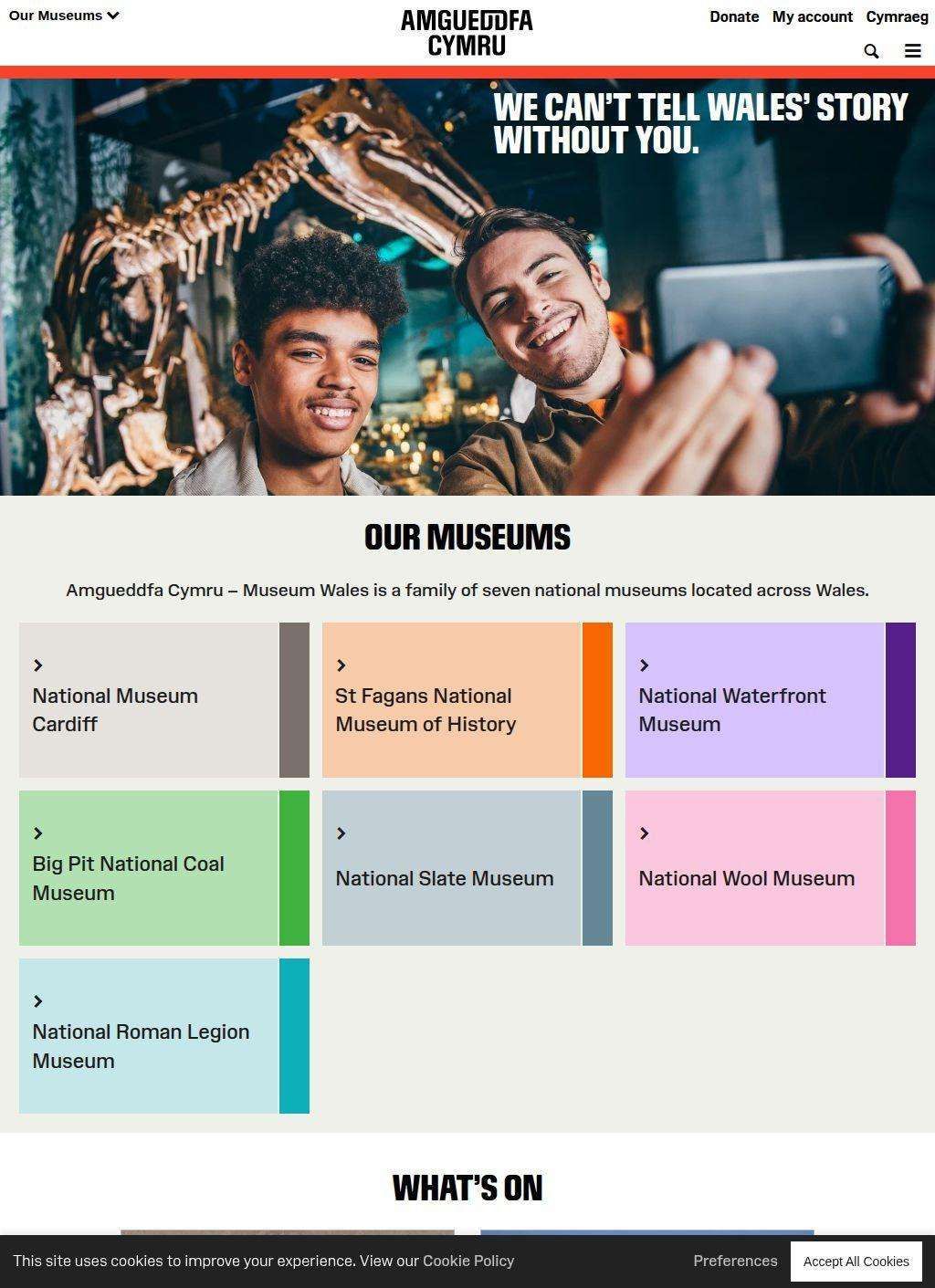
Seven separate museums sit behind a single name here, and that is the first thing worth understanding about Amgueddfa Cymru (National Museum Cardiff). What looks like one site in Cathays Park is really the front door to a national network: the art and natural history galleries in Cardiff, St Fagans National Museum of History, the National Waterfront Museum in Swansea, Big Pit National Coal Museum, the National Slate Museum, the National Wool Museum, and the National Roman Legion Museum. The web presence ties all of them together, so a person planning a day out and a researcher chasing a specific object both land in the same place and branch off from there.
Seven museums under one collection
The scale of the holdings is genuinely hard to picture. The network describes 5.3 million objects and memories covering art, history, natural sciences, and industry, which is the sort of collection that takes generations to assemble and a properly built website to make navigable. The site treats that range honestly. Fine art galleries sit alongside fossils, alongside a colliery you can descend into, alongside the looms and slate-splitting tools of Welsh industry. Amgueddfa Cymru (National Museum Cardiff) does not pretend to be one tidy theme. Wales had coal, wool, slate, Roman legions, and a long art tradition, and the museums reflect that spread without forcing it into a single story.
Visitor information for each venue
Most museum websites are at their best when they answer the dull practical questions, and Amgueddfa Cymru (National Museum Cardiff) does this clearly. Each of the seven venues carries its own visitor information: opening hours, admission, and directions, presented per site so you are not guessing whether the Swansea waterfront museum keeps the same times as the slate museum further north. That separation is useful when the venues are scattered across the country and run on different rhythms. An exhibitions and events calendar pulls the temporary shows and one-off happenings into a single feed, which is the part of any museum that changes week to week and the part a static brochure could never keep current.
Education programmes for schools and researchers
There is a real education programme behind the public face, branded Learn at Amgueddfa Cymru (National Museum Cardiff), aimed at schools, families, and researchers. These three audiences want very different things, and the site does not flatten them into one generic "education" tab. A teacher booking a class trip, a parent looking for a half-term activity, and an academic needing structured access are pointed down their own routes. The collections and research access goes further than a gallery slideshow: records are digitised and available online, so someone studying a particular artist, specimen, or industrial process can begin the work remotely.
That online collection is the quiet strength of the whole thing. A museum can show only a fraction of what it owns at any one time, and the gap between what is on the wall and what is in storage is usually enormous. Digitised records narrow that gap. For Amgueddfa Cymru (National Museum Cardiff), opening the catalogue to the public turns a building you have to travel to into a resource you can consult from anywhere, which is exactly what a national collection funded for the nation ought to do.
Shop and membership programmes
Beyond the core visitor and research material, the site runs the supporting machinery you would expect from an institution of this size. There is an online shop, venue hire offered across the museum sites, a blog, membership programmes, and donation and support options, plus community involvement opportunities for people who want to give time as well as money. None of these are the reason to visit, but together they show an organisation that is using its web presence to do administrative and fundraising work, well beyond posting a map and a set of opening times.
Bilingual Welsh English experience
One detail says a lot about who the museums are for. The whole site operates bilingually in Welsh and English, not as a token language switch buried in a footer but as a genuine parallel experience. For a national institution of Wales that is not decoration, it is the point. A Welsh-speaking visitor reads the same content in their own language, and the site treats that as ordinary practice. There is also an accessibility statement, which shows that the practical side of getting people through the door, or through the web pages, has been considered and not left to chance.
It is worth being plain about what this is. Amgueddfa Cymru (National Museum Cardiff) is a registered charity, number 525774, and a public body, so the website is doing a job that goes past tourism. It is the digital arm of a national cultural service. That framing explains choices that might otherwise look uneven: the heavy investment in research access, the bilingual build, the donation and membership routes. These are the priorities of an organisation answerable to the public, and the site reads as one built to serve that remit rather than to sell tickets, which it largely does not need to since several of the venues are free to enter.
Visitor ratings across review platforms
On outside reputation, a search for Amgueddfa Cymru (National Museum Cardiff) across review platforms turns up ratings on Google and Tripadvisor running into thousands of entries, with scores consistently in the four-to-five range across the individual venues. Big Pit and St Fagans in particular draw detailed visitor accounts. The volume is high enough that the pattern is meaningful, not a handful of outliers.
One hub with seven identities
The structure of the site makes sense once the seven-venue model clicks. Amgueddfa Cymru (National Museum Cardiff) keeps one authoritative hub and lets each museum retain its own identity underneath. A visitor interested only in Big Pit can go straight to it; a researcher who does not care which building holds an item can search across the lot. That dual approach, one network with distinct sites, is the right call for a collection this varied, and the navigation supports both habits without making either feel like an afterthought.
The range can feel almost too wide on a first visit. Jumping from Renaissance painting to a working coal mine to Roman military history inside one menu takes a moment to absorb. Once you accept that Amgueddfa Cymru (National Museum Cardiff) is a whole nation's museum service rather than a single themed attraction, the breadth stops being confusing and becomes the appeal. Few organisations can offer art, natural science, and heavy industry under one roof, and the website does not waste that advantage by hiding any strand.
If there is a limit to what the site can do, it is the same limit every large institutional web presence faces: depth versus clarity. With 5.3 million objects and seven venues, there is a permanent tension between surfacing everything and keeping the front pages calm enough to use. The calendar, the per-venue information, and the search-driven collection are the tools that manage it, and on the evidence of how the visitor material is laid out, Amgueddfa Cymru (National Museum Cardiff) has landed on the usable side of that balance. The digitised collection in particular pushes the site past what most museum web presences manage, and that is where Amgueddfa Cymru (National Museum Cardiff) pulls clear of the average institutional page.
Business address
Amgueddfa Cymru / Museum Wales
Cathays Park,
Cardiff,
Cardiff
CF10 3NP
United Kingdom
Contact details
Phone: 0300 111 2333