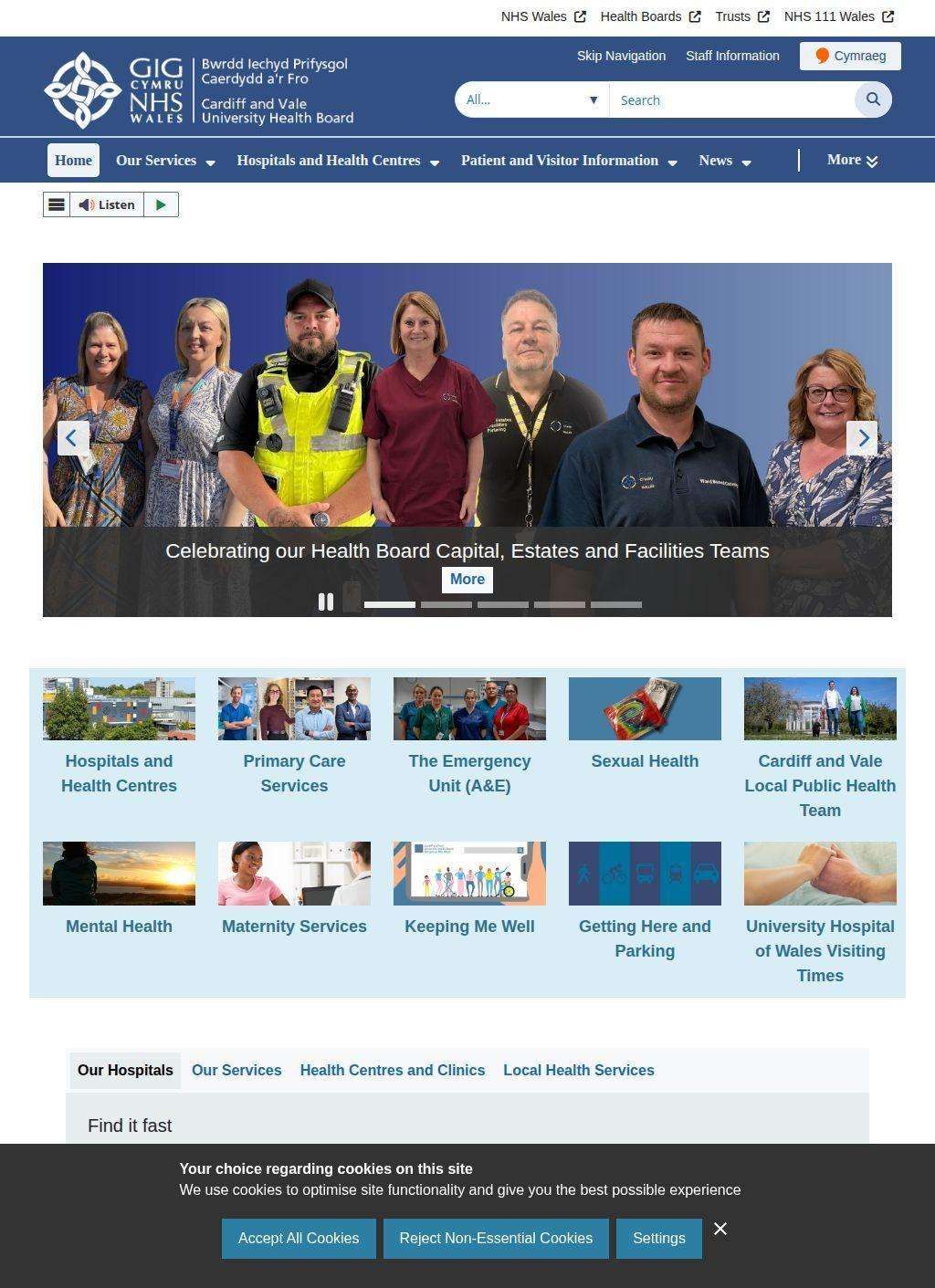
Someone whose father has just been admitted to a ward in Cardiff, or a parent trying to work out whether a feverish child needs A&E tonight or a GP tomorrow, arrives with a very practical set of questions: where do I go, when can I visit, who do I call, and what happens next. The site run by Cardiff and Vale University Health Board is built to answer exactly that, and it does so without making you dig. The main entry points cover the hospitals it runs (University Hospital of Wales, University Hospital Llandough, Barry Hospital and the others), emergency and urgent care, outpatient and inpatient pathways, and the everyday details of visiting hours and patient rights that matter most when a family is anxious and short on time.
Services organised by care type
What sits underneath those front-door pages is the full span of an NHS Wales statutory body. Cardiff and Vale University Health Board provides hospital, primary, community and mental health services across the city and the Vale of Glamorgan, and the site is organised along those lines. Maternity has its own space. Mental health services are listed separately from general community care. There is dental information, guidance for people navigating GP and primary care, and a section on waiting times that tells patients where things stand for particular services. This is the sort of breadth you would expect from Cardiff and Vale University Health Board, the body responsible for the health of a population that large, and the site does not pretend the estate is smaller or simpler than it is.
Patient rights and complaints process
The patient-facing material is where Cardiff and Vale University Health Board treats people as participants in their care rather than as cases on a list. Visiting arrangements, patient rights, and the Putting Things Right process (handled through PALS) are laid out plainly, so a person with a complaint or a concern can see the route before they pick up the phone. When care goes wrong, or even when it just feels confusing, a clear complaints pathway is worth a lot more than a dead end, and this site puts the pathway in front of you instead of burying it in a footer link.
Public health prevention efforts
The public health side gets real space too, not a token mention. Health improvement campaigns and prevention material sit alongside the clinical service pages, in keeping with a health board judged on the wellbeing of its whole area and not solely on what happens inside its wards. A reader looking for practical guidance on staying well, or on where to turn for a specific service, will find it grounded in the actual services Cardiff and Vale University Health Board runs, which beats generic advice detached from any local provision.
Board governance documents
Governance is handled with the openness the public sector is meant to show. Board papers, meeting dates, minutes and annual reports are published, and there is a freedom of information route for anything the standard pages do not cover. This is the unglamorous part of a health board's website, and it is often the part that gets neglected, so it counts in favour of Cardiff and Vale University Health Board that the material is present and reachable. Anyone who wants to understand how decisions get made, or to check what the board committed to and whether it followed through, has the documents to do it. Accountability that you can actually inspect is worth more than a reassuring paragraph about accountability.
Careers training at Cardiff University
The careers and education content rounds the picture out. Cardiff and Vale University Health Board recruits through NHS jobs, runs training, and partners with Cardiff University's medical school, and the site treats staff and prospective staff as an audience in their own right. That teaching-hospital connection is not incidental. It shapes the kind of care the University Hospital of Wales in particular can offer, and it explains why the clinical breadth here goes beyond what a smaller district provider would attempt. News and press releases keep the whole thing current, which is what you want from an organisation where service changes and seasonal pressures are constant.
Site navigation challenges
If there is a fair criticism, it is the one that applies to almost every large NHS site: the sheer volume of services means the navigation asks something of the reader, and a first-time visitor may need a moment to find the precise page they came for. But the information is there, it is accurate to the organisation, and it is not padded with marketing. For the population it serves, Cardiff and Vale University Health Board offers the reference layer people genuinely reach for in a stressful moment, and it does not fall apart under that kind of pressure.
How does this compare to NHS 111 Wales?
Weighed against a national front door like the NHS 111 Wales symptom and service finder, the two do different jobs and are best used together. NHS 111 Wales is the place to start when you are unsure how urgent a problem is. The Cardiff and Vale University Health Board site is where you go once you know the care sits with this health board, because it carries the hospital detail, the local service specifics, the visiting and complaints information, and the governance record that a triage tool was never meant to hold. For anyone in Cardiff or the Vale of Glamorgan, that makes it the page worth bookmarking.
Business address
Cardiff and Vale University Health Board
Woodland House, Maes-y-Coed Road, Llanishen,
Cardiff,
Vale of Glamorgan
CF14 4HH
United Kingdom
Contact details
Phone: 029 2074 7747