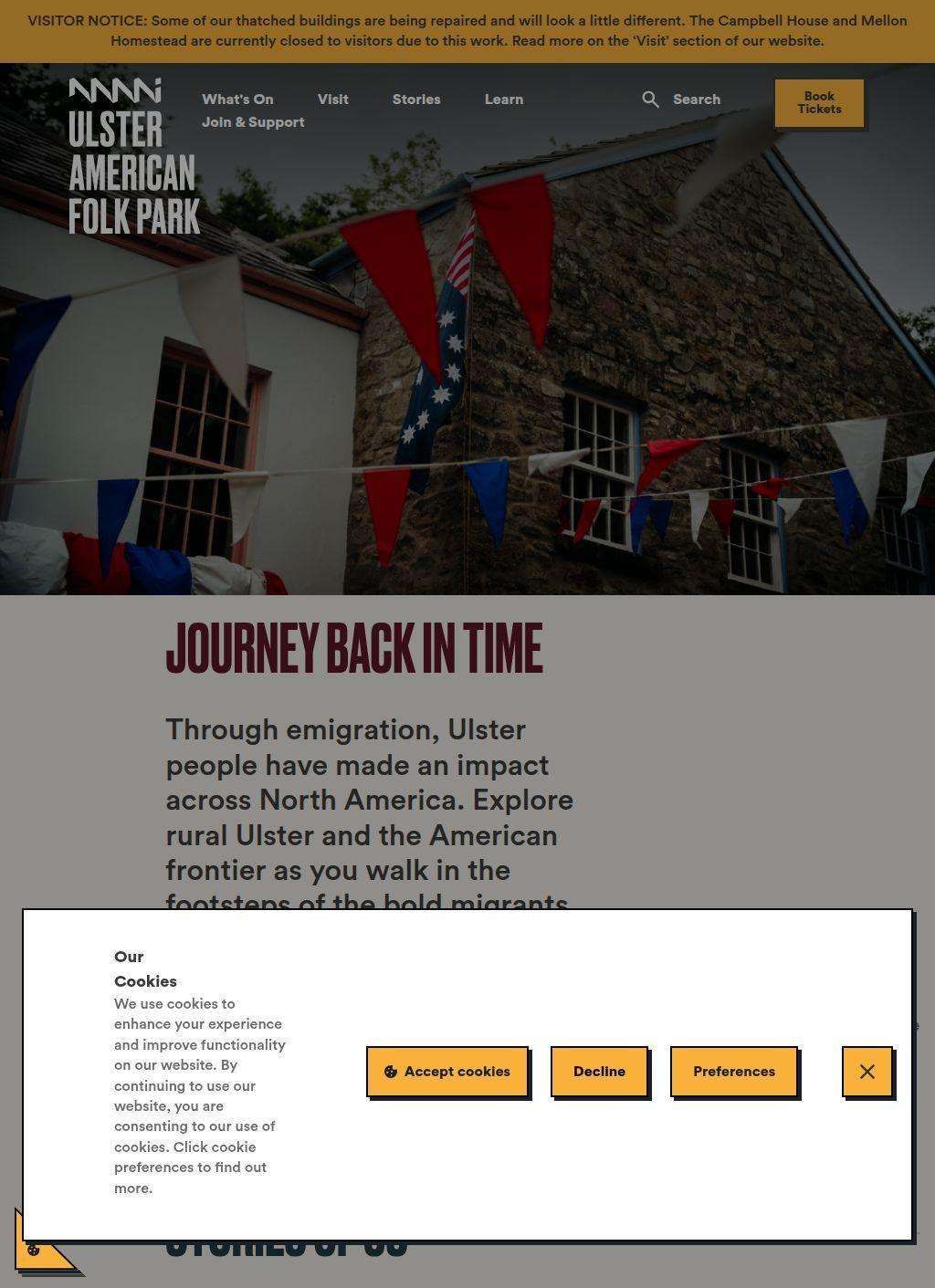
You want a day out near Omagh that holds a child's attention and still leaves an adult with something to think about, and the Ulster American Folk Park sets out to do exactly that. This is an open-air museum built around one specific story: the wave of Ulster emigration to North America across the 18th and 19th centuries. The conceit running through the whole place is geographic as much as historical. Visitors walk through reconstructed streetscapes and buildings on the Ulster side, then cross over to the kind of settlement those families found waiting for them in America, with costumed demonstrators populating the gap between the two worlds.
Walking between two worlds
That structure is the thing that lifts it above a static collection of old houses. Migration is hard to make legible, especially to anyone who has never had to weigh leaving everything behind, and the answer at the Ulster American Folk Park is to make you physically pace the distance. The 18th and 19th century framing is narrow on purpose, and the museum is better for the focus. It is not trying to cover all of Irish history. It is trying to explain one departure, repeated thousands of times over, and what people carried with them.
National Museums NI operations
It helps that the place is run by National Museums NI rather than a small private trust, because the scale shows in the upkeep of the grounds and the depth of the costumed interpretation. The demonstrators are not there for a quick photo. They cook, work, and answer questions in character, and on a good day that turns a row of empty rooms into something that reads as a working settlement. Children tend to respond to this far better than they do to a glass case, which is the quiet logic behind the whole layout.
Rotating exhibits and events
The standing exhibits are supported by a rotating programme. "Under the Hawthorn Tree" is pitched squarely at families, drawing on the children's novel of the same name, which gives younger visitors a narrative thread to follow rather than a series of plaques to read past. Running alongside it through the summer is "From Here to the White House," a set of portraits by Frank McKelvey of American presidents with Ulster roots. That second show ties the migration theme back to a tangible payoff: the people who left were not anonymous, and some of their descendants ended up running a country. It is a smart pairing, one exhibit built for the under-tens and one that gives the adults a reason to slow down on the way out.
Seasonal programming and concerts
The events calendar at the Ulster American Folk Park leans into the same American thread without straining for it. There are Bluegrass BBQ concerts, an American Independence Weekend across the fourth and fifth of July, and a Live from the Folk Park concert at the end of August. These read as a sensible extension of the subject matter, music and food that crossed the Atlantic and came back changed, slotted into a site that already trades in that exchange. For repeat visitors, there is also a cross-site offer giving half off a next trip to other National Museums NI properties, which is a quiet nudge to treat this as one stop in a wider circuit.
Ticketing and membership options
Practical access is straightforward. General admission ticketing covers the basic visit, and the Ulster American Folk Park also handles venue hire and runs membership programmes for people who expect to come back more than once a year. Opening is Tuesday through Sunday, ten in the morning until five, which closes the door on Mondays but otherwise gives a generous window. The membership angle is worth weighing if you live within reach, since a single ticket to a site this size is easier to justify when you can spread it across several returns and pick up the seasonal exhibits as they rotate in.
Current building closures
The honest caveat sits in the fabric of the site itself. Campbell House and Mellon Homestead are both shut for repairs at the moment. Those are not minor props. The Mellon connection is part of the founding story of the Ulster American Folk Park, and the homestead is one of the buildings people specifically come to stand inside. A museum whose entire method is walking you through authentic structures loses something real when two of them are roped off, and anyone planning a visit around those particular buildings should check the status before setting out, since the listing gives no date for the work being finished.
Maintenance versus public access
What the closures expose is the standing tension in any living-history site. The buildings are the exhibit, so maintaining them and showing them are the same job pulling in opposite directions. The temporary shows and the concert season keep the calendar full and give a reason to come this summer specifically. The reconstructed core is what people remember, and right now part of that core is behind scaffolding. Whether the rest of the Ulster American Folk Park carries a visit on its own, or whether the gaps leave the central emigration story feeling abridged, is the thing you cannot settle from the listing, and it depends heavily on which buildings happen to be open the day you go.
Business address
Ulster American Folk Park
2 Mellon Road,
Castletown, Omagh,
County Tyrone
BT78 5QU
United Kingdom
Contact details
Phone: 028 8224 3292