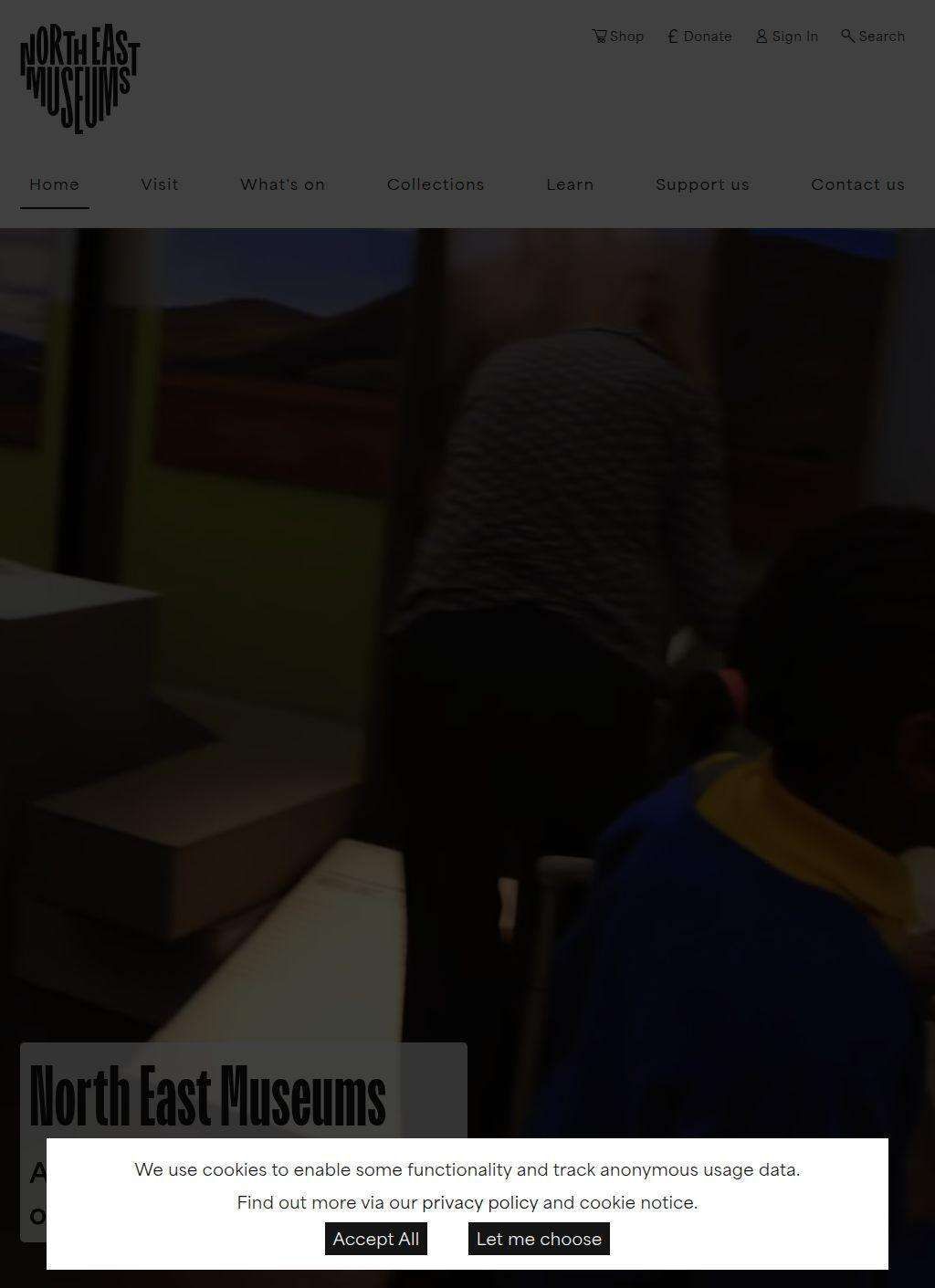
North East England's cultural memory is concentrated, to an unusual degree, under a single organisation. More than most visitors would guess. Tyne & Wear Archives & Museums, which presents itself online as North East Museums, runs twelve separate venues spread across the region, and the website is the front door to all of them at once. That breadth is worth understanding from the start. This is not one museum with a website; it is a service that ties together Roman forts, art galleries, a steam railway, a bagpipe museum and a working archive, and the site has to carry all of that without collapsing into a list of disconnected pages.
Twelve venues across the region
The venues under Tyne & Wear Archives & Museums read like a tour of the region's history in objects. Arbeia Roman Fort and Segedunum Roman Fort cover the Roman frontier. The Discovery Museum and Stephenson Steam Railway lean into the area's industrial and engineering past. Then there is fine and decorative art at the Laing Art Gallery, the Shipley Art Gallery and the Hatton Gallery, natural history and archaeology at the Great North Museum: Hancock, and local collections at South Shields Museum & Art Gallery, Woodhorn Museum, Hexham Old Gaol and the Morpeth Chantry Bagpipe Museum.
The collections span Roman-era material through to modern social history, taking in archaeology, natural sciences, and industrial heritage. A visitor planning a day out can see at a glance which site fits the mood, whether that is paintings, fossils, or a fort. Few regional bodies hold a spread this wide.
Behind the archive and research database
Beyond the exhibition floors, the research side of the operation is what stands out. Tyne & Wear Archives & Museums provides a searchable collections database, which turns a regional museum service into something a student or family historian can query from home without needing to visit in person. The organisation also gives access to the Tyne & Wear Archives themselves, a genuine working archive for researchers, not a curated display of highlights. Archives and museums are different disciplines, and a body that runs both offers depth that a single gallery cannot. Anyone tracing a family line, a local business, or a shipyard record has a real starting point here, and the database means the first step can happen before anyone leaves the house.
Balancing permanent and rotating exhibitions
The exhibitions are both permanent and rotating, which is what keeps repeat visits sensible. A permanent Roman gallery anchors a venue while a changing programme of temporary shows gives regulars a reason to come back. The site has to juggle twelve sets of opening information, ticketing where it applies, and current shows, and the structure has to make that legible. The navigation problem is the one this organisation lives or dies by online: a person arriving to find out about the Laing should not have to wade through Segedunum to get there.
Learning programmes for schools
Learning sits high in the priorities of Tyne & Wear Archives & Museums. There are schools and learning programmes, family activities, and dedicated programming for under-fives. The venues are run as community and education spaces, not simply places to look at things behind glass. Programming for the very youngest visitors reveals something about the organisation's orientation: it thinks about who walks through the doors on a wet Tuesday, well beyond the headline blockbuster show. Schools planning a trip can match a venue to a topic, from Roman occupation at the forts to engineering at the railway, and that curriculum fit is doing quiet work behind the public programme.
Extra services beyond exhibits
There is a commercial and participatory layer around the core too. Venue hire is offered, presumably to fund the wider operation, alongside volunteering opportunities and a supporter or donation scheme for people who want to back the work directly. An online shop adds a retail strand, and the inclusion of Newcastle City Guides walking tours extends the reach of Tyne & Wear Archives & Museums out of the buildings and onto the streets of the city itself. That last item is notable because it positions Tyne & Wear Archives & Museums as a guide to the place as a whole, more than a custodian of indoor collections. Whether the walking tours are run in-house or simply hosted on the site is the sort of thing the page should make plainer.
Online account registration is available, which is expected of an organisation handling bookings, archive requests and donations. The practical question is how much that account opens up in practice: whether it saves a research trail across the collections database, manages event tickets, or exists only for the shop. A login that does little is a friction point; one that ties the database, bookings and the supporter scheme together would make the whole sprawling operation feel like one service.
One brand, twelve distinct venues
The single regional identity is a strength and a quiet risk at the same time. A unified brand lets Tyne & Wear Archives & Museums cross-promote, so a visitor to the Discovery Museum learns the Stephenson Steam Railway exists. The risk is that twelve venues with very different audiences can blur together under one banner until none of them feels distinct. A bagpipe museum in Morpeth and a Roman fort on the coast do not draw the same crowd. The collections justify the umbrella. The website's job is to make each venue feel like itself while still belonging to the larger family, and that is a hard balance to hold across so many sites.
Google and TripAdvisor return individual venue reviews for Tyne & Wear Archives & Museums rather than a single organisation-level score, which is typical for a multi-site body. The separate venues accumulate their own feedback, and the Laing and Great North Museum in particular have substantial visitor commentary. No aggregated rating exists for the organisation as a whole; that is the nature of the structure, not a gap in the record.
The case for a visit
What the listing establishes is substance. This is not a modest operation dressing up a single attraction; it is a wide-ranging cultural service with real collections, a genuine archive, an education remit and a public-facing programme that runs from toddlers to academic researchers. The depth of what Tyne & Wear Archives & Museums holds, from Roman archaeology to industrial machinery to decorative art, is the kind of range a visitor could return to for years without exhausting it. Few regional services can claim a steam railway and a fine-art gallery in the same portfolio, and fewer still pair that with a researchable archive. The collections of Tyne & Wear Archives & Museums are the case for the visit; the website's quality is the only thing left to take on trust until you arrive.
Business address
Tyne & Wear Archives & Museums
Discovery Museum, Blandford Square,
Newcastle upon Tyne,
Tyne and Wear
NE1 4JA
United Kingdom
Contact details
Phone: 0191 232 6789