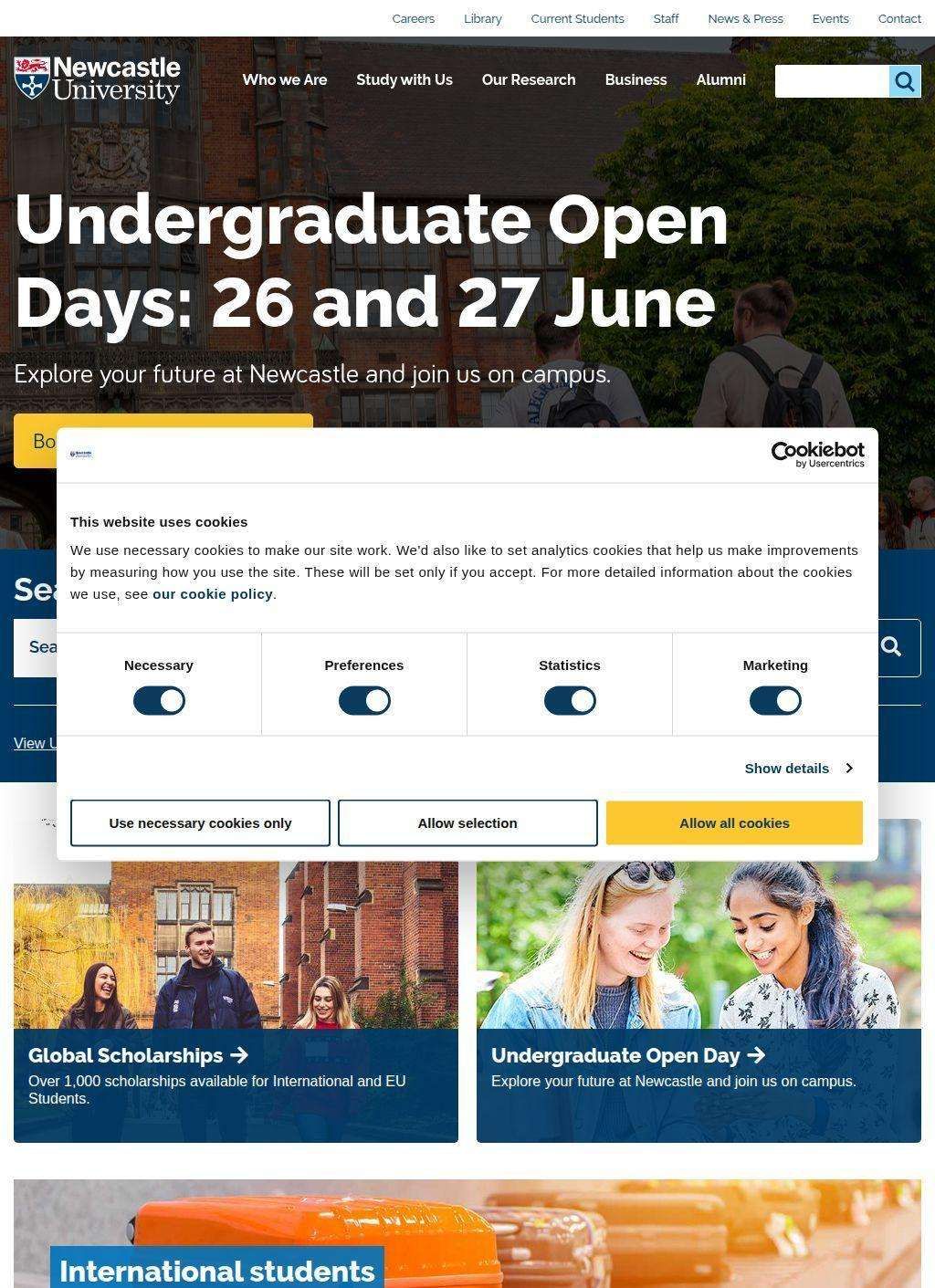
Newcastle University is a Russell Group institution based in Newcastle upon Tyne, and its official site at ncl.ac.uk is the front door to everything the place does across teaching, research and student services. The structure follows the shape of the university itself, which is split into three faculties: Humanities and Social Sciences, Medical Sciences, and Science, Agriculture and Engineering. Someone arriving without a clear goal still lands somewhere useful, because the top-level sections map to real intentions: study here, research here, come from abroad, work with the university, or find out what it stands for.
Study programmes and funding options
The Study area does the heavy lifting for prospective students. There is a course finder that spans undergraduate and postgraduate programmes, both taught and research degrees, and it sits alongside the practical machinery that decisions actually turn on: entry requirements, fees and funding, and scholarships.
Newcastle University also runs online and distance learning options and study-abroad or exchange pathways, so the catalogue is not limited to full-time attendance in the north east. Applications route through the usual online and UCAS channels, and Newcastle University backs this with open days, virtual tours, and the sort of orientation material that answers questions before an enquiry gets sent. The fees and funding pages sit close to the courses they apply to, and scholarships are listed as their own strand instead of being folded into a wall of small print. For a family working out whether a place is affordable, that placement does real work.
Research strengths by faculty
Research gets its own substantial territory instead of a token mention. The pages break down by faculty and institute, and they set out research strengths and the impact of that work. This is where an institution of this size has to prove it is more than a teaching operation, and the layout treats research as a first-class part of what Newcastle University is, with staff and department directories that can be searched by subject. For an academic trying to find a potential collaborator, or a student weighing where a research degree would be supervised, that searchability is worth more than a glossy overview. It turns the site into something a researcher can query with a specific name or field and get a real answer.
Business partnerships with external organisations
Bridging into the outside world, the Business and Partnerships section covers collaboration, innovation, consultancy, and general business engagement. It is aimed at companies and organisations that want access to the university's expertise or facilities, and it reads as a distinct audience track with its own logic. The presence of that section says something about how Newcastle University positions itself: research and industry sit close together here, and the site does not bury the commercial and applied side behind the recruitment material. A firm scoping a consultancy project or a research partnership has a clear place to start.
The About section rounds out the picture with history, governance, strategy, and rankings. That is the material people consult when they want to understand the institution as an organisation, whether that is a journalist, a prospective donor, or an applicant comparing where a degree stands against others. Newcastle University keeps this reasonably candid, putting its governance and strategy where they can be read instead of treating them as internal paperwork. The rankings sit here too, presented as part of the record rather than as a banner across the top of every page.
Student support services across three campuses
Student life is handled with real detail, the sort someone needs before moving their whole life to a new city. The pages cover accommodation, campus facilities, the students' union, and wellbeing and support services. This is one of the harder things for a university site to get right, because it has to speak to a nervous applicant and a current student at the same time, and Newcastle University gives the support and wellbeing side genuine room instead of a single reassuring line. Careers services, the library, and IT provision are all documented for students who are already enrolled, which keeps the site useful past the point of admission. A second-year looking up an IT service or booking a careers appointment is served by the same site that recruited them.
From Newcastle to London and Singapore
The geography is broader than one campus. The main site is in Newcastle upon Tyne, but Newcastle University also operates a London campus and an overseas campus in Singapore, NUIS. Anyone reading the International pages gets country-specific detail, named agents, and English language requirements, not a generic overview. A student in another country is not left to guess how their qualifications translate, and the international material is specific enough to be acted on. Newcastle University lays out the English language requirements plainly, which is exactly the point where vague guidance tends to cost applicants time.
News, press releases, and events listings keep the site current, and they double as a way of seeing what Newcastle University is producing month to month. The alumni relations pages extend the relationship past graduation, which fits a university that wants long-term ties with the people who pass through it. None of this is unusual for a large institution, but Newcastle University assembles it coherently, so the alumnus, the applicant, and the researcher each have a plausible route through. This entry sits among many Tyne and Wear organisations in the business directory, and what separates it from a plain listing is that the site is genuinely usable once someone lands on it rather than a big name with little behind it.
A few things are worth calling out because they raise the practical value of ncl.ac.uk above the average university homepage. The course finder and the fees and funding pages are close together, which respects how people really make the decision. The staff directory being searchable by subject turns a static site into something closer to a working tool. And the split between a recruitment audience, a research audience, and a business audience is maintained consistently, so each visitor is not forced to wade through content meant for someone else. Newcastle University clearly designed the navigation around who is arriving, not around its own internal chart.
If there is a limitation, it is the one every large institution's site shares: the sheer breadth means the front page can only gesture at what sits underneath, and finding a very specific document sometimes takes a few clicks more than it should. That is a scale problem, not a content problem, and the search tools and clear section headings mostly compensate. Newcastle University has enough real material here that the depth is a feature to work through, not padding to skim past.
Taken together, ncl.ac.uk functions as a complete reference for Newcastle University: degree programmes with the funding detail attached, research organised by faculty and institute, an international pathway with country-level specifics, student support that goes beyond the minimum, and a business track for external partners. The three-campus footprint across Newcastle, London and Singapore is stated plainly and threaded through the relevant sections. A prospective postgraduate can find a research degree, check the entry requirements, look up a potential supervisor by subject, and read the funding options without leaving the site, and that continuity is the thing this listing is really pointing at.
Business address
Newcastle University
Newcastle University, King's Gate,
Newcastle upon Tyne,
Tyne and Wear
NE1 7RU
United Kingdom
Contact details
Phone: 0191 208 6000