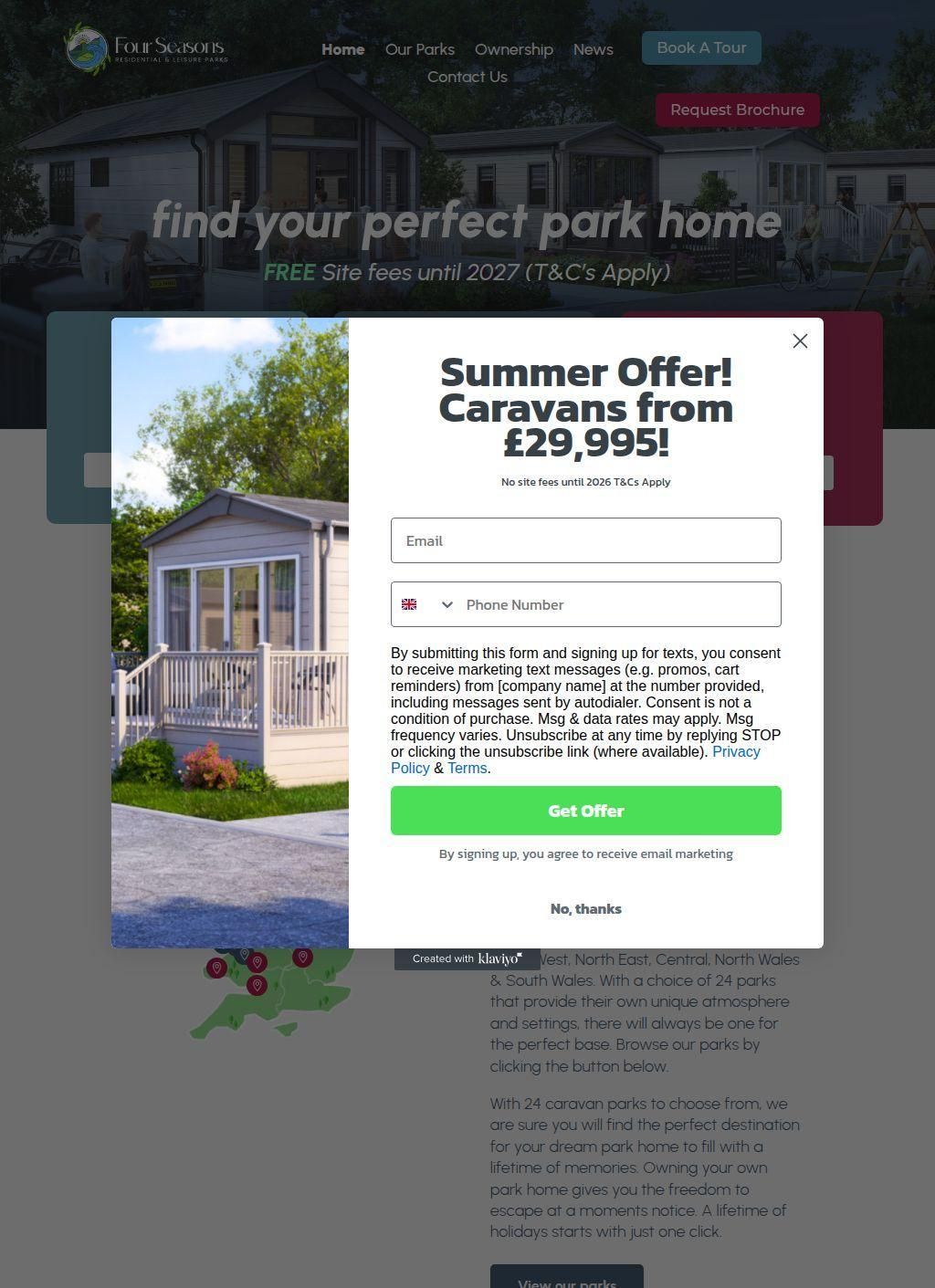
Four Seasons Parks is a UK operator running 24 residential and holiday caravan parks spread across Lancashire, the wider North West, the North East, Central England, North Wales and South Wales. The core of the offering is property: new and pre-owned residential park homes built for permanent living, static caravans, and luxury lodges aimed at holiday use. Buyers are shown a finished unit and then given real options beyond it. The interior specification can be adjusted, and the site is specific about how far that goes, naming carpets, flooring, appliances, worktops, furniture, curtains, and the smaller fixtures and fittings as things a customer can choose.
Two markets, one operator
That level of customisation tells you who the Four Seasons Parks homes are really built for. One audience is people moving into a park home as their main residence, often retirees who want a smaller place with less upkeep and a predictable bill. The Band A council tax figure quoted on the site speaks straight to that group, since the running cost is one of the first questions anyone leaving a conventional house tends to ask. The other audience is families looking for a holiday base they can return to, which is where the lodges and static caravans come in. Four Seasons Parks tries to serve both without pretending they want the same thing, and the split between residential parks and holiday parks across the 24 sites reflects that clearly.
Purchase options and financing
The purchase side at Four Seasons Parks is handled with more practical detail than a lot of similar operators bother to publish. There is a part-exchange route, so an existing home can be put toward the cost of a new one, and there are financing and payment plans described as flexible for buyers who do not want to pay outright. Those two things together lower the barrier for the retiree market in particular, where a sale of the family house and the purchase of the park home often have to line up. Seeing both options stated up front, instead of buried behind an enquiry form, makes the commercial side feel reasonably transparent. Any business directory entry covering Four Seasons Parks should flag this, because it separates the company from operators who make pricing a gatekeeping exercise.
Managed communities with ongoing support
Beyond the sale itself, Four Seasons Parks presents its sites as managed communities rather than plots of land buyers are left to fend on alone. The company references 24-hour support, grounds maintenance, and on-site park teams. For the low-maintenance promise to mean anything, that ongoing management is the part that has to hold up, and it is sensible that the company leads with it. A park home buyer is buying the park as much as the home, and the recurring service is what separates a place that stays pleasant from one that slides.
Company details and local contacts
On the question of who stands behind Four Seasons Parks, the company registration number 04347115 is publicly listed. It lets anyone cross-check the operator against Companies House and confirm there is a registered entity rather than a trading name with nothing behind it. For a purchase the size of a home, that kind of verifiable detail is genuinely useful, and it is the sort of thing serious buyers will look for. A phone number and a sales email are both shown on the site, and the individual parks have their own listings with local contact details. That last point is more practical than a single head-office number would be, because a buyer interested in a specific site in, say, North Wales can find information tied to that location instead of being funnelled through one central queue.
Customer testimonials versus independent reviews
Reputation is where the picture gets harder to read. A search for independently verified ratings on the usual platforms did not surface anything notable for fourseasonsparks.com specifically. The homepage does carry customer testimonials, including warm comments about staff members named Malcolm and Millie and a satisfied holiday-home purchase, but those sit on the company's own site and are chosen by the company. They are pleasant to read and they do hint at the kind of personal service a park-home buyer hopes for, yet they are not a body of reviews on Google or Trustpilot that anyone can scrutinise freely. A prospective buyer would be right to treat the Four Seasons Parks testimonials as a starting point and to do their own asking, ideally by visiting a park and talking to residents who already live there.
Weighing sales material against verification
That absence of external ratings does not undercut what the company puts on the table, which is fairly substantial. Four Seasons Parks covers a genuine spread of the country, sells across the residential and holiday range, and is upfront about specification, part-exchange and finance. The thing worth weighing is the contrast between a detailed, location-rich sales site and no independent track record visible in search. How much a buyer wants to rely on the former while the second piece is missing is a judgment call that depends on how much due diligence they intend to do in person.
From holiday stays to permanent residence
For the residential market the appeal of Four Seasons Parks is easy to follow. A retiree downsizing wants a single point of contact, a predictable council tax band, a managed setting and a clear way to convert an existing house into the new home, and Four Seasons Parks lines all of that up. For families the lodges and static caravans across the holiday parks offer a repeatable base in several regions of England and Wales without the commitment of a permanent move. The same operator handling both means a customer who starts as a holidaymaker and later decides to live somewhere similar is dealing with a company that already does both. Four Seasons Parks covers that whole arc, which is not common among operators of this size.
The customisation list, the part-exchange option and the per-park information are the most concrete parts of what Four Seasons Parks puts forward. Pairing the on-site detail with a real visit to the specific park in question, and running the registration number through Companies House, would give a buyer a much clearer read on the operator than the published material alone. The published material is a reasonable starting point; a visit to the actual park is what turns the brochure version into something a buyer can act on.

Business address
United Kingdom