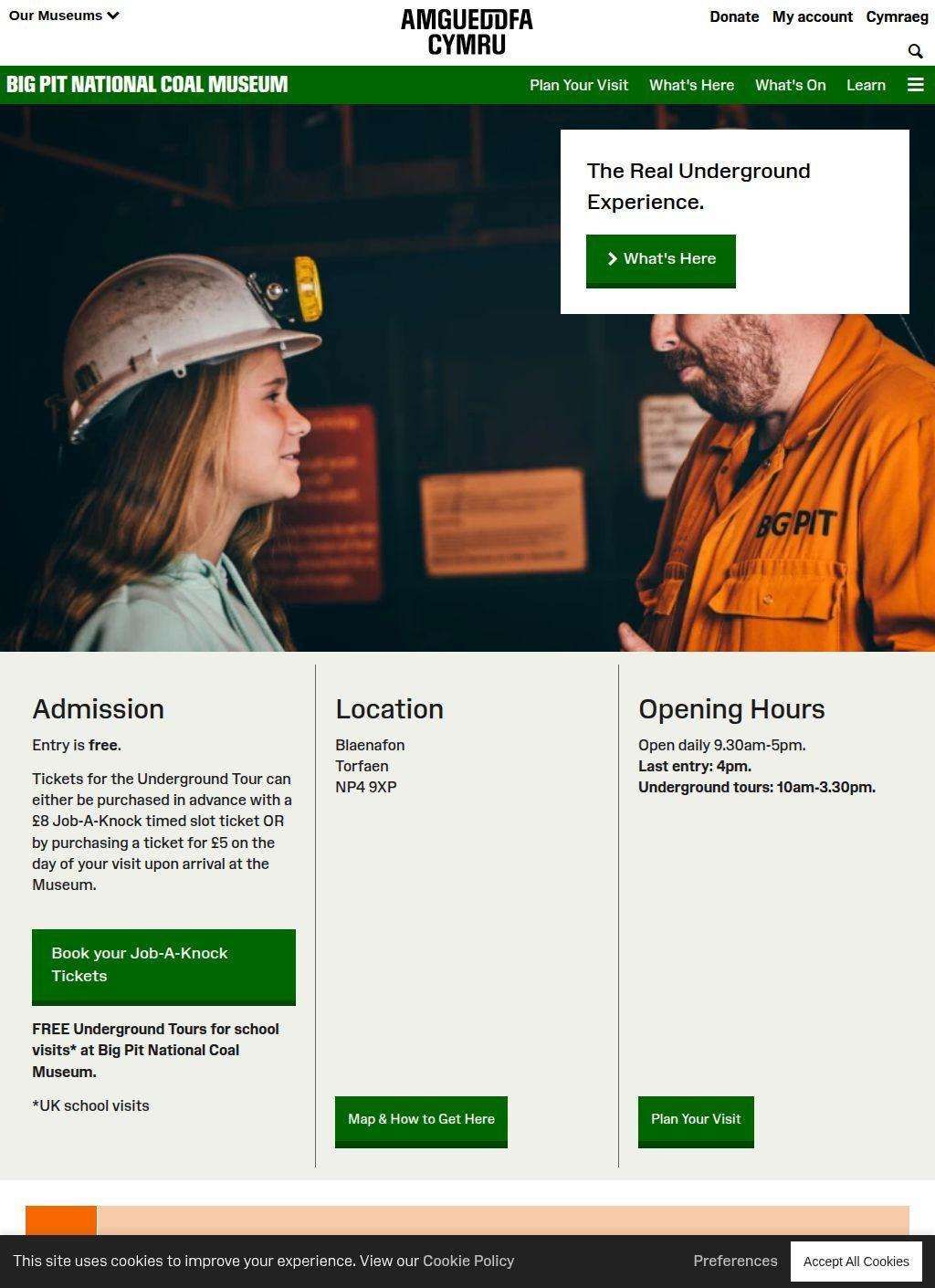
A cage drop of around ninety metres into a genuine Welsh pit, led by men who spent their working lives cutting coal, is what most people turn up for. General entry is free, the deep tour costs eight pounds booked in advance or five on the day, and school groups go down at no charge. Booking a slot beats turning up and hoping, since the cage takes a fixed number and the descent runs to a timetable the guides keep.
The cage descent with retired miners
That arrangement explains a good deal about why Big Pit National Coal Museum keeps pulling families, coach parties and curious walkers up to Blaenafon. What marks it out is the fact that a retired collier does the talking underground, not any slick staging. Big Pit National Coal Museum has that built into the ordinary visit, not saved for a handful of special dates in the calendar.
Above ground the site spreads wider than that one headline attraction. The colliery buildings survive more or less intact, so a visitor walks through the actual pithead baths, winding gear and workshops where men once clocked on, not a row of models under glass. Big Pit National Coal Museum sorts its material into clearly divided sections: Plan Your Visit for the logistics, What's Here for the collections covering Welsh coal and the industry that grew around it, and What's On for an events calendar that shifts across the year. None of it strains to be grander than it is, which suits a subject this rooted in hard physical labour, and Big Pit National Coal Museum seems content to let the machinery and the surviving fabric carry the story on their own terms.
Free entry and paid tour options
The free general entry changes how a trip feels before anyone books anything. A family can walk the surface, see the exhibits and get a sense of the scale without paying a penny, then decide whether the paid descent is for them. That lowers the risk of a wasted outing, and it lets nervous or younger visitors sample the place without committing to the shaft. The two-tier pricing on the tour, cheaper booked ahead than on the day, rewards a little planning and quietly manages the crowds who would otherwise all arrive hoping for the same slot. It suits a site that has to move real people through a real, capacity-limited mine.
Buildings and exhibits on the surface
The What's Here material sticks close to the ground it stands on: the coal industry and the communities that grew up around the pits of south Wales. Because the exhibits sit inside working colliery buildings, the collection reads less like a curated display and more like a place caught at the moment the last shift ended. That physical honesty does a lot of the interpretive work, the sort of thing Big Pit National Coal Museum could never recreate on a greenfield site with a purpose-built hall. The events calendar layered on top gives regulars a reason to return beyond the fixed exhibits, though the programme is worth checking against specific dates before counting on it.
Learning programmes for schools
The teaching side is where the operation shows its national-museum backbone. The Learn section carries workshops and structured programmes aimed at schools, and the free underground trip for pupils tells you plainly where the priorities sit. Educators and researchers get another route in through Collections Online, a digital catalogue of artefacts that opens the holdings to people who cannot reach Torfaen in person. For a mining museum that could have coasted on the tour alone, the depth of that study material is the detail that shows Big Pit National Coal Museum takes the second half of its name seriously. A shop with merchandise and a venue-hire option round out the practical side, the latter putting the industrial buildings to work for private events, kept well clear of the historical core.
Membership and donation routes come with belonging to the Amgueddfa Cymru family, reaching across the wider group of Welsh national sites, worth weighing for anyone planning to see more than this one place. Accessibility information is published too, which counts at a site built into a hillside around century-old industrial fabric, where not every corner can be reached the same way.
Big Pit National Coal Museum does not pretend the ground is level or the pit easy to enter, and that plain honesty is more useful to a wheelchair user or a nervous first-timer than blanket reassurance would be. Facebook and Instagram carry the events and day-to-day updates for anyone who wants to follow along ahead of a visit, and for a body that runs several attractions, Big Pit National Coal Museum handles its own identity without leaning too hard on the group brand.
Families with children old enough for the cage will get the clearest return, and the former-miner guides are the reason. A retired collier describing the dark, the damp and the rats in his own accent is not something a polished visitor centre can manufacture, and Big Pit National Coal Museum carries that as routine rather than a booked extra. The stories hold the history in a way the wall panels never manage, and they land differently coming from someone who lived the work rather than read about it. On that count Big Pit National Coal Museum has an edge most heritage sites would envy and simply cannot buy at any price.
School groups are plainly a core audience, given the free descent and the workshop programme, and the site reads as though class visits shaped the design. Researchers into industrial and mining heritage are served more quietly through the online collections, though how deep that catalogue runs is something a serious user would have to test against a specific subject before relying on it.
What limits a return visit?
A general visitor with a free afternoon sits between the two: the no-cost entry lowers the stakes, and the tour is cheap enough that skipping it would be the strange choice. Whether Big Pit National Coal Museum rewards a second visit as much as a first is less obvious, since the descent is the centrepiece and it does not change much between trips. That is the quiet limit on what Big Pit National Coal Museum can be for a repeat guest.
Weather and capacity constraints
What stays uncertain is how the day holds up in bad weather or at the busiest stretches. Much of the draw is outdoors and underground, and a wet afternoon around exposed colliery buildings is a different proposition from a bright one. The cage capacity that makes the descent feel real also caps how many people can go down in an hour, so a peak-season arrival without a booked place could mean a long wait or no tour at all.
The site advises booking ahead, yet the honest doubt for anyone planning a trip is whether the underground portion, the part that makes Big Pit National Coal Museum the thing it is, will be running and reachable on the day they arrive. A visitor can control the booking, but not the weather, the queue or a mechanical fault on the shaft, and if the descent is shut then Big Pit National Coal Museum becomes a decent open-air site missing the one experience that sets it apart.
Business address
Big Pit National Coal Museum (Amgueddfa Cymru)
Big Pit National Coal Museum, Blaenafon,
Blaenavon,
Torfaen
NP4 9XP
United Kingdom
Contact details
Phone: 0300 111 2 333