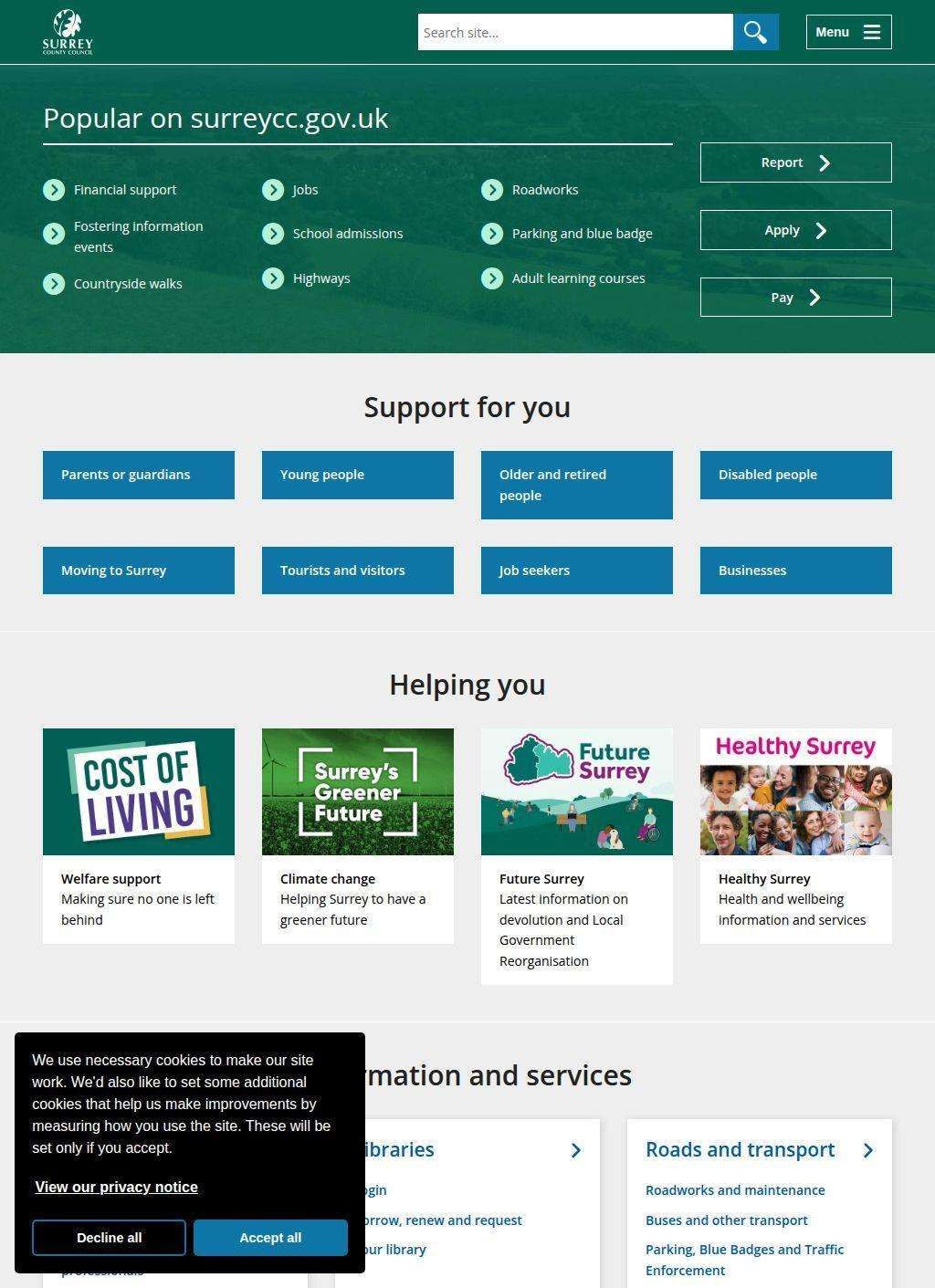
About 1.2 million people live under the remit of Surrey County Council, which makes it the upper-tier authority for one of the more populous shire counties in England, stretching across 11 districts and boroughs. The web presence has to absorb all of that, because the council is responsible for the services that touch daily life in ways residents rarely think about until something goes wrong: the road outside the house, the school place for a child, the recycling centre on a Saturday morning. The site is built to handle all of that in one place.
Inside school admissions and family services
Schools and learning form one of the busier parts of what Surrey County Council puts online. School admissions run through an online portal here, alongside adult education listings and childcare information. Parents working out catchment areas or trying to submit an application have a clear route in, and the council ties this together with the wider children and families remit, which covers social care and safeguarding referrals. That last point sits at the serious end of what an upper-tier council does, and the site does not bury it.
Tracking roadworks progress online
Roads and transport get similar attention. Surrey County Council provides a roadworks reporting tool and a tracker so people can see what is scheduled or underway, bus information, parking details, and Blue Badge applications for disabled drivers. The reporting function is the kind of thing that justifies a council site existing at all, since a pothole logged online is faster than a phone call left on hold. Surrey County Council also runs the planning and development side, with a planning application search and interactive mapping that lets residents check what is being proposed near them. As the highways authority for the county, it owns the major-road responsibilities that the smaller borough tiers do not, and the site reflects that division of labour clearly.
Libraries are handled with the practical functions you would want: borrowing, renewals, and a branch finder. None of that is glamorous, but a library service that lets people renew a loan without a trip to the branch is doing exactly what a digital council service should. Waste and recycling guidance covers disposal questions and the locations of community recycling centres, which in a county this size is genuinely useful. There is a real difference between a page that tells you the rules and one that tells you which gate to drive to on a Sunday, and the recycling pages lean toward the latter.
The site also points to financial support tools through a support finder, plus wellness and welfare resources. These sit close to the health and welfare remit, and Surrey County Council groups them so that someone in difficulty is not forced to guess which department owns their problem. Surrey County Council also covers adult learning provision through its education pages, so the pathway from welfare support to retraining is at least findable in one place. It is a sensible piece of information architecture for a service whose users often arrive stressed and short on time.
Adult social care is given proper room, covering independence support, care payments, and assessments. This is expensive, complicated work for any county authority, and the way it is presented reflects a real attempt to make a difficult process navigable. Registration services for births, deaths, and ceremonies are bookable through the site, folding civil registration and ceremonial arrangements into the same self-service approach Surrey County Council applies elsewhere.
Beyond the household-facing services, there is a layer aimed at businesses and organisations. Trading standards, licensing, and permits all have a home here. Community services bring in fire and rescue liaison, emergency planning, and climate initiatives, the sort of statutory and strategic functions that a county council runs whether or not most residents ever interact with them directly. Emergency planning in particular is one of those quiet responsibilities that only becomes visible when it is needed, and it belongs on a site like this.
Culture and leisure rounds this out with access to Surrey countryside, arts, and heritage resources, which fits a county that contains a fair amount of green space and walking territory. Having it catalogued by the same authority that manages the roads and countryside access makes a certain amount of sense. It keeps the practical and the recreational under one roof.
Council governance information hub
The council and democracy section is where the transparency commitments of Surrey County Council live. There are councillor directories, election information, and budget and finance material, so a resident who wants to know who represents them or where the money goes has somewhere to look. A jobs and apprenticeships portal sits alongside this, covering recruitment into Surrey County Council itself. Newsletter subscriptions let people keep up with changes without having to check back constantly.
What holds the whole thing together is the self-service design. Reporting, applications, and tracking are built to be done online, from the roadworks tracker to the admissions portal, and that consistency is what separates a useful council site from a directory of phone numbers. The range is wide, covering residents, businesses, and organisations operating in the county, and the structure mostly keeps that breadth from becoming a maze. A site trying to serve more than a million people across this many functions could easily collapse into clutter, and Surrey County Council has largely avoided that trap.
It is worth being honest about the limits of any council website at this scale. Breadth means some sections are necessarily summaries that hand off to forms, third-party systems, or partner bodies, and the experience of using a planning search will never feel as smooth as a consumer app. That is the nature of statutory services rather than a failing specific to Surrey. The value lies in completeness and in having a single reliable starting point.
How does the county tier differ?
The obvious alternative for a Surrey resident is to go straight to a district or borough council such as Guildford Borough Council, and the two tiers do not overlap much. The borough handles things like household bin collection, local planning decisions, and council tax billing, while the county tier covers schools, social care, major roads, and libraries. Surrey County Council is the right destination for the upper-tier services, and on the evidence of what it gathers in one place, it does that job thoroughly enough to be the first stop for anything within its remit.
Business address
Surrey County Council
County Hall, Penrhyn Road,
Kingston upon Thames,
Surrey
KT1 2DN
United Kingdom
Contact details
Phone: 0345 600 9009