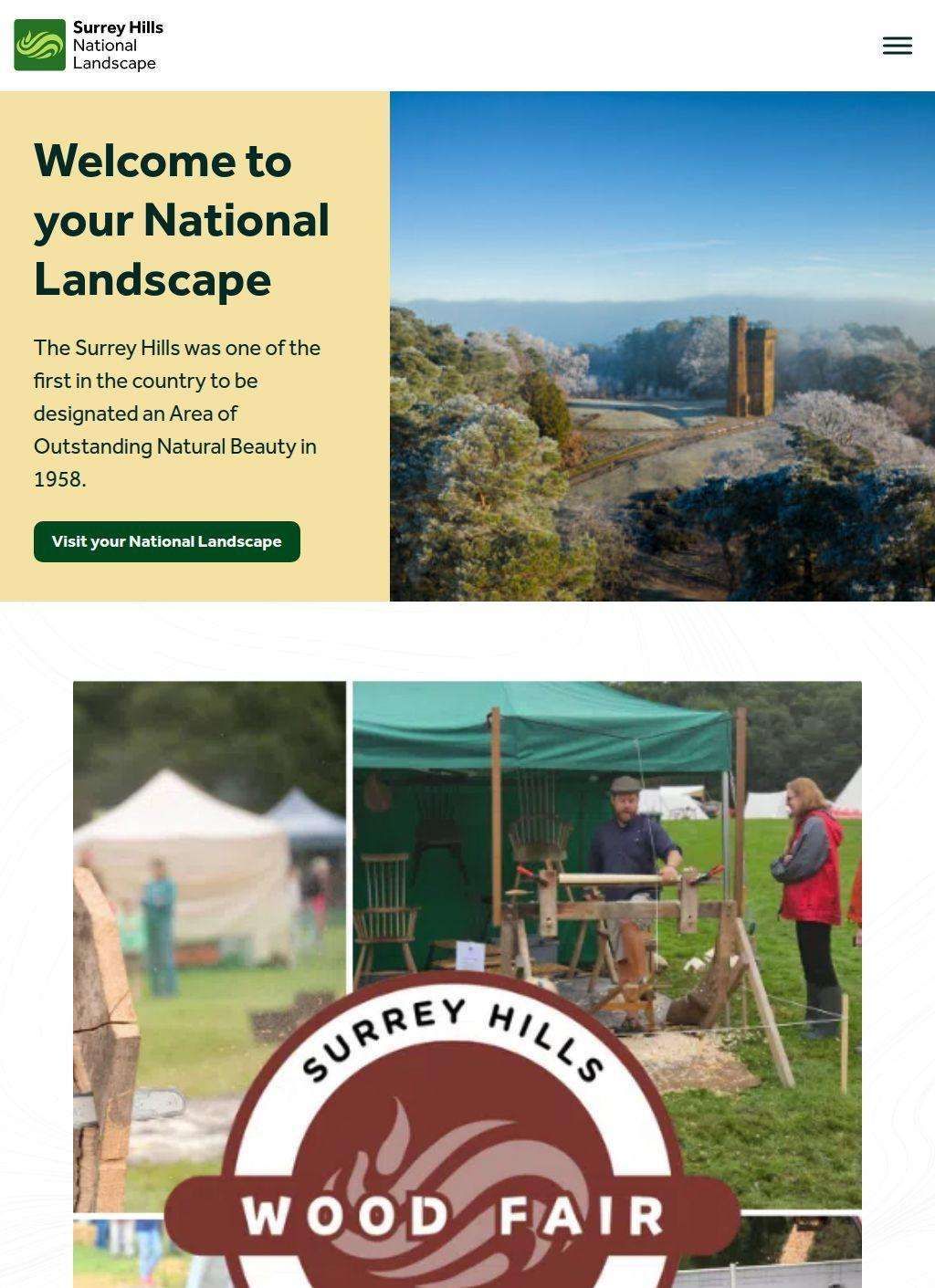
Someone wants a day out in the Surrey countryside, but they do not drive, and they have spent twenty minutes piecing together rail times against half-remembered place names. This is the gap Surrey Hills National Landscape fills early and well. The site lays out more than sixty miles of walking routes reachable by train, which is a concrete practical gain for anyone in London who fancies open hills without renting a car. The named places are here too, the ones people search for by reputation: Box Hill, Leith Hill, the Devil's Punch Bowl, Frensham Great Pond. You arrive wanting a walk and leave with a route, a station, and a sense of what you will see.
Official body managing the Area of Outstanding Natural Beauty
Behind the visitor pages sits the actual remit of the organisation. Surrey Hills National Landscape is the official management body for the Surrey Hills Area of Outstanding Natural Beauty, a designation that has stood since 1958 and covers a protected swathe of southeast England. That status shapes everything the site does. The organisation is the custodian of a landscape, not a tourist board chasing footfall, and the content reads accordingly: balanced between welcoming people in and explaining why the land needs care.
Beyond walking maps
The breadth of what Surrey Hills National Landscape covers runs well past walking maps. Beyond walking, there are cycling and horse riding routes, vineyard and food and drink guides, and an events calendar that keeps the place feeling current through the seasons. There is a section dedicated to easier-access countryside for people with limited mobility, which is the sort of provision that often gets a single token line elsewhere and here gets proper attention. Families get something specific too, an educational strand called Young Explorers aimed at younger visitors, which fits the conservation remit better than a generic kids page would.
Route details that go beyond distance
It helps that the route information goes beyond a map and a distance. The pages explain what kind of ground you are walking, what you might see, and which station puts you closest to the start. For a walker who has been burned before by a vague trail description that turned into a road slog, those few practical lines of detail make the difference between a good day and a wasted one. Surrey Hills National Landscape clearly understands that, and it shows in how the pages are written.
Business listings and a regional jobs board
The honest answer is several audiences at once, and the site mostly manages to serve them without feeling cluttered. Visitors get the routes and landmarks. Local businesses get listings: accommodation, meeting and celebration venues, vineyards, restaurants, and operators running corporate activities inside the protected area. There is even a regional jobs board, which is a useful thing to find under one roof and not where most people would think to look. That this many strands sit on one platform tells you something about the scope Surrey Hills National Landscape is willing to take on.
Inside the management plan and governance
Then there is the governance layer, and this is where Surrey Hills National Landscape shows its institutional weight. The site publishes the official 2025 to 2030 Management Plan in full, along with updates on a boundary extension project and information about the Wealden Heaths National Nature Reserve. Conservation material sits alongside arts and culture content, which makes sense once you understand that a protected landscape is also a working cultural place where people live and create. A member login portal and a newsletter signup round out the engagement side for people who want to stay involved beyond a single visit.
Open access to planning documents
What I appreciate is that the planning documents sit in the open, reachable in a click or two rather than tucked behind a specialist portal. A resident worried about development near a beloved hill can read the same Management Plan that policymakers reference. That openness is what you want from a public conservation authority, and it lends the whole operation a credibility that no amount of pretty photography could.
From trails to vineyard tastings
The vineyard and food experiences deserve a separate mention because they reflect how the Surrey Hills have changed. English wine has grown into a serious regional industry across these chalk slopes, and the site treats it as part of the landscape story instead of a novelty. Pairing a walk with a tasting is a genuinely good day, and having both signposted from the same place saves the visitor a lot of cross-referencing. By presenting the vineyards as neighbours of the trails, Surrey Hills National Landscape gives a fuller picture of what the protected area now contains.
Check the site's navigation limits
If there is a limit to the site, it is the inevitable tension of trying to be the front door for so many different visitors. A first-time walker, a wedding venue hunter, a job seeker, and a planning consultant all land on the same domain, and the navigation has to carry a lot. Most of the time it holds together, though the sheer range means a casual visitor might need a moment to find the one route they came for. That is a mild quibble against a site attempting more than a single-purpose tourism page would.
Social media updates on trail conditions
The social media presence on Facebook, Instagram, and X gives the organisation a way to surface seasonal moments, trail conditions, and event reminders that would otherwise sit static on a calendar page. For a body covering a living landscape that shifts with the weather and the seasons, that ongoing channel keeps the timely information flowing in a way a static page cannot.
Conservation and arts programming
The conservation and arts content is worth lingering on, because it is the part that separates Surrey Hills National Landscape from a simple tourism portal. Information on the Wealden Heaths National Nature Reserve, the boundary extension updates, and the cultural programming all point to an organisation thinking in decades, not seasons. A visitor scrolling for a walk may skim past this material, but it is the backbone of why the place looks the way it does. Reading it gives context to the hills you are about to walk, and it quietly justifies the protected status the area has held for so long.
Pulling the threads together, Surrey Hills National Landscape is a substantial and well-considered resource. It helps you enjoy the hills and shows its working on how they are protected, which is a combination you rarely get from a single site. One honest reservation stands: the depth that makes it valuable for a planner or a business can feel like a lot for someone who only wants a Sunday walk, and the navigation reflects that tension. For most users the trade-off is worth it. The walking and access information alone, paired with the named landmarks and the rail-reachable routes, make Surrey Hills National Landscape a genuinely useful first stop before heading into this corner of England, and the governance transparency behind it means you are reading from the people who actually look after the place.
Business address
Surrey Hills National Landscape
Warren Farm Barns, Headley Lane, Mickleham,
Dorking,
Surrey
RH5 6DG
United Kingdom
Contact details
Phone: 01372 220653