George Frederic Watts picked up the nickname "England's Michelangelo" in his lifetime, and the charity that now looks after his legacy has built something more substantial than a house-museum around that reputation. Watts Gallery Trust runs the gallery and the broader Artists' Village at Compton, near Guildford, and the site reflects an institution that has thought carefully about what it is offering. Paid admission covers the permanent holdings of Watts paintings and sculpture alongside a set of contemporary exhibition spaces, so you get both the fixed collection and something that rotates through the year.
Rotating exhibitions and Arts and Crafts focus
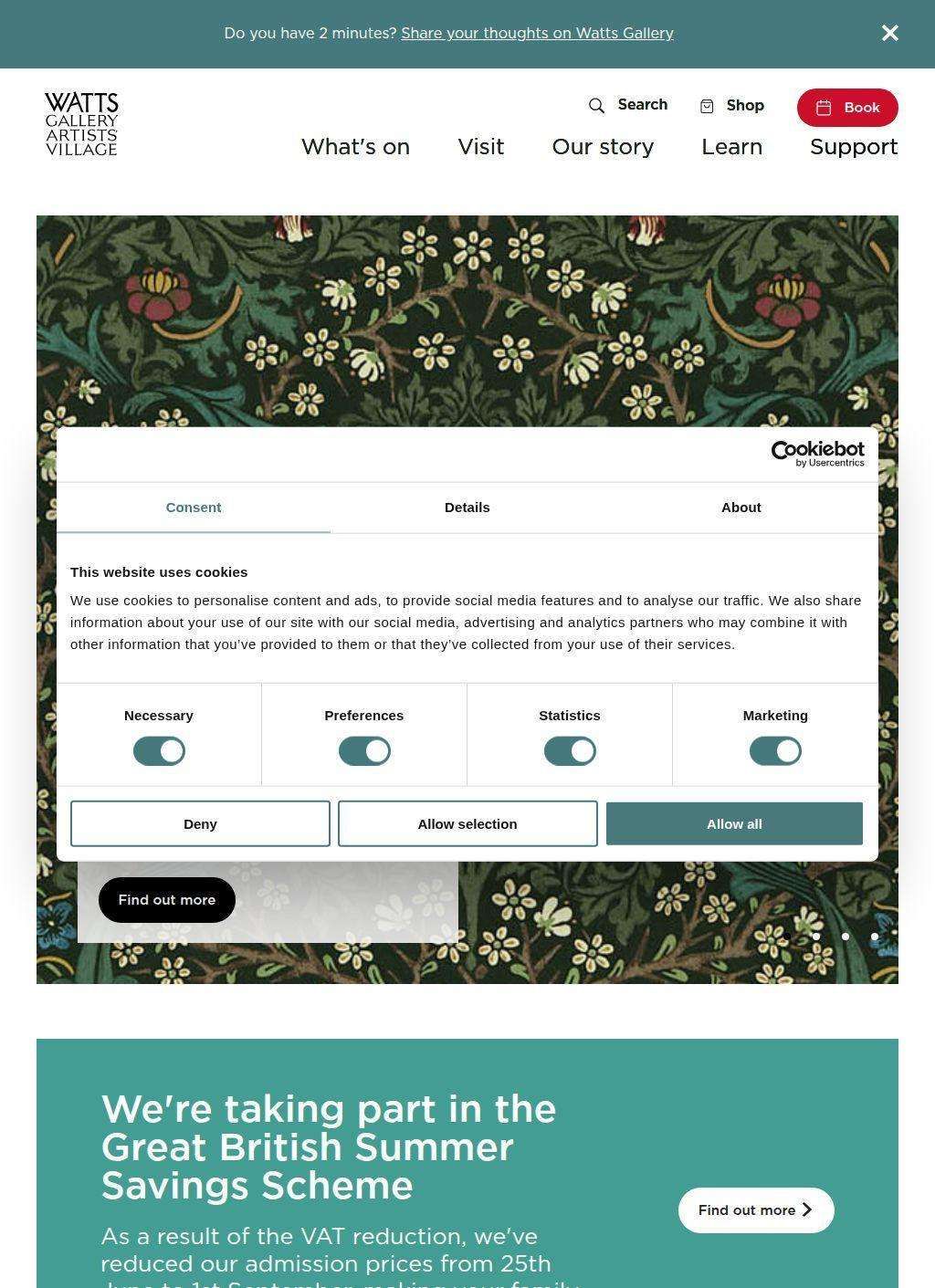
The rotating programme is where Watts Gallery Trust keeps its energy. Recent examples listed on the site include a wallpaper exhibition centred on Morris and Co and displays of ceramics, which shows the curators reaching past their own founder into the wider Arts and Crafts world he inhabited. That is a sensible approach for a smaller institution: it gives a returning visitor a reason to come back rather than treating the collection as something you tick off once and leave.
Watts Chapel as destination
The Chapel is the detail that tips this from a pleasant afternoon into something you are likely to remember. Mary Watts designed the nearby Watts Chapel, and Watts Gallery Trust describes its Celtic and Roman Arts and Crafts decoration at length. It is the kind of building people travel to see in its own right, and pairing it with the gallery gives a half-day shape to the outing. The practical side is handled plainly on the site: an on-site cafe offering homemade soups, sandwiches and salads, and a gift shop on the premises. Neither is glamorous, but the difference between a quick look and an unhurried morning often comes down to whether there is a quiet table where you can sit with a coffee afterwards.
Conservation demonstrations
Watts Gallery Trust also runs creative workshops and courses for adults and children, educational programmes with resources aimed at schools and families, and a membership scheme offering unlimited admission, exclusive events and discounts. One genuinely unusual feature is the conservation work: it takes place with public-facing demonstrations in the gallery spaces, so visitors can watch restoration in progress instead of only seeing the finished result. For anyone curious about how old paintings survive, that is a real draw, and few institutions of this scale attempt it.
Educational programs for schools
The educational strand deserves attention on its own terms. Watts Gallery Trust puts real weight on school learning alongside workshops open to general visitors, which is more durable than running a gift shop with pictures attached. The family resources available suggest the place is set up to handle children properly, which is a practical consideration for parents choosing how to spend a weekend.
Visitor reviews across platforms
The reputation picture is healthy and well populated. Tripadvisor lists the Artists' Village under the Guildford area with 506 traveller reviews, a substantial volume for a destination of this scale. No single aggregate star figure surfaced in the search snippets checked, so no number is put on it here, but individual comments run warm: one reviewer calls it a "real gem," others land on "fascinating" and "beautiful." WhichMuseum and Wheree carry visitor write-ups in the same direction, with repeated notes about the quality of the art and the strength of the educational work. That spread across more than one platform counts for something.
Planning your visit
Contact details are clearly handled. A phone number and full postal address appear on the site, alongside a "Plan Your Visit" section and a proper contact page. For an attraction where opening times, admission prices and travel directions are the first thing a would-be visitor needs, having all of that surfaced without digging through menus is exactly right.
What to expect from admission
The ordinary reservation about any paid, fixed-location attraction applies here too: Watts Gallery Trust rewards people who can get to Compton and are prepared to spend on admission, and it will mean less to someone hoping for a digital collection to browse from a screen. The site reads as a planning tool for a real visit, which is what it should be. That is the nature of the thing rather than a flaw in how Watts Gallery Trust has put it together.
Next steps for booking
The concrete next step is to open the "Plan Your Visit" section on the Watts Gallery Trust site to check current exhibitions and admission, and if the conservation demonstrations or a course look interesting, it is worth ringing ahead on the listed number to confirm dates. Watts Gallery Trust has put enough substance on the page to make that straightforward.
Business address
Watts Gallery Trust
Down Lane, Compton,
Guildford,
Surrey
GU3 1DQ
United Kingdom
Contact details
Phone: 01483 810235