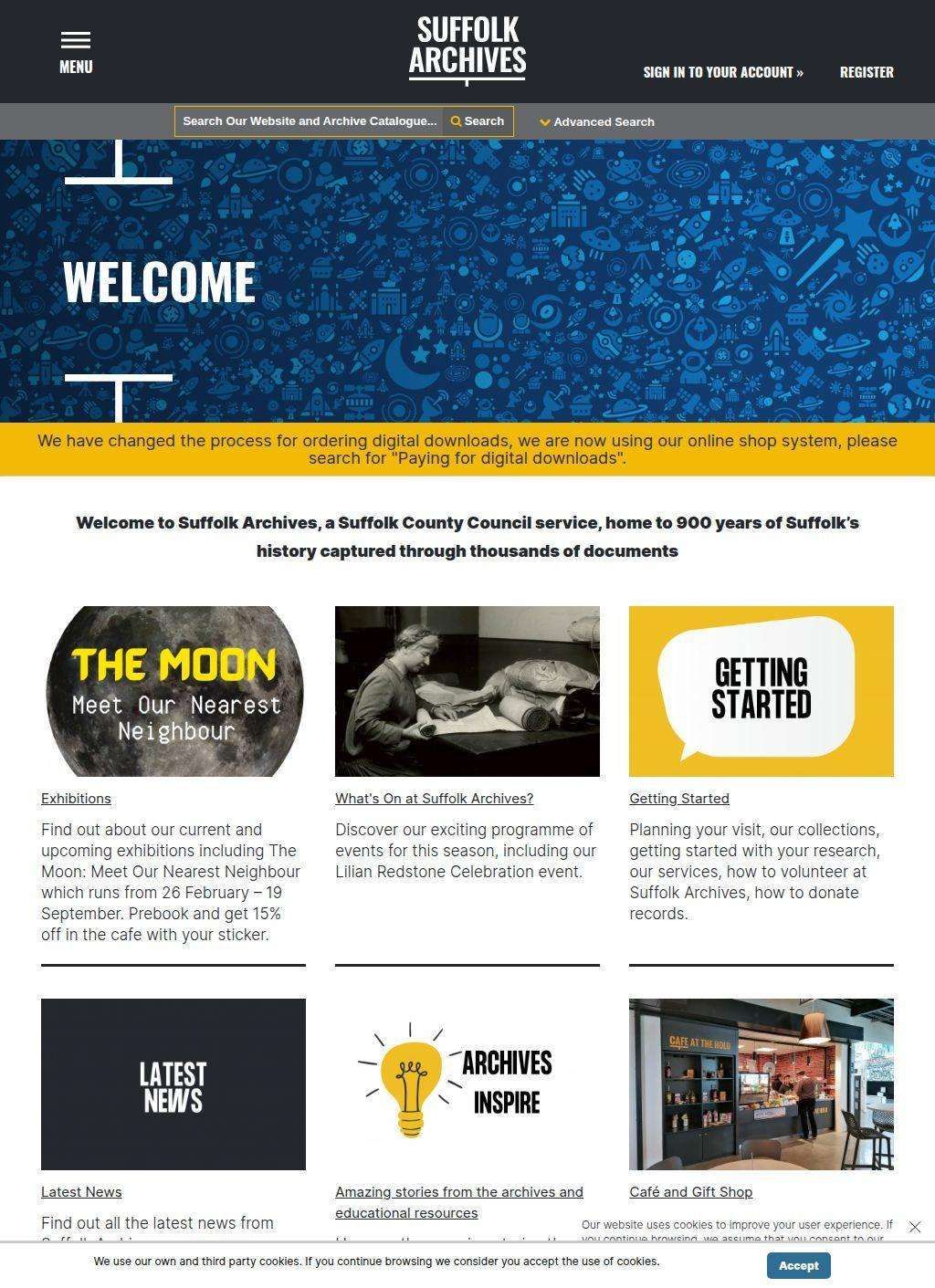
Where do you go when you want to trace a Suffolk family back through centuries of parish registers, or settle a question about who owned a particular house two hundred years ago? Suffolk Archives is the Suffolk County Council service built to answer exactly that, and Suffolk Archives has been doing it for long enough that the holdings now span 900 years of the county's records. It holds 900 years of the county's records and runs its main reading facility from The Hold in Ipswich, with the working collections spread across the medieval to the modern era.
Collections spanning 900 years
The reach of the holdings is what pulls most people here. Documents run from medieval deeds through wills, maps, business papers and council records, and the online catalogue is the front door to all of it. Search is more capable than the usual keyword box: there is full-text searching, proximity matching, and filtering by date range, creator, place, subject, format and identifier. Anyone who has spent an afternoon guessing at spellings of an old surname will recognise how much that flexibility saves. The catalogue lists thousands of documents, and it does the useful work of telling you what exists before you commit to a visit.
Search the online catalogue
Suffolk Archives is not a single building. Beyond The Hold, it keeps three record office branches at Bury St Edmunds, Ipswich and Lowestoft, so the geography of the county is reflected in where the material physically sits. The searchroom is where in-person research happens, and the archives and library are open Tuesday to Saturday from 10am to 4:30pm. That schedule matters for planning, because original documents are consulted on site, not posted out.
Three record office branches across Suffolk
For people chasing ancestors, there is a practical sweetener: Ancestry and FindMyPast can both be used free on the premises. Those subscriptions are not cheap to hold at home, so the on-site access turns a research trip into something that pays for itself. The family history and property history resources are organised as their own strands, which suggests the staff know these are the two questions most visitors arrive with.
Free access to genealogy databases on site
If a trip is not possible, paid services fill the gap. Through an online shop you can order digital downloads, copies and transcription work, so a document held in Ipswich can reach someone in another country without either party moving. That mix of free on-site access and paid remote service is a sensible split, and it keeps the collection genuinely usable for people who cannot get to East Anglia.
Services for remote researchers
The John Blatchly Local Studies Library shares the building, which adds printed and reference material alongside the original archives. For local studies, having the library and the archives under one roof is an arrangement that turns a half-finished search into a finished one, because the secondary sources sit a few steps from the primary ones.
Local Studies Library and exhibitions
Beyond research, Suffolk Archives runs a programme of exhibitions and events. There is a current exhibition titled "The Moon: Meet Our Nearest Neighbour" running from 26 February to 19 September, and a calendar of events such as the Lilian Redstone Celebration. Schools are served through educational programmes, which puts the collection in front of younger users who might not otherwise open a 400-year-old document. The Hold also hosts events as a hireable venue, with a cafe and a gift shop on site, so the place functions as a working cultural building as much as a quiet store of paper.
How does the archive grow and stay accessible?
Two further aspects show the institution thinking about its own future. Suffolk Archives accepts donated records, which is how a county archive keeps growing rather than freezing at whatever it happened to hold a generation ago. It also offers volunteer opportunities, drawing on people who want to catalogue, transcribe or otherwise help the collection stay accessible. Both of those choices treat the holdings as a living resource that has to be added to and maintained.
It is worth being clear about what the Suffolk Archives catalogue can and cannot do for a remote researcher. Listing thousands of documents online is a real service, yet much of the detail still lives in the documents themselves, which means a serious project will usually involve either a visit to the searchroom or an order through the shop. That is the nature of archival work, where the description points you to the thing but the thing has to be read in full. Suffolk Archives makes that pathway about as clear as it can be, from the filtered search down to the order form.
Suffolk Archives also caters to the casual visitor: the supporting facilities are practical rather than decorative. The cafe runs Monday to Friday from 8:30am to 3pm and Saturday from 9:30am to 3:30pm, and the gift shop is open Monday to Saturday from 10am to 5pm, with a late opening until 9:30pm on the second Thursday of the month. Those hours suggest a building people are meant to linger in, which is a reasonable ambition for a place asking the public to engage with its own history.
Genealogists tracing a Suffolk line, homeowners curious about the deeds behind their walls, teachers building a lesson around real documents, and researchers who need medieval to modern material in one catalogue will all find something useful here. Suffolk Archives covers the serious end of that work through the searchroom and the lighter end through its exhibitions and events. The online catalogue ties the two together for anyone wanting to scope a project before they travel, and that combination makes Suffolk Archives one of the more complete county archive services in England. It is a resource worth knowing about if Suffolk is your research territory, and the Suffolk Archives website makes it easy to establish whether what you need is already catalogued before you make any plans to visit.
Business address
Suffolk Archives
The Hold, 131 Fore Street,
Ipswich,
Suffolk
IP4 1LR
United Kingdom
Contact details
Phone: 01473 296666