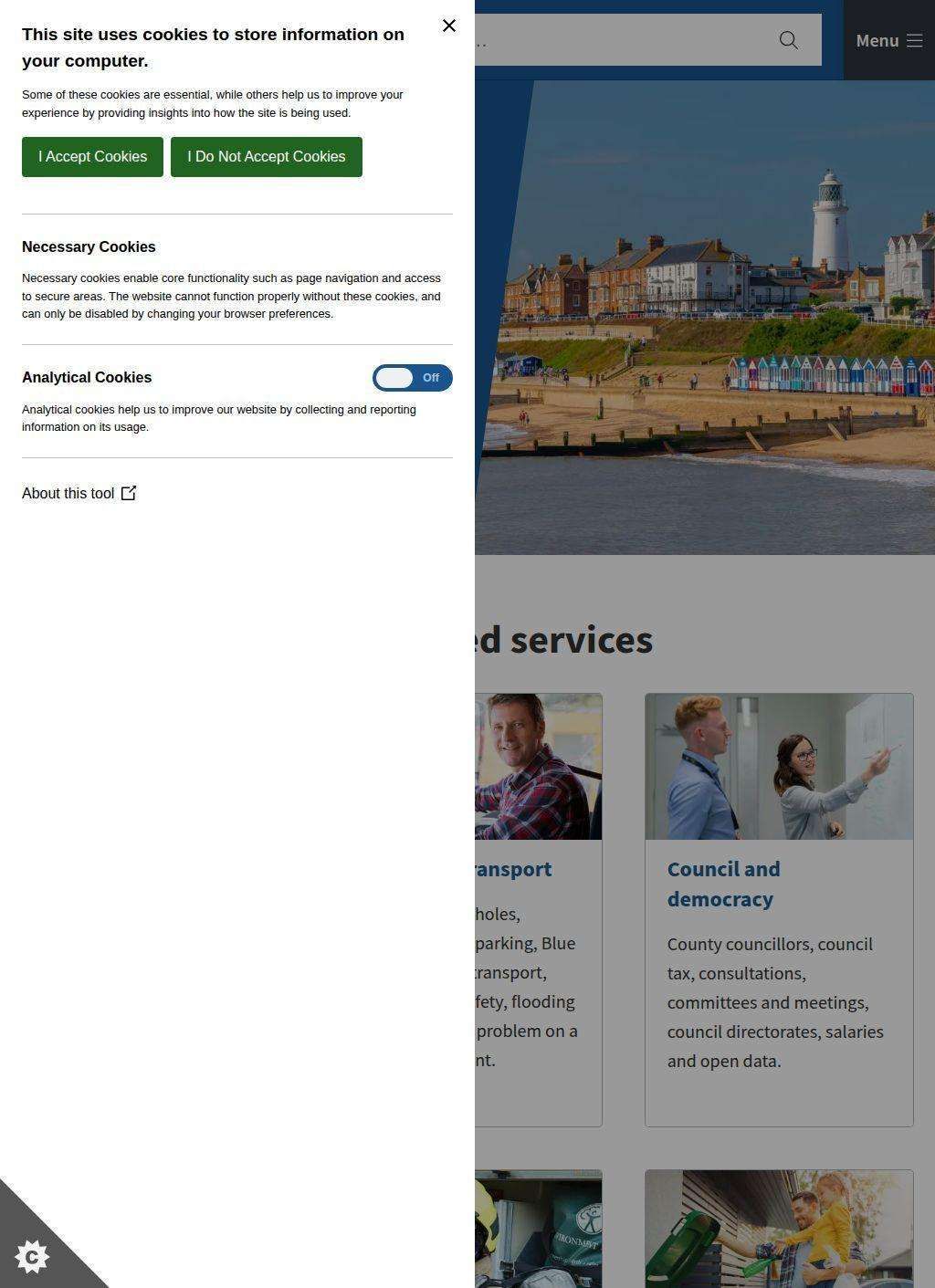
Report a pothole, book a slot at the recycling centre, or apply for a Blue Badge, and you end up on the same domain run by Suffolk County Council. The site is built around tasks like these, the small administrative jobs that pile up when you live in or run a business in the county. It is the working front end of the upper-tier authority covering Suffolk, and it tries to put the statutory functions of a large council into a form you can navigate without a phone call.
Children and family services
The breadth is the first thing that registers. Children, families and learning pulls together school admissions, support for special educational needs and disabilities, childcare information, adoption and fostering, and child safeguarding. These are not light topics, and Suffolk County Council groups them so a parent looking at SEND provision is not wading through unrelated material to get there. Adoption and fostering sit alongside the admissions pages, which makes sense given the overlap in who needs them.
Reporting road and transport issues
Roads and transport is where a lot of residents will actually land. The self-service reporting tools handle potholes, broken street lights and flooding, and there are application routes for dropped kerbs and for the Blue Badge disabled parking permit. Gritting schedules get their own space, a sensible inclusion given how much rural road gritting covers in Suffolk winters, and the public transport pages and road safety information round it out. Reporting a fault online instead of queuing on a phone line is the sort of thing that justifies a council site existing at all, and Suffolk County Council leans into it.
Adult care support explained
Adult care and support is handled with more weight than a quick form would allow. Social care assessments, home care, independent-living support and guidance on how care is funded are all covered, along with a route for reporting abuse. Funding guidance in particular is something people struggle to find clear answers on elsewhere, so having it stated on the authority's own pages carries some value. The tone Suffolk County Council takes across these sections is procedural, which suits the subject matter.
Council democracy transparency pages
On the democratic side, the council and democracy area lists councillors, explains Council Tax, and opens up budget and spending figures along with public consultations. Transparency pages of this kind are required of authorities, and how usable they are varies a lot between councils; Suffolk County Council keeps them within reach. Here they sit next to the consultation portal, so a resident who wants to comment on a proposal and a resident who wants to check where money goes are pointed at roughly the same place. That is a reasonable bit of organisation.
Fire rescue planning environment services
Fire and rescue is folded in too. The pages there handle emergency response, fire-safety education and recruitment, all part of the county-level remit Suffolk County Council carries. Planning, waste and environment handles planning applications, recycling-centre booking and environmental management. The recycling-centre booking system is a practical inclusion, since slot booking became standard for these sites and people expect to sort it before driving over. Planning applications, on the other hand, are dense by nature, and a council site can only do so much to make them friendly.
Beyond the headline areas there is a long tail of services that often gets overlooked. Registration of births, deaths, marriages and civil ceremonies is here, as is business support and trading standards, community safety, and the cultural and library service. Trading standards in particular is a function residents rarely think about until they need it, and tucking it next to general business support is the kind of organisational call Suffolk County Council handles consistently across the site. Booking a civil ceremony and registering a death sit at opposite ends of life, yet both run through the same registration service, and the site does not pretend either is more pleasant than it is.
Paying applying for services online
The payment and application machinery is the part that determines whether any of this is convenient in practice. Online portals cover school meals, permits and fines, and there are application routes for licences, permits and benefits. Paying for school meals online is a small thing that saves parents real hassle, and clearing a fine without a trip anywhere is the kind of friction the site is built to remove. A business directory entry like this tends to flatten all of that into one line, but the difference between a council you can pay and apply to online and one you cannot is significant. Suffolk County Council clearly invests in self-service, and the reporting tools for infrastructure faults are the clearest example of that investment at work.
What is harder to judge from the structure alone is how well each portal performs once you are inside it. Suffolk County Council can list every service and still leave you stuck on a form that times out or a benefits application that demands documents you do not have to hand.
Checking portal performance beyond structure
The site presents the full range competently, but range is not the same as polish, and the genuinely fiddly journeys, SEND support, care funding, planning, are exactly the ones where smooth execution is hardest to guarantee and where a static overview cannot reassure you. The information architecture is sound; the experience inside the deeper tools is the open question. A pothole report is hard to get wrong, but a care assessment or a SEND application asks a lot more of the underlying system, and that is precisely where a quick look at the homepage tells you nothing useful.
Suffolk County Council's site does the core job a local authority site should: it gathers the statutory services in one place and gives residents direct ways to report, pay and apply without a trip to an office. The infrastructure-reporting tools and the booking systems are the strongest case for that approach. The verdict is solid rather than glowing, because the value of a council site lives or dies in the individual transactions and breadth of coverage only takes that so far. The published evidence confirms the range is there and the structure Suffolk County Council has built is sensible; what it cannot confirm is whether the deeper portals, the ones covering care funding, SEND, or planning, execute as well as the simpler tools do.
Business address
Suffolk County Council
Endeavour House, 8 Russell Road,
Ipswich,
Suffolk
IP1 2BX
United Kingdom
Contact details
Phone: 01473 260000