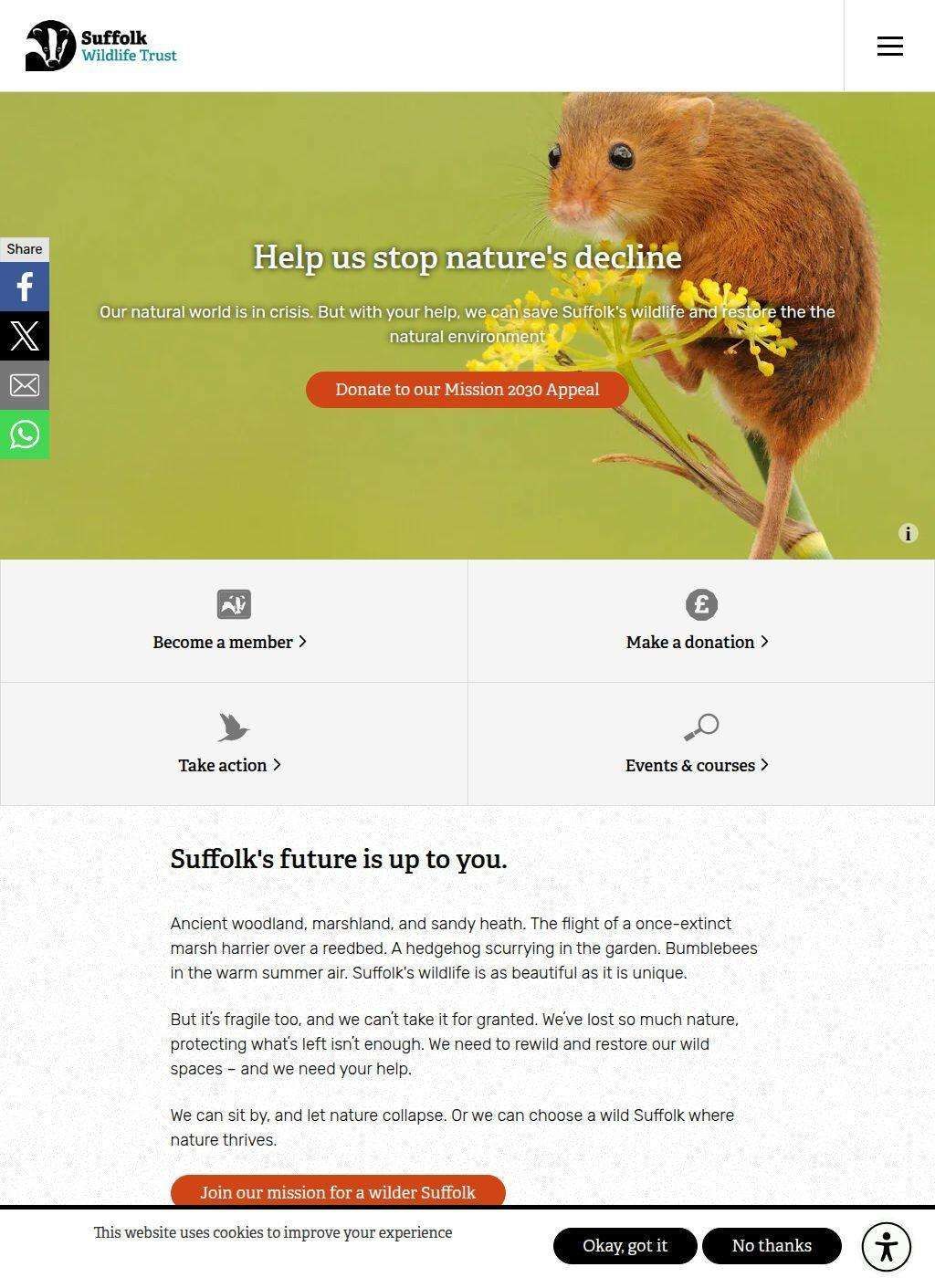
Suffolk Wildlife Trust holds responsibility for fifty nature reserves spread across the whole county of Suffolk, which makes it the single conservation body operating at that geographic scale in eastern England. That scope shapes what the site covers and how much it asks of visitors who want to navigate it without prior knowledge of the county.
Fifty nature reserves across Suffolk
Two reserves, Carlton Marshes near Lowestoft and Lackford Lakes near Bury St Edmunds, have visitor centres, and those are the natural entry points for someone arriving cold. The rest of the list runs through Bradfield Woods, Redgrave and Lopham Fen, Knettishall Heath, Foxburrow, and Arger Fen and Spouse's Vale, covering distinct habitat types from ancient woodland to heathland to fen. A business directory entry can point you there, but the site itself leaves the main practical question unanswered: which of the other forty-eight reserves are set up for a first-time visitor with parking and clear paths, and which are quieter ground better suited to someone who already knows what to expect from a fen and is content to find their own paths once parked.
Visitor centres at Carlton Marshes and Lackford Lakes
The conservation mission reaches well beyond land management. Suffolk Wildlife Trust runs landscape recovery initiatives operating at a scale larger than any single site, alongside community campaigns aimed at people who may never own a hectare but can still change what happens in their garden or on their street. Sitting alongside the charitable work is Wilder Ecology, a consultancy arm selling professional ecological services to developers, planners and landowners. That is a sharper commercial edge than a casual observer might expect from a wildlife charity, and it points toward a funding model in which Suffolk Wildlife Trust sells expertise to people who need ecological surveys done properly, using that income to sustain the conservation side.
Wilder ecology consultancy services
The events programme is broader than guided walks. Suffolk Wildlife Trust runs those, but it also offers accredited training: Forest School Training, Wild Beach Training, and a Leader in Outdoor Learning qualification aimed at teachers and youth workers as much as at committed naturalists. Creative workshops and Botanical Art courses sit alongside webinars for people who would rather learn from a screen. Whether all of these run frequently or only once or twice a year is the kind of thing the listing cannot tell you, and it would matter to anyone planning around a specific accreditation.
Training courses and creative workshops
Families appear to be a deliberate audience. The calendar carries children's activities, school holiday events, and birthday parties on reserve sites, which tells you Suffolk Wildlife Trust treats its land as somewhere to bring children rather than a fenced-off scientific preserve. School visits and a Communities and Learning strand extend that reach into classrooms. It reads like an organisation that has decided protecting wildlife in the long run means getting local people, especially younger ones, to care about it in the first place.
Family activities on reserve sites
Suffolk Wildlife Trust lays out a wide set of funding routes: individual membership, one-off donations, memorial and celebration gifts, bequests, and corporate partnerships. There is also a Wildlife Wins Lottery, which is a livelier mechanism than a standard donate button and requires no standing commitment. Membership is the most common way people support county wildlife trusts, and the site gives it sensible prominence without burying the alternatives for those who would rather give once or leave a legacy.
Funding options for supporters
Volunteering is handled as its own track. Suffolk Wildlife Trust separates practical conservation work, youth volunteering, and local Wildlife Groups that operate at a community scale for people who want something closer to home. That tiering reflects a realistic understanding of why people show up to help: not everyone wants a muddy Saturday morning clearing scrub, and the options acknowledge that.
Volunteering opportunities across Suffolk
Suffolk Wildlife Trust publishes its registered charity number, 262777. For an organisation soliciting wills and lottery subscriptions, that is the detail a cautious donor looks for first, and it allows independent verification through the Charity Commission register before any money changes hands.
On public reputation, review platforms carry very little for Suffolk Wildlife Trust specifically. A search of Google and Trustpilot returns no meaningful review record, which for a regional charity is not surprising: most support comes from members and local donors who do not tend to leave online ratings. The organisation's standing rests on its presence in the county, the reserve network, and the charity registration, all of which can be verified through public records.
Suffolk Wildlife Trust clearly operates at genuine scale for a single-county charity. The harder question the site leaves open is how evenly that effort is spread across fifty sites and multiple programme strands. Two reserves have visitor centres; the remainder are described but not mapped in terms of practical accessibility. The ambition is stated plainly, and the charity registration and published reserve list are solid grounding. How much of it a first-time visitor can actually experience next weekend is harder to judge from the listing alone.
Business address
Suffolk Wildlife Trust
Brooke House, The Green, Ashbocking,
Ipswich,
Suffolk
IP6 9JY
United Kingdom
Contact details
Phone: 01473 890089