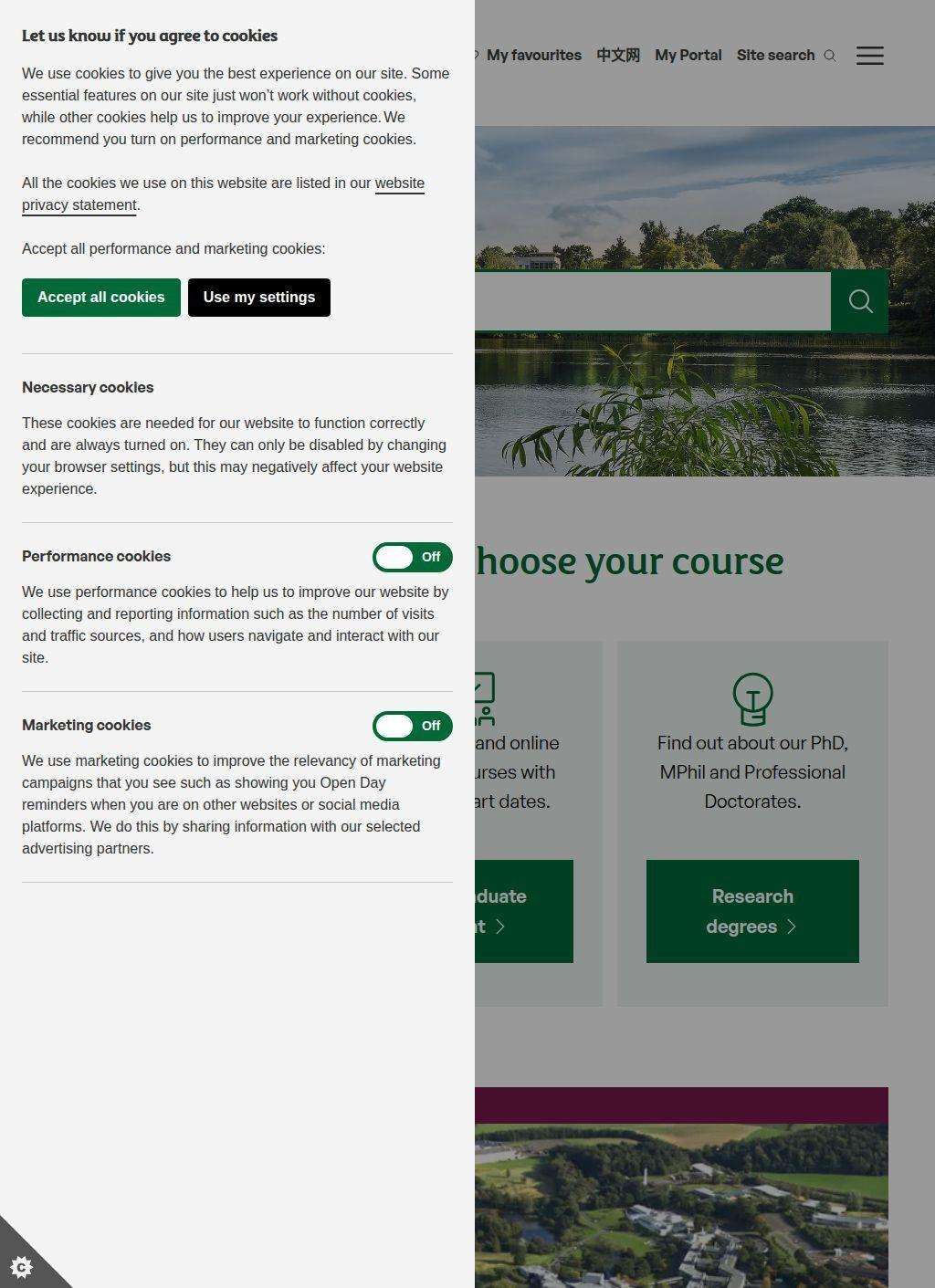
Stirling sits in central Scotland and lists more than 170 undergraduate degree programmes, a number that reflects how broadly the institution has built itself. Breadth is the operating principle. A prospective student can choose across arts and humanities, social sciences, the natural sciences, business, education, health sciences and sport, and the programmes are described as flexible, which in practice means the institution has spread its teaching across enough subject areas that few applicants will find their field absent. The site sets all of this out plainly, organised by faculty, with enough programme detail to let someone genuinely compare options before they decide anything.
Undergraduate and postgraduate programmes
Postgraduate study sits alongside that undergraduate spread and is given comparable prominence on the site. Taught Masters degrees are offered both on campus and online, and the listing notes multiple start dates through the year, useful for anyone whose timetable does not fit a single September intake. Beyond the taught route there are research degrees: PhD, MPhil and a set of Professional Doctorates aimed at people who want doctoral-level study tied to practice. The online delivery and the staggered start dates are the practical hooks, and they point at an institution building for working students and international applicants alongside the school-leaver moving into halls.
Taught Masters with flexible start dates
One claim University of Stirling makes about itself is worth pausing on because it is specific and verifiable: the title "Scotland's University for Sporting Excellence." That is not loose marketing language but a positioning the university leans into, backed by its naming as the Official University Partner to Team Scotland for the Commonwealth Games 2026. For applicants weighing sport science, athletic facilities, or a degree they want to combine with serious training, this is a genuine differentiator. It separates University of Stirling from the many institutions that treat sport as an extracurricular afterthought and say nothing more about it.
Scotland's University for Sporting Excellence
Breadth and depth do not always travel together, so it is fair to ask what backs the long programme list. The research side of University of Stirling answers part of that. The institution frames its research around addressing global challenges and runs dedicated research mission programmes, with published impact case studies that let an outside reader see what the work has actually changed. Impact case studies are a useful indicator, because they are concrete: they describe outcomes, and a university willing to publish them is inviting scrutiny. The mission statements wrapped around those cases lean on broad language that most research universities now use, which is the weakest writing on the site, but the concrete evidence underneath is the strongest.
Research mission and external accreditation
There are also external markers that are not self-awarded. University of Stirling holds the Athena Swan Silver Award, which speaks to its work on gender equality in academic careers, and it is recognised by the UK Quality Assurance Agency. Those two together cover different things, one about culture and staff progression, the other about academic standards, and both are assessed by bodies outside the university. For a prospective postgraduate or research student in particular, the QAA recognition and a published research mission are more meaningful than a glossy ranking line: they describe process and oversight, which a single snapshot score does not.
Checking impact case studies
University of Stirling is also registered as a Scottish Charity, number SC011159, which situates it squarely as a public body. That status, combined with its standing as a Scottish public research university, frames how it is governed and funded. None of this is unusual for a UK institution, but seeing it stated clearly on the site is reassuring in the dull, useful way that proper institutional transparency tends to be.
Campus facilities and virtual tours
The physical setting gets attention on the site, and University of Stirling makes a point of its campus in central Scotland, set within scenic grounds. For visitors who cannot get there in person, a virtual campus tour is provided, which is sensible practicality for international applicants and anyone deciding whether the place feels right. The campus description covers modern academic buildings, recreational facilities and a Students' Union, presented without overselling.
University of Stirling clearly draws a mixed population: domestic UK students, international students, and distance learners studying online. That last group is worth noting, because building genuine online provision is harder than attaching a webcam to a lecture hall, and the university treats its online Masters offering as a first-class route with its own start dates. Applications, undergraduate or postgraduate, run through the university's own online portal, which keeps the process under one roof and avoids shunting applicants off to third-party systems mid-journey.
The sport positioning ties back into this campus picture in a way that feels coherent. A university that calls itself Scotland's home of sporting excellence and partners with Team Scotland needs the facilities to back the claim, and the recreational infrastructure on campus is presented as part of that whole. Whether a given applicant cares about elite sport or simply wants somewhere with decent grounds and training facilities, the offer reads as consistent: University of Stirling has decided what it wants to be known for and built around it, and that kind of institutional clarity is rarer than it looks.
The site as described is a high-level prospectus, and a serious applicant will need to click through to individual programme pages to find entry requirements, module breakdowns and the specifics that shape an actual application. That is normal, but worth noting: the headline of 170-plus programmes is an orientation, not a finished answer. University of Stirling gives a strong overview and trusts the visitor to drill down, which is the right instinct, though it means a reader looking for module-level detail will need to go deeper. A reader who wants to judge University of Stirling on research output should go straight to the impact case studies published on the site, where the institution can be assessed against concrete outcomes, not aspirational framing.
Taken together, University of Stirling presents as a credible, established Scottish public university with real breadth, external accreditation, a well-defended specialism in sport, and online provision that looks built rather than improvised. The verdict is positive but measured: University of Stirling is a transparent institution that knows its identity. The main caveat is that the top-level listing only goes so far, and the published impact studies and individual programme pages are where the substance lives.
Business address
University of Stirling
University of Stirling, Airthrey Road,
Stirling,
Stirlingshire
FK9 4LA
United Kingdom
Contact details
Phone: 01786 473171