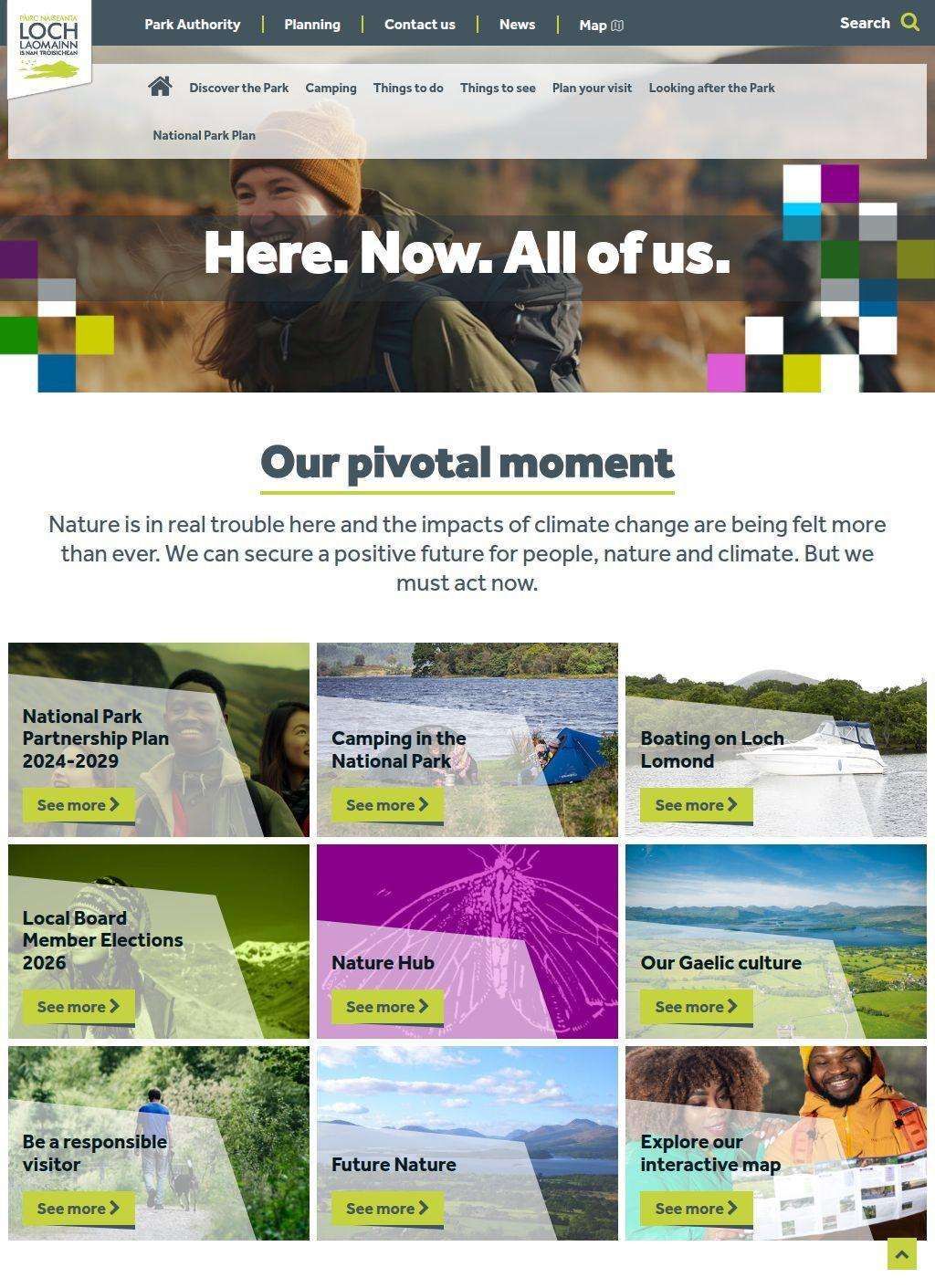
Scotland's first national park covers 720 square miles of loch, glen and hill, and the body that manages all of it is Loch Lomond and The Trossachs National Park Authority, a statutory organisation established under Scottish Parliament legislation. Its website is where that responsibility becomes something readable, plannable, and actionable. The land stretches across parts of Stirlingshire, Argyll, Perthshire and Dunbartonshire, a lot of varied Highland terrain to hold under one remit, and the site is built to speak to several audiences at once: the visitor planning a weekend, the resident living inside the boundary, the landowner with a development question, and the business trying to operate within the park rules.
Activities, routes, visitor facilities
Start with the visitor side, because that is what most people arrive looking for. The activity guides cover camping, hiking, cycling, boating, angling and golf, each treated as its own subject with enough practical grounding to plan from. An interactive map and a journey planner do the unglamorous work of turning a vague idea into an actual route with a destination. Visitor centre locations are listed so you know where to find a staffed point on the ground. Wildlife and nature resources sit alongside all of this, aimed at the person who wants to understand what they are looking at and why, not simply where to park. The breadth here is sensible, not padded: the categories map onto how people genuinely use the park, and they stop short of inventing content nobody asked for.
Strategic plans for conservation
What lifts the site above a tourism brochure is the layer underneath the activity pages. Loch Lomond and The Trossachs National Park Authority publishes and administers the National Park Partnership Plan for 2024 to 2029, the document setting strategic direction on the climate and nature crises across the whole park. That plan is the framework Loch Lomond and The Trossachs National Park Authority is legally meant to deliver against, and having it openly available means a resident or a campaigner can read the same priorities the staff are working to. Conservation and biodiversity publications, including the "Future Nature" material, are available to download, useful to anyone studying the area's ecology or trying to hold the body to its own commitments.
Planning guidance for development
Planning is the other half of the job, and it gets proper treatment. Loch Lomond and The Trossachs National Park Authority offers guidance on development applications and land management within the park boundary, which is genuinely useful because the rules inside a national park differ from those outside it. Someone hoping to build, extend, or change the use of land needs to know how Loch Lomond and The Trossachs National Park Authority weighs proposals against conservation duties before spending money on drawings. The planning content answers that question early. For landowners and developers, this is arguably the most important material on the whole site, and the authority treats it as a service to explain, not a hurdle to hide behind.
From volunteering to governance
Community work runs through the site as a distinct strand. Loch Lomond and The Trossachs National Park Authority recruits volunteers, runs outdoor learning, supports youth opportunities, and administers the John Muir Award, a well-known scheme that encourages people to discover and care for wild places. These are not token line items; they reflect a body that sees its purpose as partly about getting people involved in the park, alongside the enforcement side of the job. Career vacancies are listed too, a practical resource for anyone in Stirlingshire or the wider region who wants to work in conservation, planning, or visitor management close to home, and a clear sign of a working organisation that continues to hire and grow.
The trickier part of the remit gets honest space here. Managing a national park that millions of people want to visit means managing pressure: too many tents in fragile spots, fires where there should be none, and the slow damage that comes from a place being loved hard. Loch Lomond and The Trossachs National Park Authority oversees responsible-visitor campaigns and sustainable tourism work, and the site sets out guidance on camping management zones and the bylaws that govern where and how you can stay overnight. Loch Lomond and The Trossachs National Park Authority explains those rules plainly on the site, with the reasoning attached.
A visitor who reads this before arriving avoids both a fine and the awkwardness of being moved on. That difference, between a body that wants compliance and one that wants genuine understanding, is visible throughout the way Loch Lomond and The Trossachs National Park Authority presents this material.
For anyone interested in how the park is governed, Loch Lomond and The Trossachs National Park Authority does not stop at glossy plans. The site provides access to formal consultations, committee papers and governance documents, the paper trail of a public body under Scottish Government oversight. A curious resident can follow a decision from proposal to vote; a journalist or researcher can check what was discussed and when. Plenty of organisations bury this kind of thing. That Loch Lomond and The Trossachs National Park Authority makes consultations and committee papers reachable is a mark of a body that accepts it answers to the public it serves.
If there is a fair criticism, it comes with the territory for any body doing this many jobs at once. A site that must serve the day-tripper, the planning applicant, the volunteer and the policy reader will always ask different visitors to dig past content meant for someone else. The breadth is a strength and a modest tax at the same time: the camper wading toward bylaw detail and the developer hunting planning guidance both have to navigate around the rest. That is a navigation reality, not a content failure, and the interactive map and journey planner do real work to soften it on the visitor side at least.
Taken as a whole, Loch Lomond and The Trossachs National Park Authority offers what its position demands and something more besides: clear visitor planning tools, substantive conservation and biodiversity publications, planning guidance that respects the user's time, real community programmes, and an open governance record. The activity guides will satisfy the casual visitor, while the Partnership Plan, the "Future Nature" downloads and the committee papers reward the person who wants to understand the place, not simply move through it. The harder topics, camping zones, bylaws, the climate and nature crises, are met head on instead of softened into slogans.
Loch Lomond and The Trossachs National Park Authority comes across as a body that knows its job is both to welcome people and to protect the ground they walk on, and it has built a site that holds those two duties together without flinching from either. Visitors heading to Stirlingshire and the wider park should open the interactive map and journey planner first, then read the camping management zone guidance and bylaws before departure. Landowners and prospective developers will find the planning guidance the natural starting point; Loch Lomond and The Trossachs National Park Authority sets out clearly how it assesses applications inside the boundary. Those wanting to give time to the place should look at the volunteering pages and consider the John Muir Award as a way in.
Business address
Loch Lomond and The Trossachs National Park Authority
Carrochan, Carrochan Road,
Balloch,
Stirlingshire
G83 8EG
United Kingdom
Contact details
Phone: 01389 722600