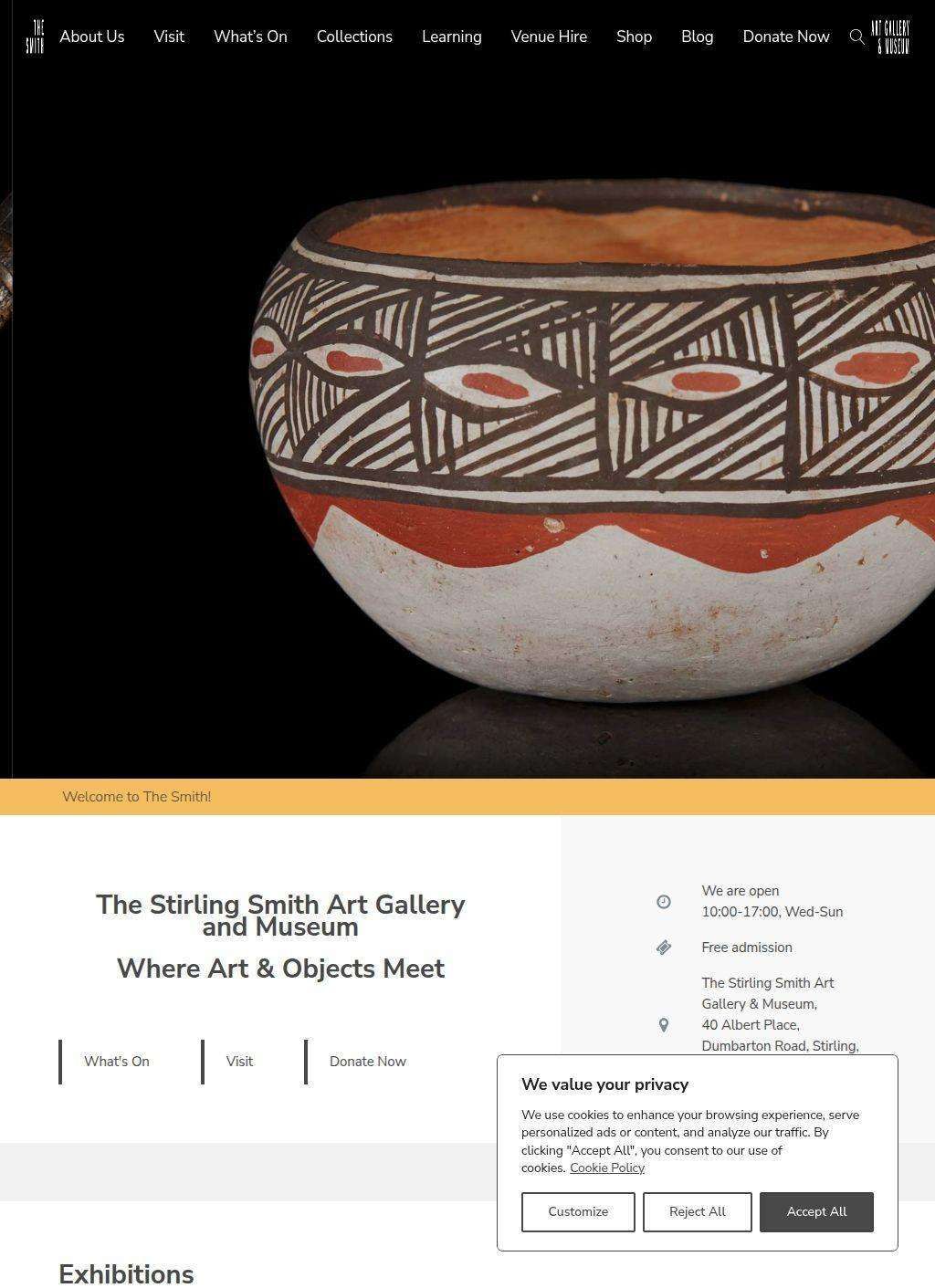
Free admission at The Stirling Smith Art Gallery and Museum changes how you use the place. You can walk in on a wet afternoon, look at one painting for twenty minutes, and leave without the small guilt of having paid for a full day you did not spend. The collection rewards both that quick visit and a longer, slower one, and that dual fit is rarer than it sounds for a venue this size.
The Stirling Story exhibition
At the centre of The Stirling Smith Art Gallery and Museum is a permanent exhibition called The Stirling Story, which takes the town from prehistory through to the twentieth century. That is a wide span to hang on one gallery, and the choice tells you where the museum places its loyalty. It is a local institution first, concerned with the specific ground it sits on, the people who lived there, and events that ran through the town over thousands of years. A visitor who knows nothing about Stirling can use The Stirling Story as an orientation before walking out into the streets, which is the most useful thing a town museum can offer.
Rotating temporary exhibitions
Around that fixed core, the programming rotates. Temporary exhibitions reach well past local history into subjects with no obvious connection to central Scotland, and that range is one of the more interesting things about the place. There has been a show on the heritage of Ancient Sudan, a photography exhibition called At the Heart of the Lens, a colour-driven display called Colourscapes, and Young Creatives, which gives space to work by younger artists. A single venue moving between Sudanese antiquity and youth art within the same year is doing something more ambitious than ticking through the expected regional fare.
Fine art holdings
On the fine art front, the holdings of The Stirling Smith Art Gallery and Museum include works by the Mach brothers, which gives the gallery a connection to a recognised artistic name rather than leaving the art wing as a vague gesture toward culture. I tend to trust a small museum more when it can point to specific holdings instead of describing its collection in the abstract, and naming the Mach brothers does exactly that. It shows that the art on the walls has been collected with intent and that someone can tell you why a given piece is there.
How historical material shapes visits
The split between fine art and contemporary art also affects how the place feels across a visit. You are not looking at one register the whole way through. The historical material in The Stirling Story sits alongside older paintings and newer pieces, so the building shifts in tone as you move through it. That variety keeps a return visit from feeling like a repeat, especially when the temporary shows turn over.
Events and talks
The Stirling Smith Art Gallery and Museum clearly wants people inside it doing things, and filing past glass cases is the least of what it expects from a visit. The events programme runs on two tracks. There are ticketed talks, priced at five pounds, on subjects such as curatorial practice and local history, the sort of session aimed at someone who wants to go a layer deeper than the wall labels allow. Then there are free community events, including evenings tied to Culture Night Stirling, among them a programme titled Trans Cosmologies. The pricing structure is honest about who it serves: a five-pound talk is cheap enough to be an impulse, and the free events lower the bar to nothing at all.
Community-focused programming
That orientation toward community is the throughline of the whole operation. The Stirling Smith Art Gallery and Museum is built around local communities, school groups, and ordinary visitors, and the programming follows that brief rather than chasing a national or tourist audience it cannot realistically hold. School groups are a natural fit for a place that pairs a deep local-history exhibition with art and rotating shows, since a single visit can cover several subjects at once. The talks and community nights fill out the calendar so that the museum stays active between exhibition changes.
The audience pitch of The Stirling Smith Art Gallery and Museum reads clearly in the kinds of events on offer. A curatorial-practice talk speaks to people with a real interest in how museums are run, while the local-history sessions and the Culture Night evenings reach a broader crowd who simply want something to do on a given night. Programming this varied takes effort to sustain, and the spread points to a museum that treats its calendar as a living thing.
Keeping track of what's on
For people who want to keep up with what is on, The Stirling Smith Art Gallery and Museum runs a newsletter signup and maintains a presence across Facebook, Instagram, and Twitter, now branded as X. Given how often temporary exhibitions and one-off talks change, those channels are the practical way to know what is showing in any particular week, and the newsletter suits anyone who would rather not track three separate social feeds. The site also takes donations, which for a free-admission museum is the quiet counterpart to the open door: nobody is charged at the entrance, so the running of the place leans on the goodwill of people who value it.
Free admission as civic service
It is worth dwelling on what free admission actually does for an institution like this. Because no ticket gates the collection, the museum can serve as ordinary civic infrastructure, the kind of building a parent ducks into with a child, a student uses for an afternoon, or a resident returns to repeatedly across years. The Stirling Story rewards exactly that kind of repeat, casual visiting, since a person can absorb a different stretch of the town's history each time without ever feeling they have to take it all in at once.
What keeps coming back is the breadth held together by a clear local anchor. The Stirling Smith Art Gallery and Museum could have settled for being a tidy town-history museum and stopped there, and it would have been perfectly respectable. Instead it carries fine art with named holdings, contemporary work, a rotating exhibition slate that reaches to Ancient Sudan and back, and an events calendar that mixes paid depth with free access. All of that sits under one roof at The Stirling Smith Art Gallery and Museum, admission-free, with the through-line being service to the town it sits in. The permanent core at The Stirling Smith Art Gallery and Museum gives you a reason to go once; the changing programme gives you reasons to go back.
Business address
The Stirling Smith Art Gallery and Museum
40 Albert Place, Dumbarton Road,
Stirling,
Stirlingshire
FK8 2RQ
United Kingdom
Contact details
Phone: 01786 471917