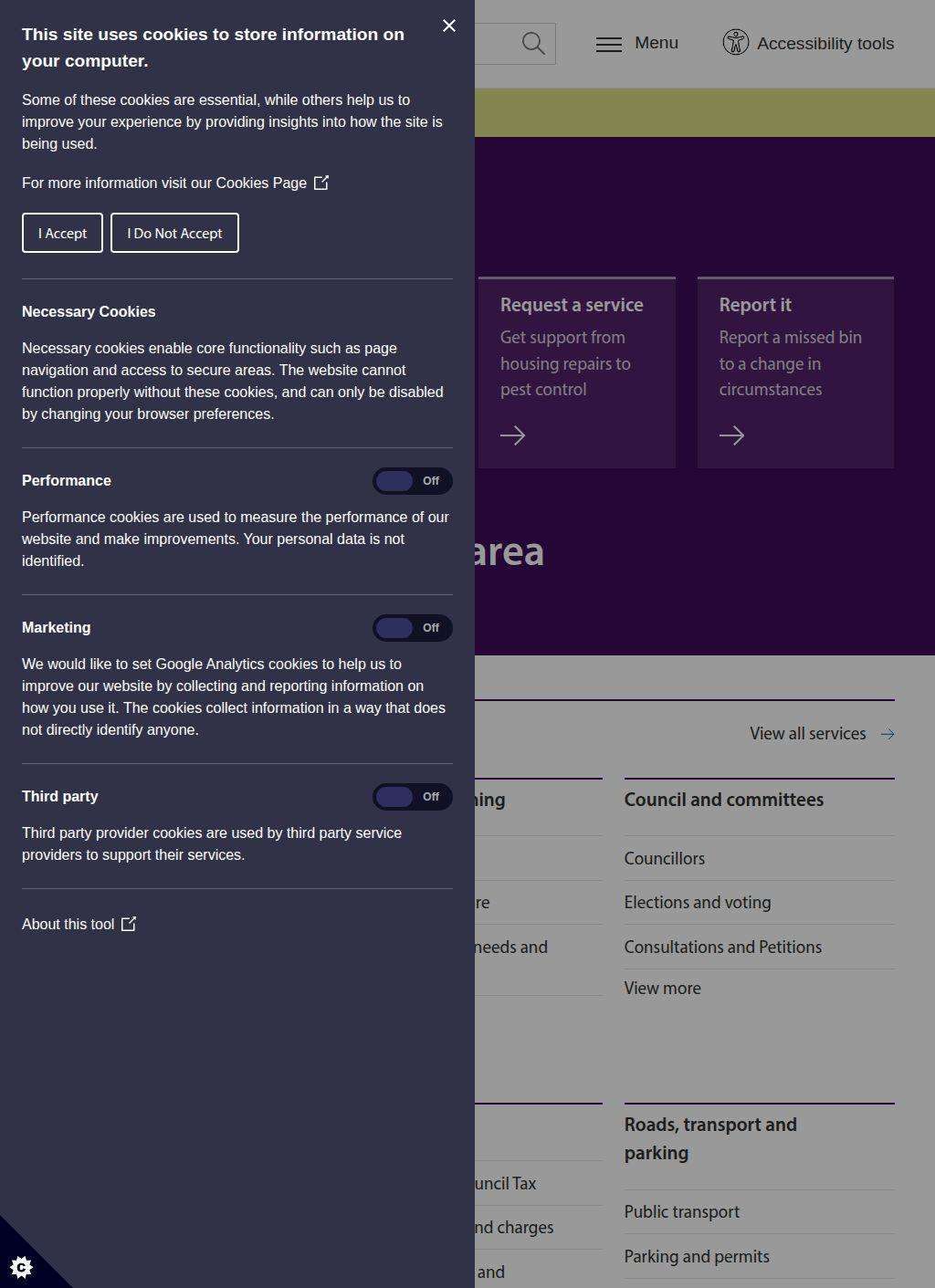
Finding your bin collection day, paying a council tax bill, or checking the band on a property before you move are routine errands most residents need sorted quickly. Stirling Council answers all three from one site, and that practical, day-to-day work is what stirling.gov.uk is built around. The bins section lets you search collection dates by address, apply for a garden waste permit, and join the kerbside trial that now takes batteries, vapes and small electricals at the door. Council tax has its own cluster: payment options, a band and charge lookup, and the route for appeals or disputes if you think your assessment is wrong.
Bins, council tax, property bands
Stirling Council is the local authority for the Stirling council area in Scotland, and the site tries to hold the whole sweep of local government in one place. That ambition is the interesting part and also the hard part. Schools and learning sit alongside housing, planning, roads, social work and registration of births, deaths and marriages. A resident applying for council housing, a parent reading up on additional support needs, and a business owner checking rates and licences are all looking at the same site, with very different reasons for being there.
Schools, housing, planning, roads
What Stirling Council does well online is breadth. Roads, transport and parking gives you public transport information, parking permits, and a way to report problems with roads and pavements. Planning and building covers planning applications and building standards, the things people most often go looking for when a neighbour starts work or they want to extend their own home. Business users get rates, licences, permits and permissions grouped together, which is sensible because those tasks tend to come as a set.
Roads, transport, parking services
Registration is handled properly too: certificate purchases, birth and death registration, and the fees laid out. Social work and social care stretches across children and families, support for adults and older people, and justice services. That last grouping is easy to underbuild, since it brings together some of the most sensitive things a person ever has to ask a council for, and keeping it as a clear front-door category rather than scattering it through other sections is the right call.
Birth and death registration
Environment and pollution runs from climate action to the Bandeath dog shelter to guidance on private water supplies, which is the sort of niche topic a rural household genuinely needs and rarely finds spelled out. Pest control sits in the same area. Community life and leisure pulls in libraries and archives, community programmes, and the Stirling Area Local Access Forum, the kind of standing body that residents who care about footpaths and rights of way will want to track. Housing covers council housing applications, housing benefits, and guidance for people in private rented accommodation, so renters are not left out of a section that often speaks only to council tenants.
From climate action to pest control
There is also a layer for the unusual and the urgent. Emergency planning gives flooding guidance, defibrillator locations and business resilience advice. Safety and antisocial behaviour offers reporting tools and links to gender-based violence support and community justice. A dedicated set of pages supports Ukrainian people through the Homes for Ukraine scheme, humanitarian donations, and sponsor thank-you payments, which shows Stirling Council keeping a current scheme visible instead of burying it.
Emergency response and Ukrainian support
The spine running under all of this is self-service. Apply online, pay online, report an issue, request a service: those four verbs are the real test of whether a council site works, because they decide whether a resident finishes a task or gives up and phones. Stirling Council leans on them heavily, and the categories above mostly feed into one of those four actions.
Self-service transactions online
Beyond transactions, Stirling Open Data is a portal for anyone who wants the figures behind the services rather than the services themselves. Publishing open data is a choice many smaller authorities skip, so its presence here counts for something with researchers, journalists and local developers. Stirling Council also maintains accounts on Facebook, X, YouTube, Instagram and LinkedIn, which becomes useful when something time-sensitive happens, a road closure or a flood warning, and people want an update faster than a web page tends to deliver.
Can residents find what they need?
The doubt is one that shadows almost every council site of this size. Holding bins, schools, planning, social care, registration and emergency response under a single roof means the navigation carries an enormous load, and breadth is not the same thing as findability. A garden waste permit and a justice service should not take the same number of clicks, yet a flat menu often treats them as equals, and the sheer count of categories Stirling Council has chosen to surface raises the stakes on how they are ordered. Whether someone arriving in a hurry, mid-flood or mid-deadline, lands on the right page on the first try is the question stirling.gov.uk has to answer over and over. That is the one no list of categories, however complete, can settle from the outside.
Business address
Stirling Council
Old Viewforth, Pitt Terrace,
Stirling,
Stirlingshire
FK8 2ET
United Kingdom
Contact details
Phone: 01786 404040