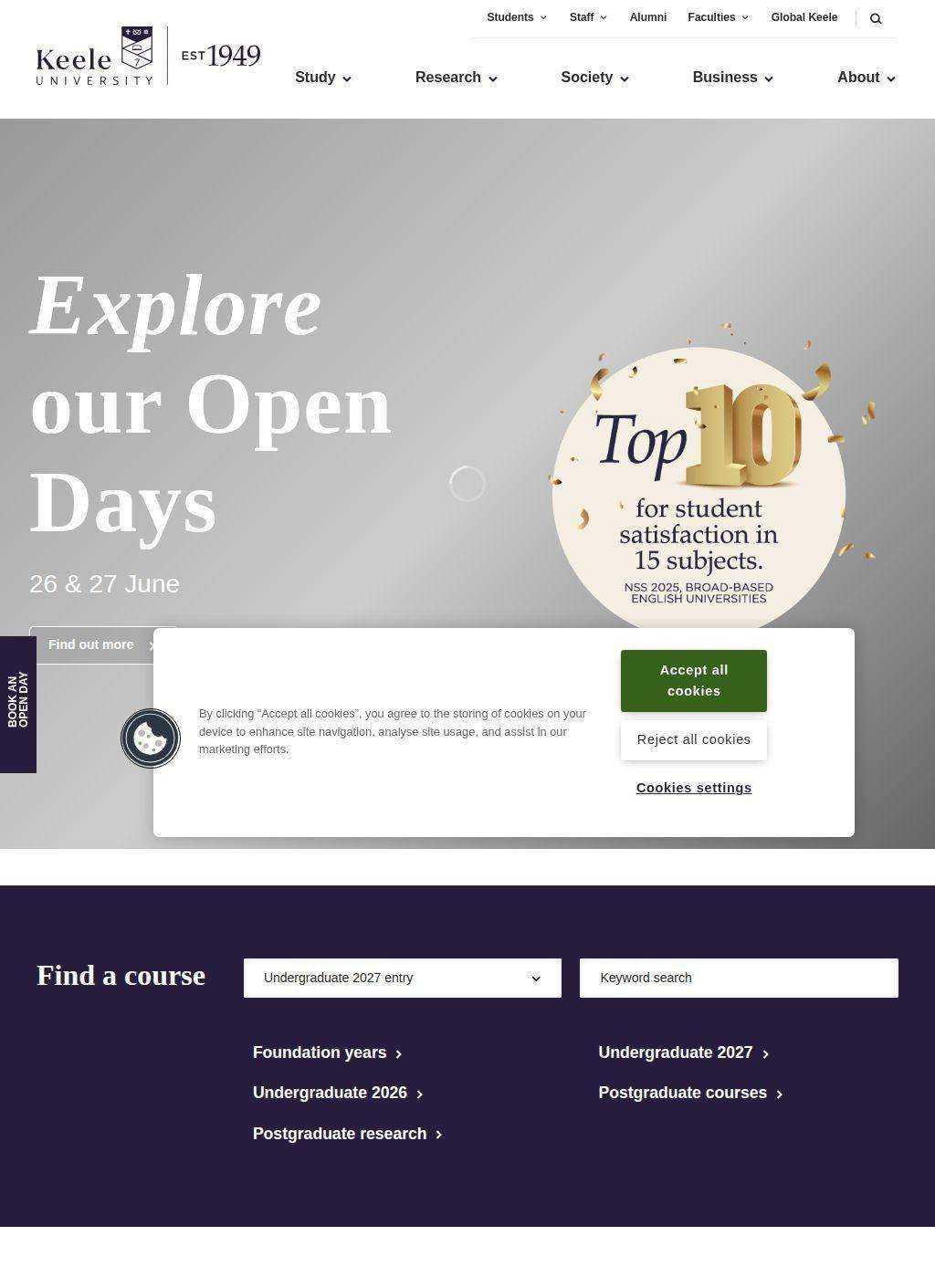
Keele University runs the only Forensic Science degree in England ranked top in its field, paired with a Pharmacy programme that sits inside the top ten nationally. Those two facts tell you a great deal about where the institution puts its weight. This is a campus-based public research university spread across a 600-acre estate in Staffordshire, just outside Newcastle-under-Lyme, and the website is built around moving a prospective student from vague interest to concrete application. The undergraduate pages already split by entry year, with separate routes for 2026 and 2027 entry, so a sixth-former planning well ahead and a current applicant are not stepping on each other's toes. Small touches like that reveal a site thought through by people who understand how applicants actually behave.
Forensic science and pharmacy leadership
The breadth of study options is wider than the headline subjects suggest. Beyond standard undergraduate degrees, the prospectus covers postgraduate taught programmes, postgraduate research that includes professional doctorates and structured doctoral training centres, and degree apprenticeships for people who want to earn while they study. There is also a Continuing Professional Development strand and a set of leadership programmes, which point the offer squarely at working professionals and not solely at school leavers.
Postgraduate and professional pathways
Someone weighing a part-time professional doctorate against a full-time taught masters will find both paths described in their own terms, with enough detail to judge whether the commitment fits their life. That spread is one of the clearer arguments for treating Keele University as a serious option at every stage of a career. Keele University is unusual among universities of its size in covering that full range within a single prospectus, from a first degree right through to a mid-career qualification.
Research performance and teaching quality
The research side is where the university makes its loudest case, and the numbers behind it are specific enough to verify independently. In REF 2021, the most recent national research assessment, 80 percent of the work submitted was judged world-leading or internationally excellent. That figure does real work on the page because it gives a measurable answer to the question most prospective postgraduates ask before investing several years in a place. A Gold Award in the Teaching Excellence Framework sits alongside it, which speaks to the quality of the teaching itself rather than the output of the labs. The two metrics together cover both ends of what a student is paying for, and Keele University keeps them visible instead of tucking them into a corner.
Four research institutes
Four named research institutes give the work a clear shape. The Institute for Global Health and Wellbeing, the Institute for Social Inclusion, the Institute for Sustainable Futures, and the Digital Society Institute each stake out a distinct theme, and the grouping reads as deliberate and purposefully structured. A researcher trying to work out whether their interests fit can map them against these four before ever contacting a supervisor. The structure makes Keele University legible from the outside, which is harder to pull off than it sounds. Plenty of large institutions present their research as an undifferentiated mass; Keele University has instead given prospective collaborators four front doors to knock on.
Graduate employability outcomes
Graduate outcomes back the academic claims up. Keele University places in the top 15 in the UK for graduate employability, a figure that connects the research reputation to a practical payoff for anyone treating a degree as an investment as much as an education. The site keeps that number close to the course information instead of stranding it on a separate marketing page. For a family doing the maths on three years of fees and living costs, having it in plain view is genuinely useful. It also reinforces the careers support described elsewhere on the site, since the two clearly feed each other.
Campus facilities and accommodation
For a campus university, the physical environment receives proper attention on the site. The 600-acre estate holds a library, sports facilities, and a spread of food and drink venues, plus more than 2,600 bedrooms on site. That last figure is concrete in a way prospective students notice, because guaranteed on-campus accommodation removes one of the larger anxieties of moving away for the first time. A single self-contained estate also means the walk between a lecture, the library, and a hall of residence stays short, and there is a settled, green character to the place that a city-centre campus cannot offer. Keele University has clearly leaned into that as a distinction.
Student support services
The support wrapped around study is described in plain terms. Health and wellbeing provision, accommodation services, and careers preparation each get their own route, and a student learning environment portal pulls the academic side of daily life into one place. None of this is unusual for a university of this size, but the site lays it out without making a reader hunt for the relevant page, and the careers thread in particular ties back neatly to that employability ranking. The portal is the kind of practical infrastructure students use every week, so giving it a clear home on the public site is a sensible choice. It also reinforces the sense that Keele University treats student life as a continuous service rather than a box ticked at enrolment.
Founded more than 75 years ago, Keele University has had time to settle into its setting, and the website reflects an institution comfortable with what it is: a research-led campus university in Staffordshire that knows its strengths and names them without dressing them up. The estate page shows its age in the best sense; details about accommodation numbers and specific venue types appear because they were confirmed over decades of student experience, and the precision of the research statistics points to Keele University having been through multiple assessment cycles and knowing how to present its record accurately. An institution with that kind of documented history does not need to oversell.
Comparing Keele with larger universities
The honest comparison for many applicants will be a larger civic neighbour such as the University of Manchester, where the scale is enormous and the city itself wraps around the campus. Keele University is making a different bet: a contained green estate, a clear set of research themes, accommodation you can count on, and a couple of subjects where it leads the country. The website reflects that position faithfully, and for forensic science, pharmacy, or research aligned with one of those four institutes, Keele University's published record is detailed enough to make a proper assessment without guessing at what the institution actually offers.
Business address
Keele University
Keele,
Newcastle-under-Lyme,
Staffordshire
ST5 5BG
United Kingdom
Contact details
Phone: 01782 732000