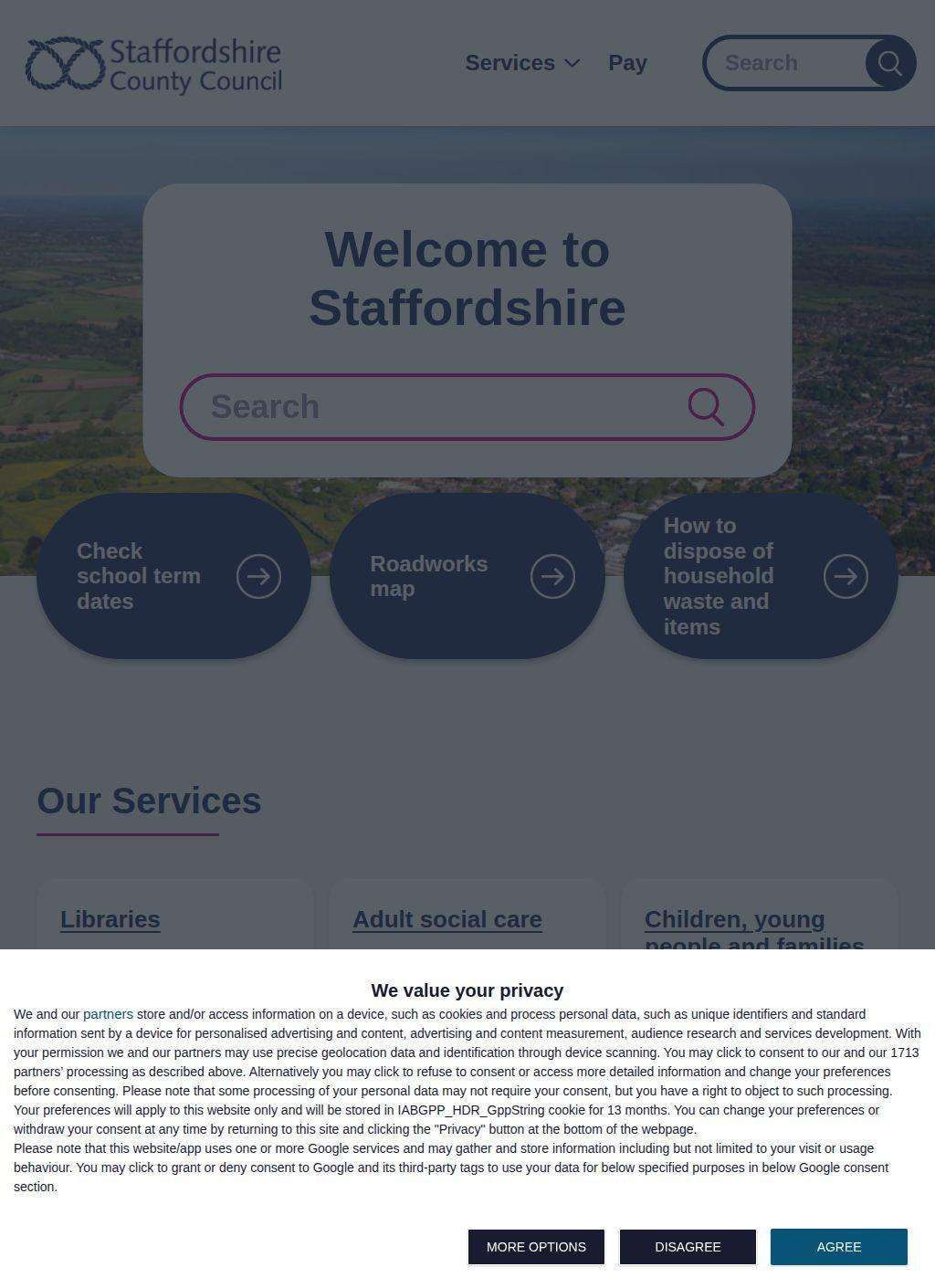
A bin has not been emptied for a fortnight, a pothole has swallowed a front wheel, or a school place needs sorting before a September deadline: these are the moments that send Staffordshire residents to staffordshire.gov.uk, and the site is built squarely around getting those jobs done. It is the official portal for Staffordshire County Council, and its job is less to impress than to route people to the right form, the right department, or the right piece of statutory information without much fuss. On that measure it mostly does what it sets out to do.
Reporting tools for roads, waste, drains
The reporting tools are the clearest example of what Staffordshire County Council does well online. Potholes and damaged roads, fly-tipping, faulty street lighting and blocked drains all have their own routes for flagging, and the site pushes residents toward online forms and portals so that a report can be logged without a phone call. Bin collection schedules sit alongside this, with recycling centre locations and details on what goes in which container. For anyone whose day-to-day contact with local government is waste, roads and reporting the small failures of a shared environment, this is the part of the site that gets used most.
Adult social care, fostering, adoption services
Where staffordshire.gov.uk is at its most useful is in the services people cannot get anywhere else. Adult social care and children's services are both covered here, including fostering and adoption pathways and support for families who need them. That is difficult, high-stakes territory, and Staffordshire County Council is the statutory body responsible for it, so the information carries an authority that no third-party site can match.
School admissions, special needs support
Education sits in the same bracket. School admissions run through Staffordshire County Council, and the site handles applications for places along with support for children with special educational needs and disabilities. These are deadline-driven, often stressful processes, and having them on the official council site means parents are reading the actual rules that will be applied to their case, not a summary written by someone at one remove. Registration services (births, deaths and marriages) round out the statutory functions, the kind of civic paperwork that only the council can issue.
Registration of births, deaths, marriages
Public health and community safety are handled here too. The breadth is wide, which is part of the point of a county council: one organisation covers a great deal of ground, and the website has to reflect all of it in a way that a resident can still navigate.
Roads and transport get substantial coverage beyond the pothole form. Highways maintenance, road closures, parking, bus passes and general travel information are all present, and in a largely rural county getting around is not a trivial question. Concessionary travel and bus pass applications in particular are the sort of thing residents need a reliable official source for, and Staffordshire County Council is that source.
Libraries, transport, business directories
Libraries have their own corner of the site, with a branch locator, a catalogue and online resources for people who want to borrow or research from home. It is easy to overlook this next to the heavier statutory services, but for a lot of residents the library service is their most regular, most positive point of contact with the council, and Staffordshire County Council keeps it properly represented online.
Business support and economic development make up another strand, aimed at companies operating in the county area alongside planning and environment guidance, plus a business directory listing local firms for anyone trying to find or verify one. Council tax and benefits information is here as well, though the billing itself falls to the district and borough councils rather than Staffordshire County Council, a split that can confuse residents but is a fact of two-tier local government, not a failing of this particular site. Jobs and careers with the council get their own section for anyone looking to work in the public sector locally.
How does the site balance so many services?
The audience is broad by design. Staffordshire County Council is speaking to residents, businesses, schools and visitors at the same time, and the site has to serve a pensioner applying for a bus pass and a developer checking planning guidance from the same front door. That is a hard balance to strike, and while the sheer quantity of services can make the site feel dense, the search and reporting tools do most of the heavy lifting for people who arrive knowing what they need.
Finding current information on forms
What is worth being honest about is that a site like this lives or dies on how well the forms work and how current the information stays, and that is something a single visit cannot fully judge. The structure is sound and the coverage is genuinely comprehensive, spanning the full range of what a county authority is legally required to provide. Whether every online portal is as smooth as the front pages suggest is the open question with any large public-sector platform, and Staffordshire County Council is no exception.
As a reference point for civic life in the county, though, staffordshire.gov.uk does the essential thing: it is the authoritative place to find statutory services, report local problems and understand what the council is responsible for. Staffordshire County Council is not trying to entertain anyone, and the site should not be judged as if it were. It is a functional gateway to local government, wide in scope and clear about what it covers, and for a resident with a specific task in hand it is the right first stop. The verdict is a practical one: consult it when you need something official from the county, and expect competence rather than polish.
Business address
Staffordshire County Council
1 Staffordshire Place, Tipping Street,
Stafford,
Staffordshire
ST16 2DH
United Kingdom
Contact details
Phone: 0300 111 8000