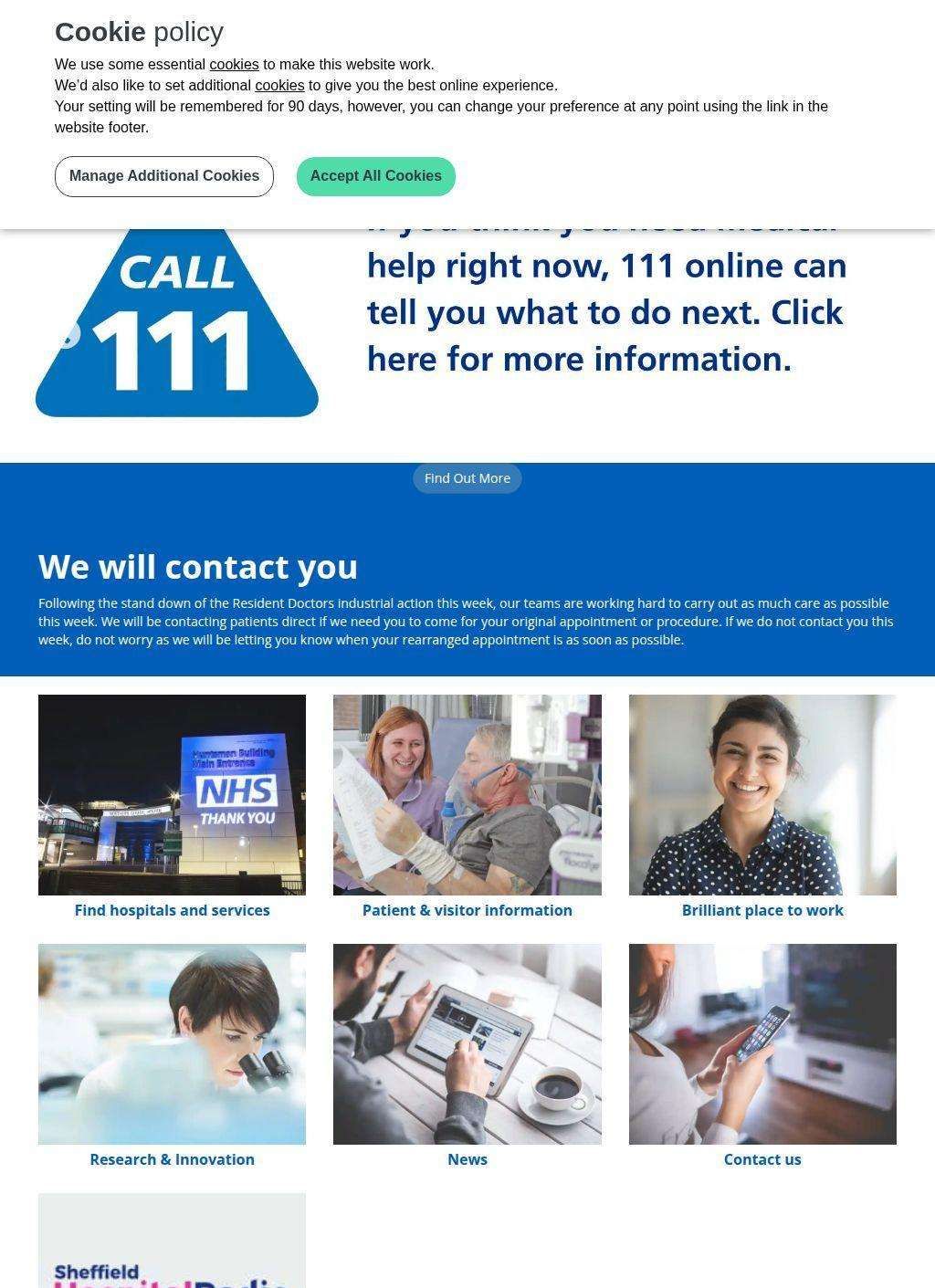
Someone in Sheffield wakes at three in the morning with chest pain, or gets a letter saying their child needs to see a neonatal team, or finds a lump and waits for the phone to ring. Underneath all of it the question is the same: where does the care actually happen, and can I find my way through it without getting lost. Sheffield Teaching Hospitals NHS Foundation Trust is the answer to that question for a large slice of South Yorkshire, and its website is built to be the front door to five separate hospital sites at once, each doing a different job.
Five hospitals, five different roles
Those five sites are not interchangeable, and Sheffield Teaching Hospitals NHS Foundation Trust does not pretend they are. Northern General Hospital handles a great deal of the acute and emergency load. Royal Hallamshire Hospital sits at the centre of specialist medicine in the city. Weston Park Cancer Centre is given over to oncology, which means a person facing a cancer diagnosis can read about the place that will treat them before they ever set foot in it.
Maternity, neonatal care, dentistry
Jessop Wing covers maternity and neonatal care, the births and the very early, very fragile beginnings. Charles Clifford Dental Hospital does the dentistry, including the oral surgery a general practice cannot. Reading the site, you come away with a clear sense of which building does what, and that clarity is enormously useful when an appointment letter names a place you have never heard of.
Services across acute medicine
What Sheffield Teaching Hospitals NHS Foundation Trust offers runs the full length of acute hospital medicine. Urgent and emergency care sits at one end. Planned surgery and procedures occupy the middle ground, the operations people wait weeks or months for. Cancer treatment, maternity and midwifery, and dentistry each have their own substantial presence. Behind all of that is an A-to-Z of clinical specialties reachable through a consultant directory, so a patient or a referring GP can look up the team responsible for a particular condition instead of guessing. That directory is a quiet but genuinely useful thing. It turns a sprawling organisation into something a single worried person can navigate without needing to phone anyone first.
Community health services integrated
Care does not stop at the hospital doors. Sheffield Teaching Hospitals NHS Foundation Trust also runs community health services, the visits and clinics that happen closer to where people live. Putting acute and community provision together on the website reflects how the trust actually works, and it spares patients the confusion of wondering whether a given service belongs to the hospital or to somewhere else entirely. For a body this size, keeping that distinction legible is harder than it looks, and the site mostly manages it.
Patient information and digital tools
The patient information library is where Sheffield Teaching Hospitals NHS Foundation Trust does something few hospital sites bother to attempt. There is an extensive set of leaflets, and they come in easy-read and foreign-language versions, which is no footnote in a city as mixed as Sheffield. A video library sits alongside the written material. A person who reads slowly, or who reads English as a second language, or who absorbs more from watching than from a page of text, is accounted for here. That is the difference between information that technically exists and information a frightened patient can actually use the night before a procedure.
On the practical side, Sheffield Teaching Hospitals NHS Foundation Trust runs a digital patient portal through MyPathway and DrDoctor. It lets patients manage appointments, read their hospital letters electronically, and change or cancel times without sitting on a phone line. Anyone who has spent a lunch break on hold to reschedule a clinic appointment will understand why this is worth flagging. It moves a chunk of low-stakes administration off the phones and into the patient's own hands, which frees staff time and spares patients the wait. The site treats the portal as a core service, not a bolt-on, and that choice is the right one.
From research to clinical care
Research and innovation form a second, heavier arm of what Sheffield Teaching Hospitals NHS Foundation Trust does. There is a Biomedical Research Centre, dedicated cancer research programmes, and the Devices for Dignity initiative, which works on technology that helps people live with long-term conditions and disability. The facilities are open to external researchers, so Sheffield Teaching Hospitals NHS Foundation Trust is not running its science behind a closed door. This is the part of the organisation that connects bedside care to the laboratory, and the site gives it room instead of burying it under the clinical pages. A patient may never read these sections, but their existence is part of why a large teaching trust treats illness differently from a smaller district hospital.
Education, apprenticeships, volunteering
That teaching mission shows up directly elsewhere on the site. Sheffield Teaching Hospitals NHS Foundation Trust runs medical education, apprenticeship routes, and volunteer programmes. The apprenticeships in particular point to an organisation thinking about how it staffs itself a decade out, training people locally instead of only recruiting the finished article. Volunteering gives the public a way in that is not as a patient. These threads do not compete with the clinical work; they are the reason a teaching trust holds knowledge that gets passed forward to the next generation of staff.
Taken together, the website does the job a body of this scale needs it to do. It explains five hospitals without blurring them, routes people to the right specialty, and backs the clinical core with information patients can genuinely read, a portal that removes friction, and a research operation the trust is willing to show rather than hide. The structure follows the way care is actually delivered, which is the strongest thing you can say about a site whose users arrive stressed and short on patience.
It is worth setting Sheffield Teaching Hospitals NHS Foundation Trust beside a likely alternative. Someone in the region might turn to the NHS national website at nhs.uk for general guidance on symptoms and conditions. That national resource is excellent at the generic question, the what-is-this and the should-I-worry. What it cannot do is tell you which Sheffield building your appointment is in, which consultant team will see you, or how to move an appointment in this trust's own system. The national site answers the condition; Sheffield Teaching Hospitals NHS Foundation Trust answers the place, the people, and the logistics specific to getting treated here. For anyone whose care is going to happen in this city, that local, building-by-building specificity is exactly what the national pages leave out.
Sheffield Teaching Hospitals NHS Foundation Trust does not oversell itself, and it does not need to. Acute care, community services, dentistry, maternity, cancer treatment, and a serious research programme sit here, and the website lets a patient, a carer, a GP, or a researcher each find the corner they came for. That is a high bar for a site this large, and Sheffield Teaching Hospitals NHS Foundation Trust clears it without any of the self-congratulation that makes official health websites so difficult to read.
Business address
Sheffield Teaching Hospitals NHS Foundation Trust
Northern General Hospital, Herries Road,
Sheffield,
South Yorkshire
S5 7AU
United Kingdom
Contact details
Phone: 0114 243 4343