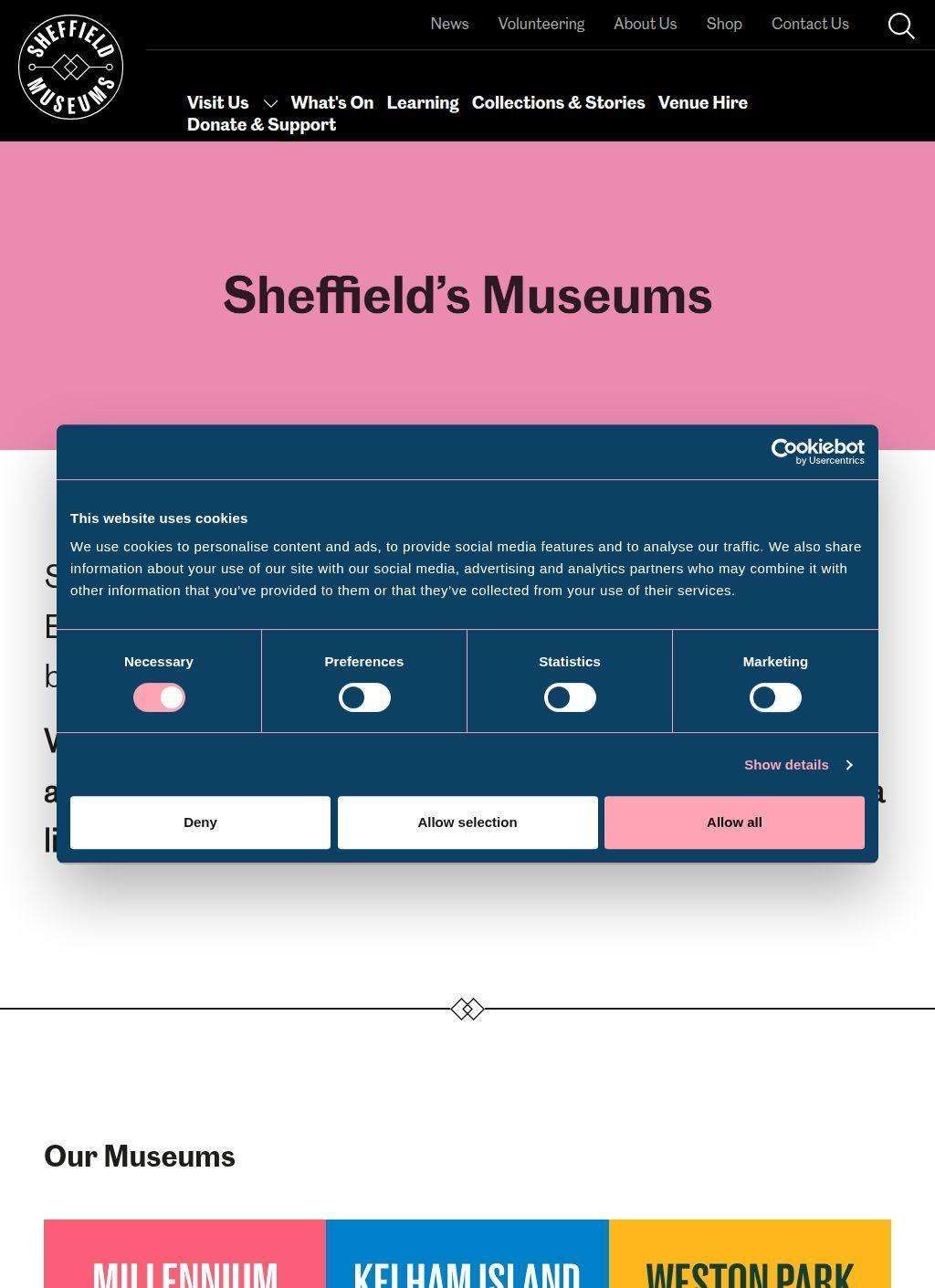
Sheffield Museums Trust is the charity that runs six public museums and galleries across Sheffield, and the website is the front door to all of them. Registered as charity number 1194032, Sheffield Museums Trust pulls together venues that would otherwise feel scattered: the Millennium Gallery for art and design, Kelham Island Museum for the city's industrial past, Weston Park Museum for everything from local prehistory to the present day, the water-powered scythe works at Abbeydale Industrial Hamlet, the Graves Gallery for fine and decorative art, and Shepherd Wheel Workshop, where knife-grinding history is kept alive. One organisation, six very different places, and the site does the useful job of letting you plan a visit to any of them from the same starting point.
Six museums under one organisation
What makes the structure work is that each venue keeps its own identity instead of being flattened into a single generic museum brand. Kelham Island carries roughly three centuries of Sheffield steel and tool-making. Abbeydale and Shepherd Wheel are working industrial sites, not display cases, and that distinction comes through clearly. Weston Park reads as the broad civic museum, the one a family with children would probably head to first. If you only know Sheffield as a steel city, the spread of these collections quietly fills in the rest, from natural history to fine art, and the Sheffield Museums Trust site is where you find out which building holds what. That single-hub approach saves a visitor from chasing six separate websites to answer one simple question about where to go.
Each venue keeps its own identity
Admission to all six sites is free, with a suggested five-pound donation, which is a meaningful detail for anyone weighing a day out against the cost. The exhibitions programme is where the calendar earns attention. The Football Art Prize runs across the summer of 2026, sitting alongside longer shows: Gathering Landscapes spans roughly a year from late 2025, Storm Cloud occupies a similar stretch into late 2026, and Queer Legacies in Sheffield's Art Collection runs for a full year from early 2026. Listing dated shows on a single hub is genuinely helpful. It tells a visitor whether a given trip is worth timing around a specific exhibition or whether the permanent collections alone are reason enough to make the journey.
Free admission with exhibitions calendar
I went looking for the practical follow-through behind those headline shows, and Sheffield Museums Trust does back them up. The site supports a membership scheme for people who return often, venue hire for those who want to use the spaces for events, and gift experiences for visitors buying for someone else. There is also a prints-on-demand service and a separate online shop, so the collections extend past the gallery walls into things you can take home. None of this is unusual for a museum group, but having it gathered in one place, instead of split across six separate venue sites, is the point of Sheffield Museums Trust existing as a single body. The plumbing behind a cultural visit, booking, buying, joining, sits where you would expect to find it.
Membership, venue hire, gift experiences
The permanent holdings give a visitor as much reason to come as the temporary draws do. Sheffield's story as a place that made the world's cutlery and steel runs through Kelham Island, Abbeydale and Shepherd Wheel, and the art collections at the Millennium and Graves galleries give the city a cultural register beyond industry. A visitor planning ahead can map a route across themes, an industrial-heritage day at the working sites or an art-focused afternoon between the two galleries, and Sheffield Museums Trust sets up the website to make that kind of planning straightforward. The free admission removes the usual hesitation about whether a single building is worth the entry fee, because there is no fee to weigh.
Permanent collections span industry to art
The education side is broader than a single schools page. Sheffield Museums Trust runs programmes aimed at schools, colleges and universities, and it also addresses families, young people and community learning partnerships as distinct audiences. Sheffield Museums Trust treats its venues as teaching resources and shared civic spaces, open to people with very different reasons for walking through the door. A teacher booking a class trip and a community group looking for a partnership are pointed to different routes, which is the right way to handle audiences with genuinely different needs.
Education programmes for multiple audiences
It is worth saying that the programmes are framed around participation as much as viewing. Community learning partnerships in particular show Sheffield Museums Trust working outward into the city, reaching audiences who might never walk in on their own. For an organisation holding collections this tied to Sheffield's own identity, that outward turn feels appropriate. The steel and cutlery history is the city's history, and a museum trust that opens it up to schools and local groups is doing the job a public collection is meant to do. The breadth here is the part that lifts the offering above a simple list of opening times and ticket prices.
Community partnerships reach beyond the buildings
Across the six sites, the offering is coherent in a way that is harder to achieve than it looks. Sheffield Museums Trust has to speak to a casual family visitor, a heritage enthusiast tracing the city's industrial roots, a teacher planning a curriculum trip, and an art follower tracking a specific show, and the website manages to serve all of them without losing track of any one group. Sheffield Museums Trust uses the same hub to handle free admission, dated exhibitions, membership, retail and learning, and the result reads as a well-run cultural organisation rather than a loose collection of buildings sharing a logo. That coherence is the quiet achievement, and it is easy to overlook precisely because it works.
Current shows signal ongoing reinterpretation
The shows currently on the calendar give a fair sense of ambition: a football-themed art prize, two landscape and atmosphere exhibitions running for the better part of a year, and a show drawing out queer histories within the existing art collection. That last one is a sign of a collection being read in new ways instead of left static, and it tells a returning visitor there is always a reason to come back. Sheffield Museums Trust is clearly trying to keep its permanent venues feeling current, and the programming supports that intention. A museum that re-reads its own holdings and finds new angles in them is one that keeps its regulars coming back.
External reviews point to visitor satisfaction
A search for third-party reviews of Sheffield Museums Trust turns up no aggregated ratings on the major platforms, which is common for charity-run cultural institutions where Google or Tripadvisor reviews tend to attach to individual venues rather than the trust itself. The Kelham Island Museum and Weston Park pages each carry visitor reviews that are overwhelmingly positive, so what external opinion exists points in one direction, even if it is not consolidated under the Sheffield Museums Trust name. Six free venues, a real exhibition calendar, and education and membership routes all sit in one place, covering ground from steel and scythes to fine art and natural history. The retail and prints-on-demand options extend the collections beyond a single visit, and the dated shows reward planning ahead. Sheffield Museums Trust has made that cultural spread reachable from one address.
Business address
Sheffield Museums Trust
Leader House, Surrey Street,
Sheffield,
South Yorkshire
S1 2LH
United Kingdom
Contact details
Phone: 0114 278 2600