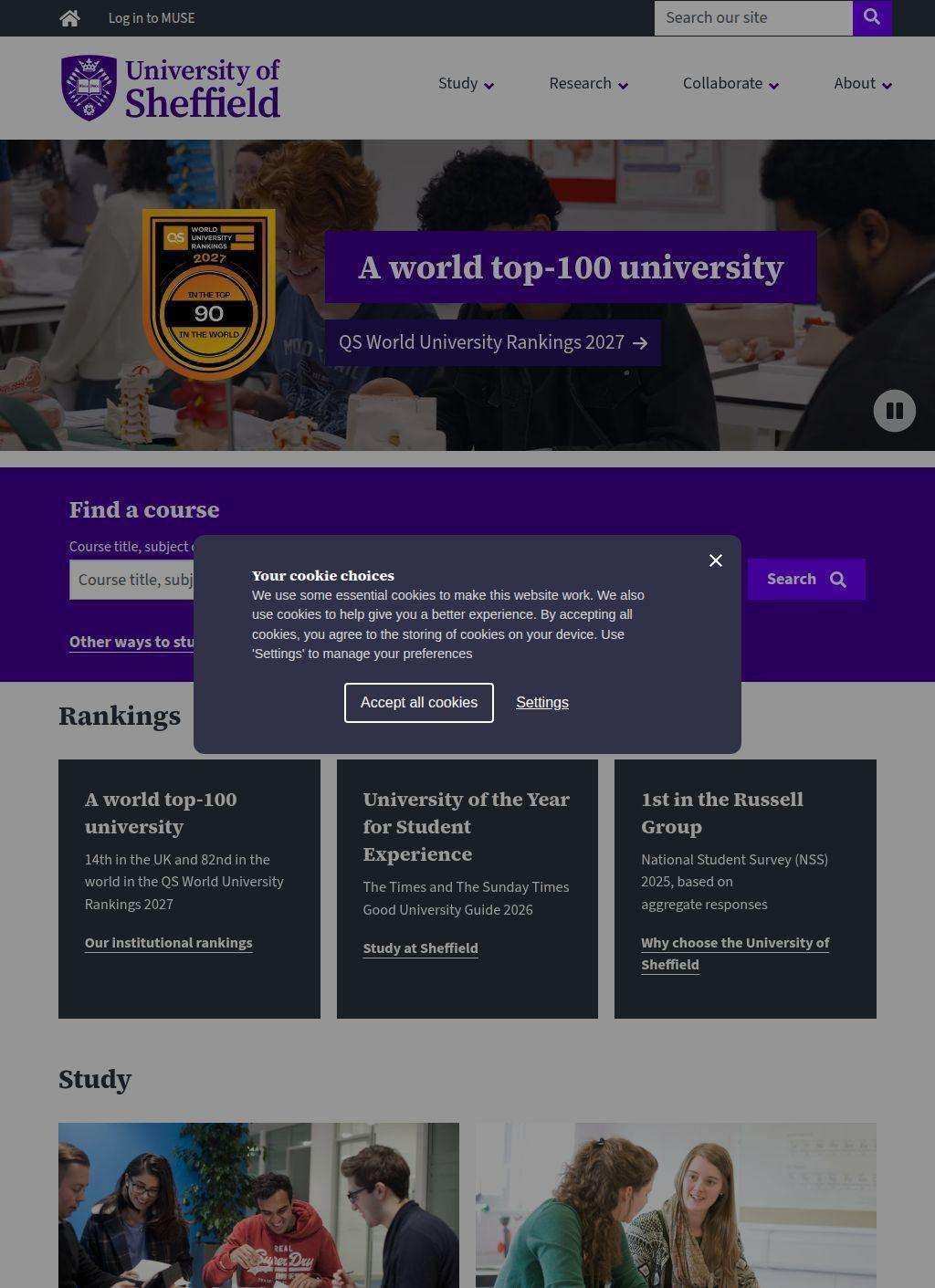
The University of Sheffield is a large public research university in the centre of Sheffield, and one of the founding members of the Russell Group of research-intensive UK universities. It traces its origins to three Victorian colleges, including a medical school dating from 1828, that merged and received a royal charter in 1905. Today it teaches around thirty thousand students drawn from more than 150 countries, and it sits consistently inside the global top 100 in the main international rankings. For South Yorkshire, it is one of the largest employers and a major part of the local economy, so its presence in a regional business directory is well justified.
Campus location and central contact points
The main campus runs along Western Bank and Glossop Road, a short distance west of the city centre, with buildings spread across the Western Bank and St George's areas and out toward the residential district of Broomhill. The central address is Western Bank, Sheffield, S10 2TN, and the main switchboard is +44 114 222 2000, which connects callers through to departments, admissions and professional services. The website at sheffield.ac.uk is the principal point of contact for prospective students, current students, researchers and partner organisations, and it carries department directories, course information and the contact routes for individual faculties.
Collaborating on advanced manufacturing research
Teaching is organised across faculties covering the arts and humanities, social sciences, science, engineering, medicine and the health sciences. Engineering is a particular strength, and the university is closely tied to advanced manufacturing through the Advanced Manufacturing Research Centre, a research operation that works with companies such as Boeing and Rolls-Royce on production techniques, machining and digital manufacturing, with a cluster of workshops and test facilities on the edge of the city.
The medical school continues to train doctors and works hand in hand with the local NHS trusts, while subjects such as architecture, materials science, automatic control and East Asian studies have long-standing reputations. Prospective students can browse undergraduate, postgraduate taught and doctoral courses through the site, with entry requirements and module outlines set out for each programme. International applicants will find guidance on English language requirements, visas and fees alongside the academic detail.
Research is central to what the university does, and it brings in substantial funding from UK research councils, charities, the European Union and industry. Work spans clean energy, advanced materials, healthcare, food security, artificial intelligence and the social sciences. The university has been recognised with several Queen's Anniversary Prizes, which are awarded for outstanding work in higher education, and a number of its researchers have gone on to receive national and international honours. For businesses, the research base is a practical asset: companies can commission work, license technology or collaborate on projects, and the site explains the routes for doing so through its innovation and partnerships pages.
Notable researchers and historic discoveries
The university has produced a notable list of researchers and graduates over its history. Sir Hans Krebs carried out the work on the citric acid cycle in Sheffield that later earned a Nobel Prize, and the institution counts several Nobel laureates and Fellows of the Royal Society among those connected with it. Its discoveries include early work on stainless steel, which was developed in the city and is bound up with Sheffield's identity as a steel town. That heritage still shapes the university's strengths in materials and metallurgy, and it is part of why advanced manufacturing remains such a strong thread through its research today. The medical and dental schools likewise carry a long pedigree, with the original medical school predating the university itself by several decades.
What defines student life on campus?
The student body is a defining feature of the institution and of the city around it. Sheffield has a large student population, and the University of Sheffield Students' Union has repeatedly been ranked among the best in the country in national surveys. The union runs venues, societies, sports clubs and welfare services, and it sits at the heart of campus life. The university itself has been named University of the Year for Student Experience in the Times and Sunday Times Good University Guide, a recognition that reflects student satisfaction across teaching, support and facilities. Sports provision is strong too, with the Goodwin centre and a range of clubs that compete in national university leagues. Anyone considering studying in South Yorkshire will find the student experience material prominent on the website.
Beyond teaching and research, the university is a significant economic and cultural presence. It employs thousands of academic and professional staff, supports a wide network of suppliers and contractors, and spends heavily on construction and maintenance across its estate. Its students and staff contribute to the local economy through rent, spending and the businesses, cafes and shops that have grown up around Broomhill and the campus to serve a large student and staff community. The university also runs public lectures, concerts at its Firth Hall, exhibitions and outreach programmes that bring local schools and residents onto campus. This is the sort of wide community footprint that makes the institution a natural anchor entry in a South Yorkshire business directory.
The library and research facilities are extensive. The Western Bank Library and the Information Commons provide study space and collections, and specialist libraries serve law, health and engineering. The university holds important archives and special collections, and it provides high-performance computing and laboratory facilities that support both its own researchers and external collaborators. For postgraduate researchers in particular, the depth of these resources is one of the reasons the university attracts applicants from around the world. Facilities information, opening hours and access arrangements are published on the site for students and visiting researchers alike, and the Information Commons in particular is open around the clock during busy periods.
The university also plays a part in regional partnerships. It works with the South Yorkshire Mayoral Combined Authority and with Sheffield Hallam University, the city's other large university, on skills, innovation and economic development. The two universities together make Sheffield one of the larger university cities in the UK, and there is a degree of collaboration as well as healthy competition between them. The University of Sheffield's links with the NHS, with manufacturers in the Advanced Manufacturing Innovation District, and with local schools through widening-participation programmes all reinforce its role as a regional institution rather than a closed academic enclave. The university also hosts spin-out companies and supports start-ups founded by staff and graduates, several of which have stayed in the region and added jobs locally.
Weighing practical considerations for prospective students
There are honest caveats for anyone weighing the university up. Like most large universities, it is a complex organisation, and a first-time visitor to the website can find the sheer number of departments, schools and professional services daunting. Enquiries sometimes need to pass through a central admissions or enquiries team before reaching the right academic contact, which can add a step. Accommodation in the most popular student areas can be competitive and, in places, expensive, a point prospective students should factor in. None of this detracts from the academic standing of the institution, but it is the practical reality of dealing with a body of this size.
For prospective and current students, for researchers, for businesses seeking academic partners, and for anyone interested in the educational and economic life of the region, the University of Sheffield is an authoritative and central institution. Its long history, its research strength and its place in the local economy all make it a sound entry in a business directory covering South Yorkshire. The Western Bank campus at postcode S10 2TN, the main line on +44 114 222 2000 and the website at sheffield.ac.uk together give a clear, official point of contact for one of northern England's leading universities.
Business address
The University of Sheffield
Western Bank,
Sheffield,
South Yorkshire
S10 2TN
United Kingdom
Contact details
Phone: +44 114 222 2000