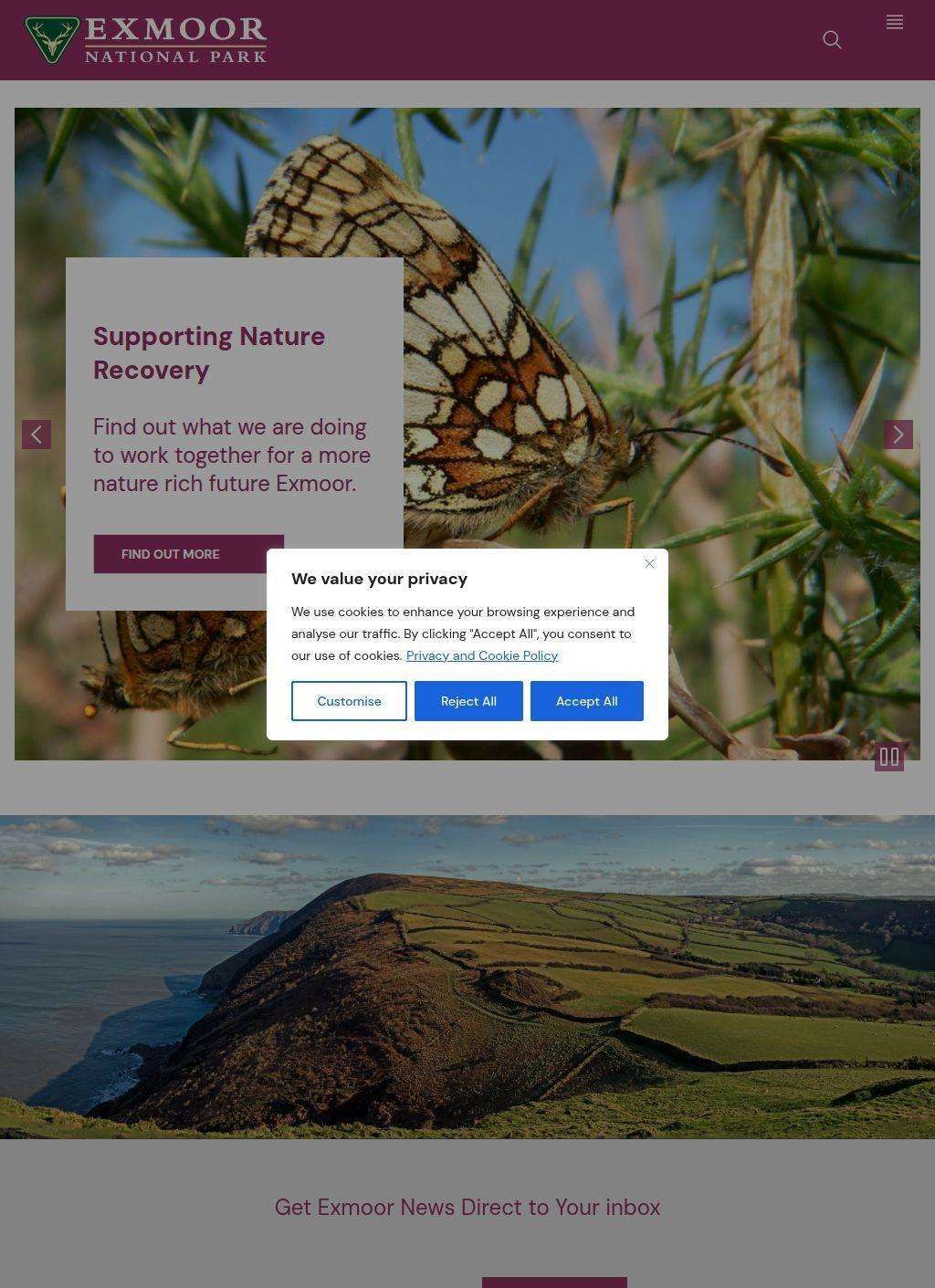
Farming in Protected Landscapes, the programme run through Exmoor National Park Authority, has put more than 1.2 million pounds into projects across the park, money that has gone toward habitat restoration, hedge laying, orchard creation, river and wetland work, and the kind of farmyard improvements that rarely make headlines. That single figure tells you a fair amount about what Exmoor National Park Authority does day to day. This is the statutory body that governs roughly 693 square kilometres of moorland and farmland straddling Somerset and Devon, and the website reflects that split between practical land management and public access in a way that feels honest about its priorities.
Funding habitat restoration and farmland projects
Exmoor National Park Authority became a freestanding body in 1997, and the site reads like one: a working public organisation that has had decades to accumulate responsibilities. The DEFRA-funded grant scheme is administered here, which means farmers and land managers looking for support on a specific project can find the programme details, the eligibility, and the categories of work that qualify. Community-supported agriculture sits alongside river improvement and wetland restoration in the list of fundable activities, which gives a sense of how broadly Exmoor National Park Authority interprets its conservation remit. The breadth is deliberate. By funding a hedge, a wetland, and a working farmyard as equally worthwhile, Exmoor National Park Authority treats the park as a lived-in landscape, not a museum.
Planning applications and development management
A large share of the site is given over to the development management function, and this is where Exmoor National Park Authority behaves most like the regulator it is. Planning applications are handled here, pre-application advice is offered, and enforcement falls under the same umbrella. For anyone who owns land inside the park boundary, or is thinking about building or altering anything within it, this is the part of the site to read first, since Exmoor National Park Authority is the planning body for that area.
The Exmoor Local Plan covering 2011 to 2031 is published in full, with its policies, its stated vision, and an online policies map that lets you check how a particular parcel of land is designated. That map is genuinely useful. Instead of reading paragraphs of policy and trying to work out whether they apply to a given field or building, you can look it up directly. The Planning Policy and Community Team prepares and monitors these documents, and the site explains that all land use within the park comes under that remit, which removes a lot of the guesswork about who decides what.
What I appreciate about this section is that it does not pretend planning is simple or welcoming. It is procedural, it is detailed, and the site treats visitors as people who need accurate information to comply with rules, not as customers to be charmed. For a regulatory function that is the correct tone.
Mapping rights of way with current aerial imagery
On the public-facing side, the Plan Your Visit section covers accommodation, travel, and the practical essentials for getting onto the moor and finding your way around. None of this is unusual for a national park, but the execution is better than the generic version. The interactive Access and Recreation Map is the standout. It layers Public Rights of Way over Permissive Paths, marks gates and signs, and even includes 2024 aerial photography, so you can see the actual terrain rather than a stylised diagram.
One telling detail: the map shows gates and signs that are available for sponsorship. That is the sort of thing only an organisation actually maintaining the infrastructure would bother to surface, and it quietly confirms that Exmoor National Park Authority owns and maintains the physical fabric of access across the park. The 2024 aerial layer also dates the material in a reassuring way, since it shows the mapping is kept current instead of left to drift.
For a walker or rider planning a route, the combination of rights of way, permissive paths, and recent aerial imagery is close to everything you would want before setting out. It is the kind of resource that saves a printed map and a guidebook, and it is free to consult on the site.
Beyond mapping, the visitor pages handle the ordinary questions of where to stay and how to get there, which keeps the practical and the regulatory sides of the operation under one roof without letting either crowd the other out.
Nature recovery through farming partnerships
Nature recovery runs through much of what Exmoor National Park Authority publishes, and it is framed as landscape-scale work done in partnership with farmers, land managers, conservation bodies, and local communities. Exmoor National Park Authority chairs the Nature Friendly Farming Project, which fits the pattern of an organisation that coordinates as much as it directs. On a working landscape where most of the land is privately farmed, that collaborative posture is realistic. Conservation here depends on the people who own and work the ground, and the site reads as though Exmoor National Park Authority understands that dependency rather than papering over it.
Committee structure and public access forum
The governance material is more thorough than most public bodies bother to make accessible. The Committees and Meetings section lays out the full committee structure, the strategies, and the policies, and there is a public Access Forum that advises specifically on open-air recreation access. That forum is worth noting because it gives the public a documented route into decisions about how the moor can be used, which is the sort of transparency that an organisation could easily bury and Exmoor National Park Authority chooses instead to publish. Publishing strategies and policies alongside the meeting structure means a parish councillor or a curious resident can follow a decision from the committee that made it back to the policy it rests on.
Learning programmes led by named staff
Learning and engagement has a named lead, Ben Totterdell, managing it, and the children's educational sessions are documented on the site. Naming the manager is a minor thing, yet it makes the function feel staffed and accountable instead of abstract. Schools and families looking at what the park offers younger visitors can see that there is an actual programme behind the heading.
Taken together, the conservation, governance, and learning strands show Exmoor National Park Authority doing several quite different jobs at once: regulator, grant administrator, landowner liaison, educator, and keeper of public access. The site manages to hold all of those without one swamping the rest, which is harder than it looks for a body with this range of duties.
The audiences split fairly cleanly. Farmers and land managers come for the grant programme and the planning policy. Walkers, riders, and holidaymakers come for the access map and the visit planning. Researchers, parish councillors, and anyone tracking how the park is run come for the committee papers and the Local Plan. Teachers and parents come for the learning sessions. The site serves all of them from a single structure, and the navigation broadly respects those different reasons for arriving.
If there is a limitation, it is the one inherent to any organisation of this kind: the material is dense, and a casual visitor wanting nothing more than a pretty picture of the moor and a car park location will have to wade past a lot of statutory content to get there. That is a fair trade. The depth is the point, and the visitor planning is still there for people who want only the basics.
The 1.2 million pounds in allocated grants, the 1997 establishment date, the 693 square kilometres under its care, the 2011 to 2031 plan period: these are the concrete markers of a body that has been doing detailed, unglamorous work across two counties for a long time. The website does not dress any of it up. It lists what Exmoor National Park Authority does, publishes the documents that prove it, and leaves the moorland to speak for itself.
Business address
Exmoor National Park Authority
Exmoor House,
Dulverton,
Somerset
TA22 9HL
United Kingdom
Contact details
Phone: 01398 323665