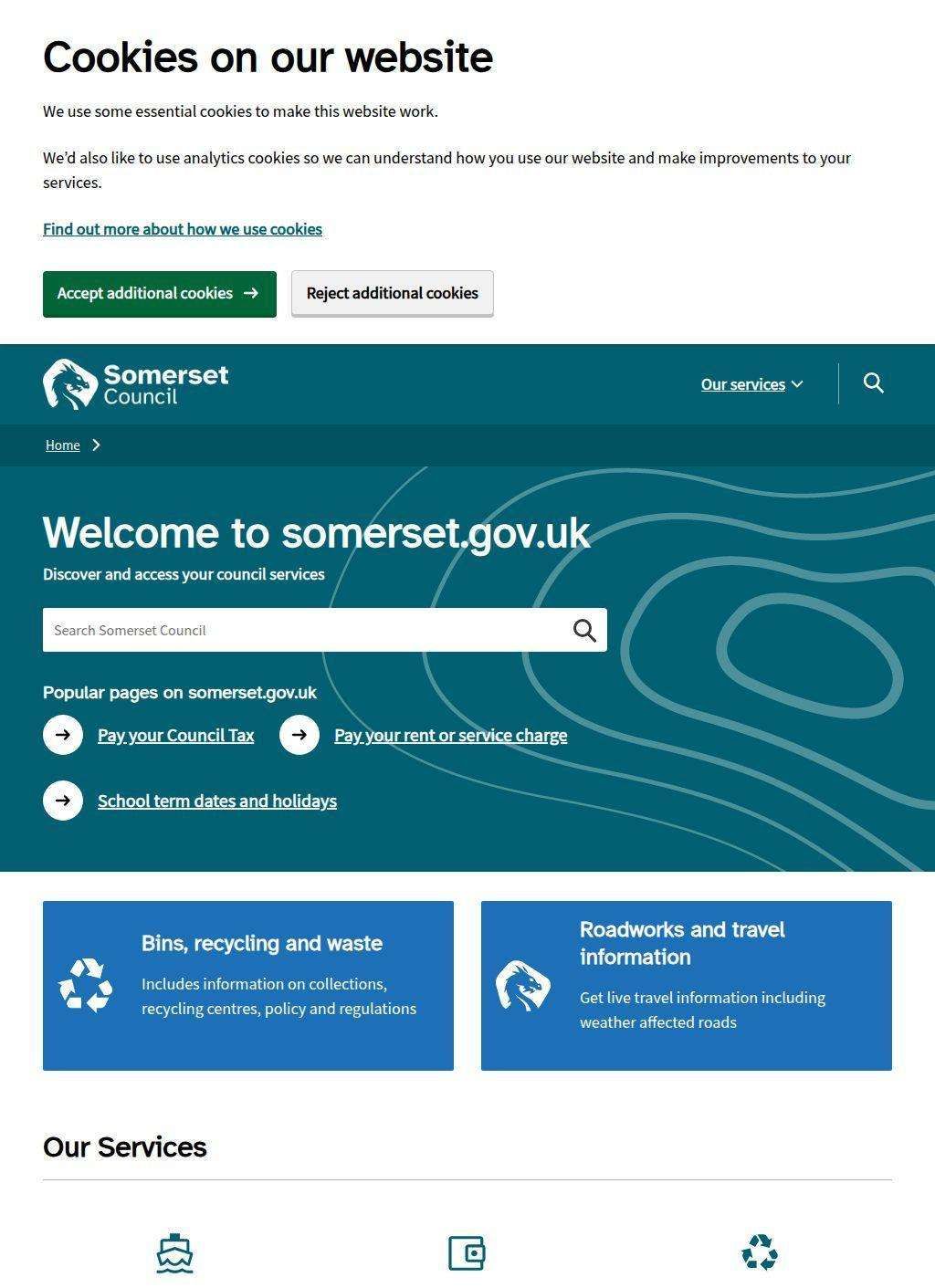
Type your postcode into the bin day lookup on the homepage and you get back your exact collection schedule, which is the sort of small, practical thing that tells you what Somerset Council is built to do. The same page pushes you straight toward paying council tax or checking whether you need planning permission, and those three shortcuts sit at the top because they are what most people arrive looking for. Somerset Council runs a working tool for managing the daily business of a county, and the site behaves accordingly.
Five councils merge into one authority
The body responsible for all of this is relatively young in its current shape. In April 2023 four district councils (Mendip, Sedgemoor, Somerset West and Taunton, and South Somerset) folded together with the old Somerset County Council into a single unitary authority. That history matters for anyone using the site, because services that used to be scattered across five separate websites now have to live under one roof, and the spread of more than twenty service categories reflects how much was pulled together. Council tax, benefits, waste, planning, highways, schools, adult care, registrations, libraries, business support, coastal and flood matters, and community services all hang off the one structure.
Council tax payments and benefit claims
Council tax is the section people return to most. Somerset Council lets you pay, set up a direct debit, and apply for discounts or exemptions without phoning anyone, and the benefits area runs alongside it with housing benefit, council tax support, and routes into housing needs and homelessness help. Putting the support claims next to the payment tools is sensible, since the people applying for council tax support are often the same people working out how to pay the bill in the first place.
Reporting waste, applying for planning permission
Waste handling is the everyday workhorse. Beyond the bin day lookup there is information on recycling centres, a way to report fly-tipping, and the environmental health function. Planning sits a notch up in complexity: you can submit and track applications, deal with building control, and order land charges searches, which covers both the resident putting in a small extension and the developer or conveyancer doing professional work. The planning permission enquiry getting its own homepage shortcut is a clear sign of how much traffic that single question generates, and Somerset Council has evidently noticed.
Roads, travel updates and flood risk
Transport and highways get real attention too. Roads and roadworks reporting, parking, and live travel updates for weather-affected routes are all there, and that last item is genuinely useful in a county with rural roads and a flood-prone coast. The coastal and flood section backs this up with beach and port management, flood risk information, and waterways content, which is not boilerplate for somewhere like Somerset where flooding has a long and serious local history. Somerset Council appears to have treated these as core services rather than afterthoughts.
School admissions, adult social care support
Families and education form one of the heavier parts of the site. School admissions, a childcare finder, term dates, children's social care, and SEND support are grouped together, and the adult social care section carries the same weight: care assessments, direct payments, support for carers, and mental health services. These are the areas where a council's website stops being a convenience and starts being a lifeline, and the fact that Somerset Council has laid them out as plainly as the bin schedule says something about its priorities.
Registering births, deaths, marriages
Registration services cover births, deaths, marriages, civil partnerships, and ceremonies, the official paperwork that bookends most people's lives and that can only really come from one place. Somerset Council keeps this section straightforward, and the absence of unnecessary gates or detours is welcome given that people accessing it are often under some kind of pressure.
Somerset library network, business support, community services
The lighter material is present without crowding out the essentials. The Somerset Library network has an online catalogue, the business services area runs economic development, licences and permits, and grants, and there is a community strand covering leisure, tourism, volunteering, and community safety. None of it feels like padding, because each piece points to a real function Somerset Council performs.
A few extras round things out. There is a searchable jobs board for council vacancies, e-newsletter subscriptions you can pick by topic so you only hear about what concerns you, and an accessibility statement, which on a site this large and this obliged to serve everyone is a baseline requirement that has genuinely been met. Topic-based newsletters are a small kindness on a site that could easily flood subscribers with everything at once.
Extra services, job vacancies and newsletters
What you do not find here is salesmanship, and that is correct for what this is. Somerset Council does not need to persuade anyone to use it; if you live in Somerset, this is where the council tax goes, where the planning application gets decided, and where the care assessment starts. The test for a site like this is whether it makes those unavoidable tasks faster, and the homepage shortcuts plus the breadth of self-service options mean it mostly does. The merger could have produced a tangle of inherited systems; what it produced instead is a single front door covering everything from a bin collection to a child's SEND support.
Can Somerset Council keep this coherence?
The breadth is the strongest thing about Somerset Council online, and also the hardest thing to maintain. Twenty-plus categories spanning life-and-death social care, statutory planning duties, and the mundane reality of waste collection is a lot to keep accurate and current across one website. The structure on display handles it well enough that most residents can land on the homepage and reach what they need in a couple of clicks, which for an organisation of this scale is a real measure of success. Whether Somerset Council stays this coherent as it keeps absorbing and rationalising the services of five former bodies is the open question, and the answer will show up not in any statement but in how the planning tracker, the care assessment routes, and the next round of bin day lookups actually perform over time.
Business address
Somerset Council
County Hall, The Crescent,
Taunton,
Somerset
TA1 4DY
United Kingdom
Contact details
Phone: 0300 123 2224