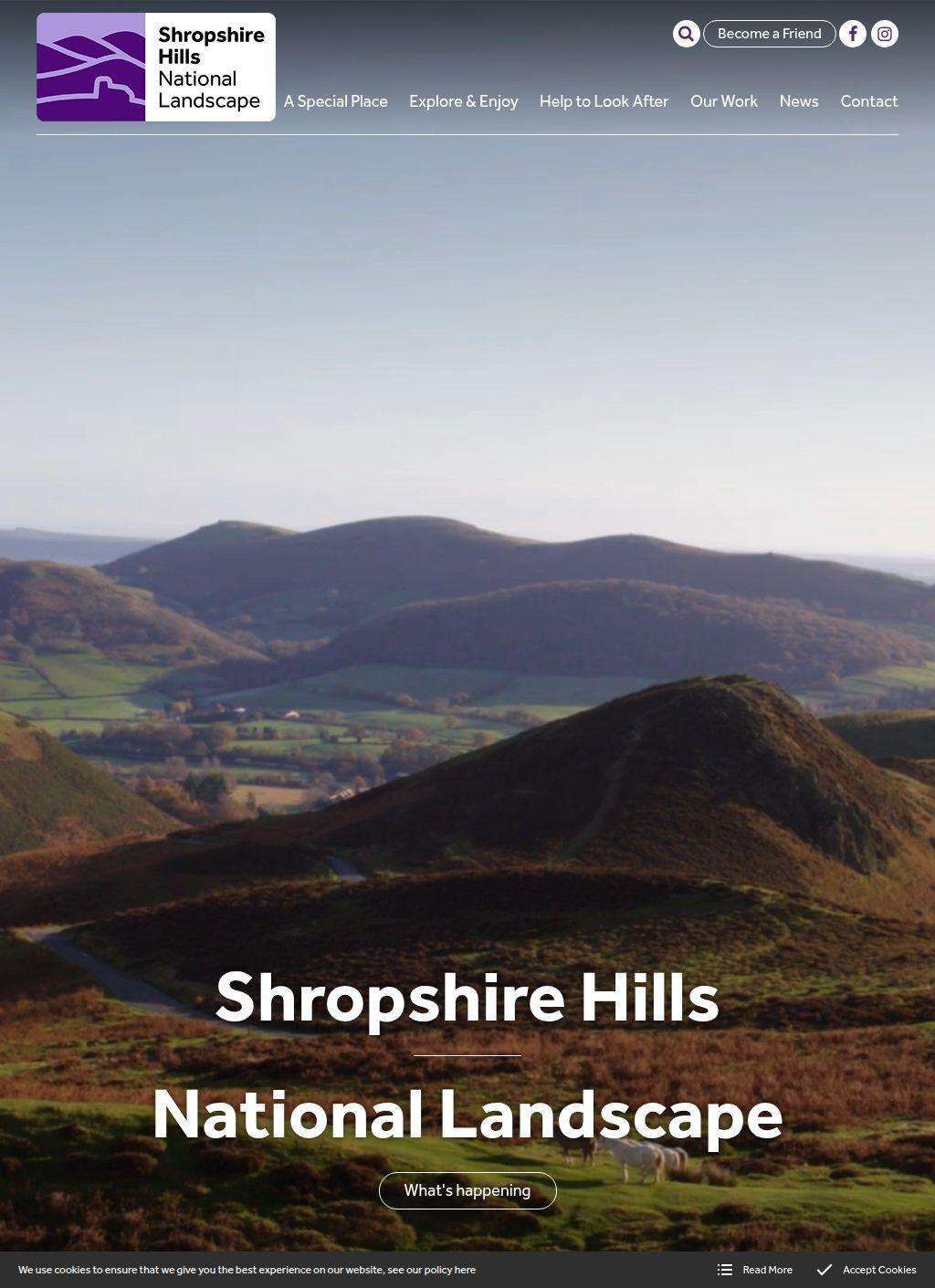
What does a National Landscape body actually put on its website beyond a mission statement? In the case of Shropshire Hills National Landscape, the answer is a working set of tools and information for the protected stretch of countryside that used to carry the Area of Outstanding Natural Beauty label. The site is run in partnership with Shropshire Council, and it works more like a desk where several different jobs happen at once: route planning for visitors, grant administration for farmers, conservation project records, and planning guidance for anyone proposing to build within the designated boundary.
That breadth is the first thing worth registering. The protected area covers the Long Mynd and the surrounding hill country, and Shropshire Hills National Landscape has to answer to walkers on a weekend, a farmer weighing up a heritage grant, a school looking for an outdoor learning visit, and a developer checking what the designation means for a proposed site. Each of those readers gets their own corner of the site, and the content is sorted to match. A listing in a business directory rarely conveys how much operational weight sits behind a public-body domain, and this is a site worth examining on its own terms.
Walking routes with interactive mapping
For visitors, the practical material does the heaviest lifting. There are walking and cycling guides paired with interactive mapping, so a route can be traced rather than just read about, and in country where a printed paragraph rarely tells you enough about gradient or access, that combination is genuinely useful. Anyone planning a day out on the Long Mynd or the wider hills can pull together a route, check where it goes, and judge whether it suits the group they are bringing. Shropshire Hills National Landscape has built this out to a point where Thursday-night planning for a Saturday walk produces real, specific answers.
Shuttle bus and visitor accommodation
One specific but telling detail: the shuttle bus information. A protected landscape that wants to cut car traffic on narrow lanes has a real interest in pointing people toward a bus, and Shropshire Hills National Landscape gives that service a page of its own. Visitor information and accommodation resources sit alongside, covering where to stay across the landscape area. None of this is dressed up. It is the sort of logistical content you check before setting off.
Practical information for day trip planning
Because the mapping and route guides are built around the actual terrain, the Shropshire Hills National Landscape site avoids the common fault of protected-area pages that describe scenery and forget to explain how to reach it. The practical and the descriptive go together. A reader gets the case for visiting and the means of doing it on the same pages, which is rarer than it should be on sites of this kind.
Farming in Protected Landscapes grants
The land-management side is where the official function of Shropshire Hills National Landscape shows most clearly. The organisation administers the Farming in Protected Landscapes scheme, the FiPL grant programme that funds local landowners and farmers for conservation, access, and heritage work. For a farmer inside the boundary, that programme is a concrete reason to come to this site, and Shropshire Hills National Landscape treats it as one of its core services. The detail on what FiPL can fund turns a vague idea of countryside support into something a landholder can act on.
Conservation projects with volunteer opportunities
Conservation work runs on several tracks. Shropshire Hills National Landscape documents ancient woodland restoration and nature recovery projects, and it runs volunteering and outdoor learning programmes for people who want to take part in the work directly. A Landscape Trust funding mechanism is described as a way to support wider conservation, giving anyone inclined to contribute a route in. These are not abstract pledges. They are named projects and named programmes, which is the difference between an organisation telling you it cares about the land and one showing you what it is doing on it.
Planning guidance for development proposals
Then there is the governance layer. Shropshire Hills National Landscape publishes landscape management plans broken down by region, plus planning guidance for development that affects the designated area. For a developer, an agent, or a parish considering a proposal, that guidance is the reference you need before a planning application goes in. Heritage and countryside site details fill out the picture, mapping what is being protected and why the designation exists. This is the spine of the operation, and the site does not hide it behind the visitor-facing pages.
What holds the two halves together is consistency of purpose. The recreation content and the conservation content are both shaped by the same designation, so the walking routes and the woodland restoration belong to one story about a single protected place. A reader who arrives for a cycle route and leaves understanding why grazing or woodland structure matters here has been served well by the structure, even without meaning to learn any of it.
News, events, educational resources
Beyond those two pillars, the Shropshire Hills National Landscape site hosts news, events, educational resources, and a public events calendar. The calendar is the practical anchor: it gives residents and visitors a reason to return and check what is happening, from guided activities to seasonal programmes. For schools, the educational and outdoor learning resources connect a classroom to a real protected landscape within reach, a stronger teaching prop than a textbook chapter. A maintained calendar and current news section are worth something because this is the part of a public-body site that goes stale fastest.
A search for Shropshire Hills National Landscape across the main review platforms returns no third-party ratings. That is not unusual for a statutory landscape body; people do not typically leave Google reviews for a grant programme or a planning guidance document. The absence reflects what the organisation is set up to do.
Audience and site navigation
It is worth being plain about who this site is not built for. A casual reader looking for a single famous viewpoint and a postcard will find more here than they wanted: the planning guidance, the grant scheme paperwork, and the regional management plans are written for people with a stake in the land, an audience that reads closely. That is not a flaw. It reflects what Shropshire Hills National Landscape is as an administering body with statutory and partnership duties. The website is honest about that mixed audience instead of flattening everything into tourist copy.
The range does carry one mild cost. With visitors, farmers, developers, schools, and conservation partners all served from the same place, a first-time user has to do some navigating to land in the right section. The trade-off is reach: one boundary, and a single site that tries to meet every legitimate reason a person might have to engage with Shropshire Hills National Landscape as a protected area.
Where farmers should start
A farmer or landowner whose ground sits inside or next to the designated boundary has the clearest reason to engage with Shropshire Hills National Landscape, and the obvious next step is to read the Farming in Protected Landscapes pages and consider what the FiPL grant could fund on their own holding. The programme exists for exactly that conversation, and the site lays out enough to start it.
How different users find relevant content
Walkers and cyclists planning time on the Long Mynd should head for the route guides and the interactive mapping, then check the shuttle bus details before driving in. Schools and community groups will find the outdoor learning and events material the most useful door, and anyone weighing a development proposal near the protected area ought to read the regional management plans and planning guidance before going further. Shropshire Hills National Landscape has sorted its content to match each of those purposes, and on that count it does the job well.
Business address
Shropshire Hills National Landscape
Unit 5, Drovers House, The Auction Yard,
Craven Arms,
Shropshire
SY7 9BZ
United Kingdom
Contact details
Phone: 01743 254740