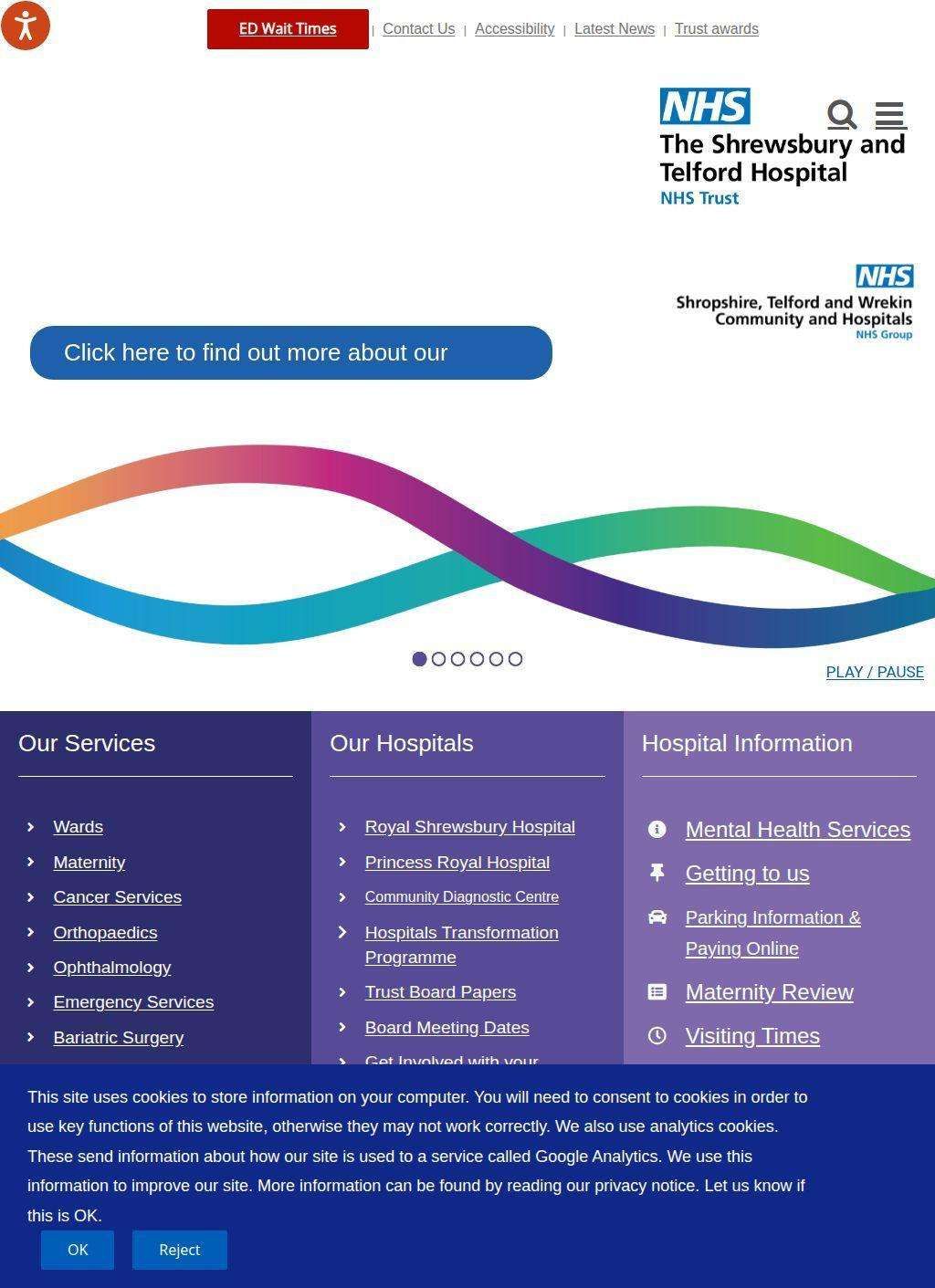
Split across two acute sites, Shrewsbury and Telford Hospital NHS Trust covers Shropshire, Telford and Wrekin out toward the Welsh border through the Royal Shrewsbury Hospital on one side of the county and the Princess Royal Hospital in Telford roughly twenty minutes away by road. That geography is the whole shape of the organisation. A Community Diagnostic Centre rounds out the estate, taking on scans and tests that would otherwise pile onto the two main buildings. Anyone trying to work out where to go for a particular procedure runs into that two-site reality straight away, and the website built by Shrewsbury and Telford Hospital NHS Trust is arranged around helping people sort out which hospital they need.
Services across two hospital sites
The clinical range is wide in the way you would expect from an acute trust, not a specialist unit. There is an A to Z directory of services, and walking it tells you more than any summary line could. Emergency care and maternity sit alongside cancer services, orthopaedics, ophthalmology, and bariatric surgery, with referral routes into mental health care as well.
A to Z directory of clinical services
It is general acute medicine plus a handful of areas where Shrewsbury and Telford Hospital NHS Trust has built out more depth. The A to Z format is a sensible choice for a hospital site, because most people arriving here are not browsing. They have a letter from a consultant or a specialty name in their head and they want the page that matches it. The directory rewards that kind of targeted arrival, which is the only kind a hospital site really gets.
Patient portal, parking, visiting information
Practical logistics get real attention, and a hospital is one place where getting them right has direct consequences. There is a patient portal for accessing appointments online, and the site carries supporting detail that turns a hospital visit from stressful into merely tedious: visiting rules, parking information, and how to find your way around two separate campuses. These are the things people genuinely search for the night before an appointment, and Shrewsbury and Telford Hospital NHS Trust keeps them within a click or two of the main pages instead of tucking them behind the clinical directory. Putting parking and visiting hours where a worried relative can find them quickly is a small consideration with an outsized effect, and plenty of larger sites get it wrong.
Accessibility support including British Sign Language
Accessibility provision is handled with more care than a token statement. British Sign Language support is named directly, which tells you that Shrewsbury and Telford Hospital NHS Trust treats access as a service to deliver and not a box to tick. For a body that serves a large rural catchment with an older-than-average population in places, getting the supporting information right is a big part of the actual job. The portal also shifts some of the appointment admin online, easing pressure on phone lines that any NHS trust struggles to keep staffed.
Urgent care is routed sensibly. The site points people toward NHS 111 for non-emergency advice, which is exactly the steer a hospital should give to keep its emergency departments for genuine emergencies. It reads as a small thing on the page but a meaningful one in practice, since the two A and E departments run by Shrewsbury and Telford Hospital NHS Trust carry the load for a wide and thinly populated area.
Hospitals Transformation Programme opening in 2028
The biggest forward-looking item is the Hospitals Transformation Programme, a capital scheme described as a multi-million pound investment with a planned opening in 2028. This is where the two-site model gets interesting, because a programme of that scale usually means reshaping which services sit at which hospital. For patients in Shropshire and Telford, that is not abstract. It can change where you go for emergency care or planned surgery, and those decisions tend to be felt keenly in communities that are protective of their local hospital.
How will the trust maintain service quality during rebuilding?
Shrewsbury and Telford Hospital NHS Trust states its values as Partnering, Ambitious, Caring, and Trusted, and a transformation of this size is where words like those stop being decoration and start being tested. Building new facilities is the visible part. Keeping two existing hospitals running safely while the work proceeds, and carrying staff and patients through years of disruption, is the harder part that no website can fully convey. The 2028 date gives a horizon, though anyone who has watched large NHS capital projects knows those horizons can move.
What the site does well is treat the programme as ongoing rather than finished. Presenting it openly is the right call from Shrewsbury and Telford Hospital NHS Trust, because a project that reshapes care for an entire county deserves to be visible to the people it will affect.
Read as a whole, the website does the core job an acute trust's site should do. It tells you which of the two hospitals to attend, lists the services in a form people can navigate under stress, handles parking and visiting and access, and points urgent-but-not-emergency cases toward NHS 111. Shrewsbury and Telford Hospital NHS Trust is the main acute provider for its corner of the West Midlands and the Welsh Borders, and the site reflects that responsibility without dressing it up. There is little gloss here, which feels right for the subject. A page about where to take a sick relative does not need flourish, and Shrewsbury and Telford Hospital NHS Trust has resisted adding any.
The harder questions sit in the years ahead rather than on the page itself. The Hospitals Transformation Programme promises a great deal for 2028, and the values printed alongside it set a high bar. Whether Shrewsbury and Telford Hospital NHS Trust can hold service quality steady across two strained hospitals through the disruption of rebuilding is unresolved, and whether that 2028 opening holds firm or slips the way large NHS projects often do will define this trust more than anything currently published. The published record shows clearly stated ambition and operational groundwork already in place: an accessible portal, sensible triage routing, detailed logistical information for two separate sites. That is a reasonable foundation, and it is the most a website can honestly offer before the construction work speaks for itself.
Business address
The Shrewsbury and Telford Hospital NHS Trust
Royal Shrewsbury Hospital, Mytton Oak Road,
Shrewsbury,
Shropshire
SY3 8XQ
United Kingdom
Contact details
Phone: 01743 261000