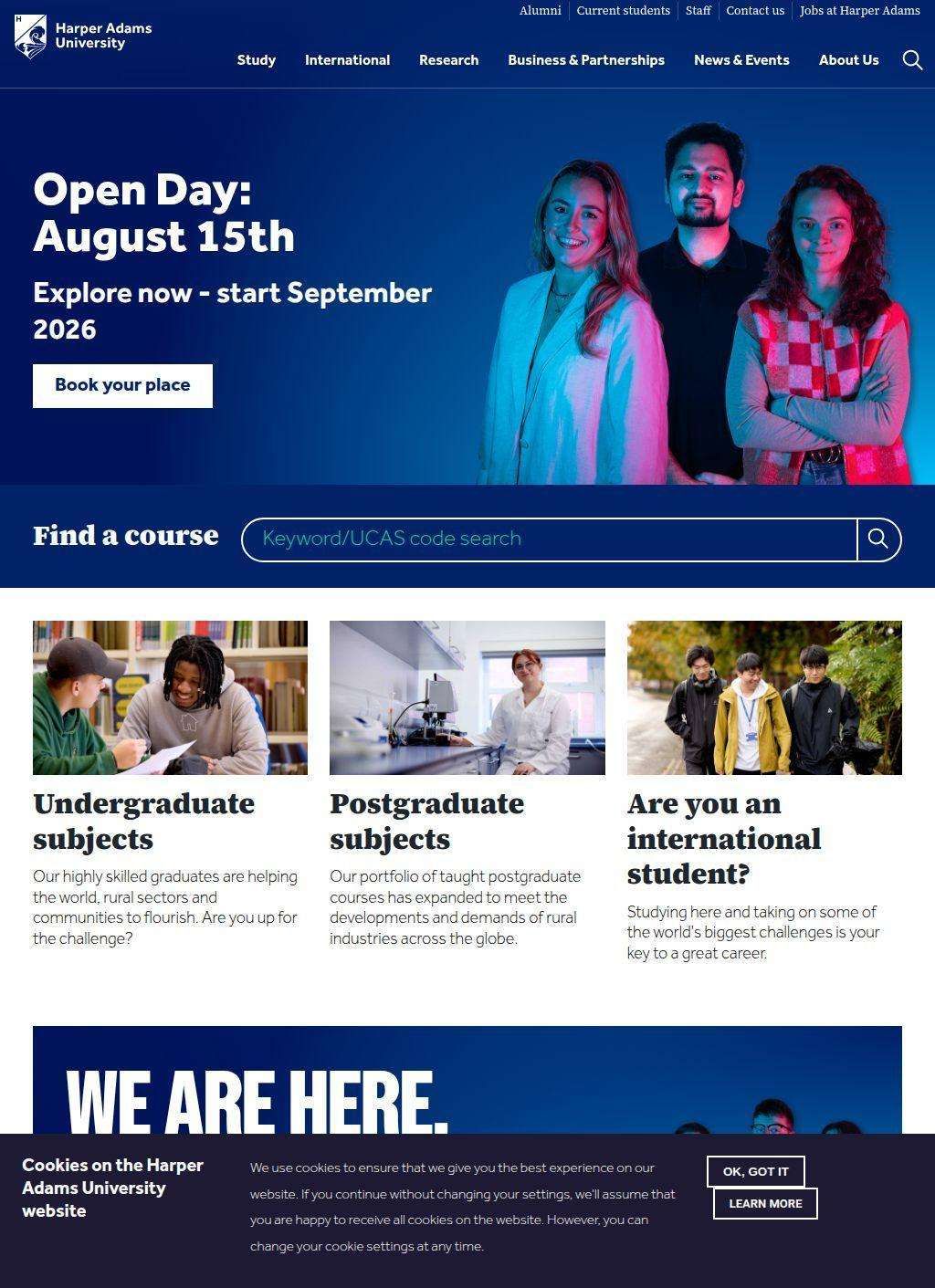
Harper Adams University runs a working commercial farm in Newport, Shropshire, and uses it as the backbone of everything the institution does. Students do not read about crop rotations or livestock systems in isolation from the land; they work on land that is being farmed for yield and for data simultaneously. Agricultural education with mud on its boots, not a theoretical module bolted onto a generic science faculty and left to manage without real land.
Learning on a working farm
The university is narrow by design, and that narrowness is the point. Its remit covers agriculture, food, land management, veterinary nursing, and the applied sciences that sit alongside them. Degrees run across agri-food, animal science, crop science, countryside and environmental management, and rural business management. The engineering side has moved with the industry, taking in agri-tech and robotics instead of treating farming as a fixed craft. For a sector now running on sensors, autonomous machinery, and tighter environmental regulations, that breadth inside a tight specialism is hard to find replicated at a general university where these subjects compete for attention against everything else on the prospectus.
Specialist degrees in agriculture, food, land management
Entry routes are more flexible than the headline figures suggest. Undergraduate programmes include foundation year options for students coming from land-based colleges or from work instead of a conventional A-level path. Above that sit postgraduate taught courses and research degrees up to MPhil and PhD level. The degree apprenticeships fold paid work and study together, and for people already embedded in farming or the food supply chain that combination is often the only realistic route to a degree without stepping away from employment. Continuing professional development through short courses and BASIS-accredited training keeps the door open to practitioners who need a specific qualification rather than another full programme.
Flexible entry routes for diverse backgrounds
Research is concentrated, not scattered across unrelated fields. The Crop and Environment Research Centre runs work tied directly to what the farm and the wider sector face, and Harper Adams University positions itself as a partner for commercial research and knowledge transfer with industry. I find that pairing more convincing than institutes that publish into a vacuum, because the questions are coming from people who have to live with the answers. The on-campus farm gives that research somewhere to be tested at real scale, closing a loop that applied science departments in larger universities rarely manage.
Research tied to industry problems
Trial plots, soil work, and livestock studies all sit a short walk from the lecture rooms, so a finding can move from hypothesis to field and back inside a single growing season instead of waiting on a partner site somewhere else. That proximity is unusual, and it shapes what the place can credibly teach about how new methods behave once they leave the page.
Campus facilities support rapid testing
Student support and placement are woven into the institutional model rather than tagged on. Halls of residence sit on site, alongside library and learning support, disability services, a Students' Union, and a careers operation that shapes how the courses themselves are built. Harper Adams University claims the top UK ranking for graduate career prospects in the WhatUni Student Choice Awards for nine consecutive years through 2025. Nine years in a row is a pattern, not a single good cohort. A long industry placement built into a degree is the kind of thing employers in this field reward, and that consistency in the outcomes table suggests the model is producing what it claims.
International applicants get a defined route in, with visa guidance and stated English language requirements laid out plainly. Agriculture and food security are global problems, so drawing students from beyond the UK fits the subject as much as it fits the recruitment numbers. Harper Adams University is not trying to be a comprehensive institution with a cosmopolitan campus; it is trying to be the best place in the country to study food and land, and the international offer reflects that same focus.
A prospective student weighing Harper Adams University against a large multi-faculty institution, such as the University of Nottingham, which also runs a respected agriculture and veterinary offering inside a much bigger campus, is really choosing between depth and breadth. Nottingham gives you a sprawling university with dozens of unrelated subjects, a bigger city, and the option to drift into something else.
A specialist site in rural Shropshire does not offer that. What Harper Adams University offers in return is a place where the farm, the research centres, the placement network, and the teaching all pull in one direction, with no competing departments diluting the culture or the resources. The graduate outcomes back that up. Someone still hedging across fields will probably be better served by a bigger institution; someone certain about farming, food, land, or veterinary nursing will find Harper Adams University difficult to beat on the evidence available.
Business address
Harper Adams University
Edgmond,
Newport,
Shropshire
TF10 8NB
United Kingdom
Contact details
Phone: 01952 820280