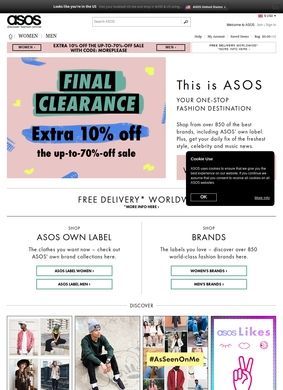
More than 850 brands sit alongside an in-house label on a single site, which is the quickest way to understand what Asos is trying to be: the place where a shopper can pick up Nike or Adidas trainers, a Calvin Klein top, an old Topshop piece and a fully own-designed outfit without leaving one checkout. The London-based retailer covers womenswear, menswear and gender-neutral ranges, and it ships to over 200 countries and territories. That reach shows up in the way the site splits into local storefronts for the US, UK, Australia, France, Germany, Italy, Spain and Russia, so prices, currency and delivery options match where the buyer is, with no defaulting to a single global template.
Own-brand lines for different body types
The own-brand side is worth slowing down on. The house label, Asos Design, anchors a set of body-specific lines: Curve, Tall, Petite and Maternity. These are not afterthought sub-lines tucked away. They map to real bodies and real situations, and the sizing follows through: the range runs from US 0 to 30+ and UK 4 to 30+. A fit assistant tool tries to reduce the guesswork of ordering online, because you cannot try anything on before it arrives. For anyone who has spent years caught between standard sizes, that breadth is the difference between browsing and buying, and it looks like a deliberate choice with no marketing claim bolted on after the fact.
Fit assistant tool reduces ordering uncertainty
The inclusivity extends beyond the own labels. Because the catalogue stretches across hundreds of outside brands, a shopper can compare cuts and fits from several makers in a single search, which is hard to do on a single-brand site. The beauty range and the Face + Body section sit beside the clothing, so a basket can mix a jacket, a pair of trainers and skincare in one order. Treating fashion and grooming as one shopping trip is a small thing on paper, yet it reflects how the target buyer tends to shop in practice.
Shopping across brands in one search
Stocking hundreds of outside labels is a balancing act. A retailer can easily become a pure reseller that carries the same names as every other shop on the internet. Asos sidesteps that by putting its own product next to the big names, not behind them. A Nike or Adidas listing can sit on the same results page as an Asos Design piece at a lower price, and the buyer decides. The beauty and Face + Body sections extend the same logic into skincare and cosmetics, pulling the site past a purely clothing-focused offer.
Beauty and grooming alongside clothing
The navigation is built around how people shop in seasons and moods, not internal departments. New In is where the constantly refreshed stock lands, Sale and Outlet are where last season goes, and Activewear pulls the sportier pieces into one place. It is a familiar structure, but it is executed without friction, and the local storefronts mean a German shopper and an Australian shopper see the same architecture filled with stock and pricing that make sense for them.
Navigation built around seasons and moods
One feature that often gets overlooked is Asos Marketplace, a separate platform where independent boutiques and vintage sellers list their own goods. Vintage and small-label clothing is genuinely hard to find at scale, and folding that supply into the wider operation gives shoppers a route to pieces the main catalogue would never carry. It is a meaningful extension of what Asos does, not a side project that looks good in press releases.
Asos Marketplace for vintage sellers
Free returns in several markets cut a significant chunk of the risk that comes with ordering clothes you cannot feel first. Next-day delivery is offered as a paid option, and for people who order often there is Asos Premier, a subscription that turns unlimited next-day delivery into a flat annual cost. For a regular buyer, that maths tips quickly in favour of the subscription, and it changes the relationship from one-off purchases to something closer to a habit. The whole returns-and-delivery setup reads as built for a market where shoppers order several sizes, keep one and send the rest back.
Delivery options and return policies
The local storefronts handle this per market rather than applying one global policy. A buyer in Spain or Italy sees delivery windows and return terms that apply to them directly, not a US default with a page of caveats. Details like that separate a retailer that genuinely ships worldwide from one that accepts foreign cards and leaves buyers to work out the rest themselves.
Student discounts through verified programs
Students get their own lane through a discount program run via Student Beans and UNiDAYS. It is a sensible fit, since the price-conscious, trend-led shopper is exactly who Asos is built around, and a verified discount keeps that audience coming back. None of these perks are unusual in isolation, but together they answer the practical questions a shopper has before a first order: how it gets here, how it goes back, and whether there is a way to pay less.
Public company status and customer reviews
Asos is a public company, listed on the London Stock Exchange under the AIM ticker ASC. That status places the operation under reporting obligations and a level of scrutiny that a privately held web shop does not face, which is a useful thing to know about a site asking for card details and an address. Outside reviews on Trustpilot run into the tens of thousands of ratings, so there is a public record to read through before ordering.
Taken together, the operation reads as a fashion business that knows its core buyer: young, online-first, watching prices, shopping across hundreds of brands and several body-specific ranges in one place. The own-label depth, size inclusivity, a marketplace for harder-to-find pieces and a delivery subscription cover the whole arc from browsing New In to sending something back through free returns. Day-to-day experience depends on stock availability and individual delivery, but the architecture is built for exactly that kind of repeat buyer.