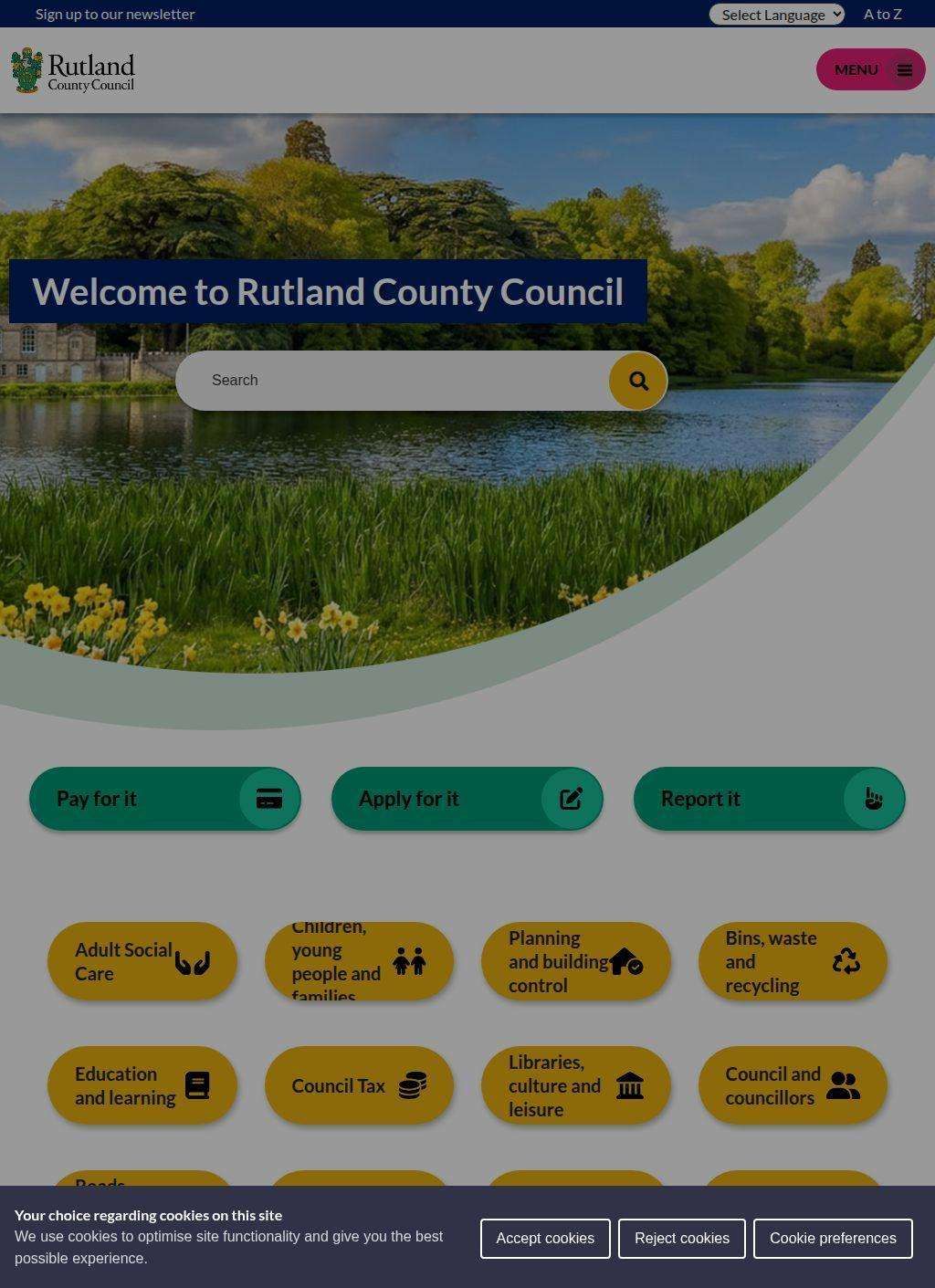
Rutland County Council is the unitary local authority for Rutland, the smallest county in England, with Oakham as its administrative centre. Its website is built around the everyday business of running that county, and it sorts almost everything residents need into three plain action verbs: Pay for It, Apply for It, and Report It. That framing tells you what the site is for before you read a single service page. Someone arriving to settle a council tax bill, flag a missed bin, or apply for a service does not have to learn the council's internal structure first.
Services organized by resident action
The service coverage is what you would expect from a body that handles both county and district functions in one place, which is the point of a unitary council. Adult Social Care sits alongside Children, Young People and Families. Planning and Building Control runs as its own portal for submissions and consultations. Then there is Bins, Waste and Recycling, Council Tax payments and applications, Education and Learning, Libraries, Culture and Leisure, Roads, Transport and Parking, Elections and Voting, Housing, Benefits and Support, Health and Wellbeing, Community Safety, Licensing, and the registration of Births, Deaths and Ceremonies.
The breadth is the whole job of local government compressed into one domain, and Rutland County Council does not appear to farm any of it out to a separate site. Keeping county-level care and district-level services such as licensing and waste under a single roof is part of what makes a unitary authority worth the structure, and the site reflects that consolidation rather than fighting it.
Unifying county and district functions
A few pages go beyond placeholder status. The waste section reflects a real operational change: weekly food waste collections began in March 2026, and a website that keeps its bin information current is doing the thing most residents will judge it on. The MyAccount portal is the spine of the self-service idea, letting people manage their dealings with Rutland County Council in one login instead of chasing separate forms. Planning, by contrast, runs through its own dedicated route, which makes sense given how different a planning application is from paying a bill, though it does mean the unified portal stops short of covering quite everything.
MyAccount portal and planning submissions
What lifts the site above a bare list of statutory duties is a layer of community-facing material. The Rutland Information Service works as a local sub-directory of community services aimed at residents and families, signposting people toward help the council itself does not always deliver directly. By hosting it, Rutland County Council acts as a hub for the wider support network in the county, covering ground beyond its own statutory functions. The Community Small Grants scheme funds local health and wellbeing projects, and publishing it on the main site rather than burying it keeps it findable for the small groups most likely to apply.
Community services and local grants
There is also evidence the council uses the site to report on what it is doing, treating it as something more than a transaction terminal. Callconnect, a demand-responsive transport service, is cited as having carried more than 19,300 passengers in its first year, which is a concrete number for a rural county where fixed bus routes do not reach everyone. A Medequip equipment return bin at Rutland Memorial Hospital gets a mention too, a small logistical detail but a useful one for anyone holding borrowed mobility kit. These are the sorts of items that show Rutland County Council treats the website as a live channel, updated as services move, not a static brochure that was set up once and left.
Reporting operational updates to residents
Democratic transparency is handled in the conventional way, and handled properly. Dates and papers for public meetings, covering full Council, committees, and other bodies, are published so residents can read what is being decided and when. For a council this size, the gap between the authority and the people it serves is short and the meetings are genuinely local, so published records translate into something residents can act on. Where a larger metropolitan body can feel remote, Rutland County Council sits close enough to its electorate that published agendas are something neighbours might actually read before turning up. The jobs section lists current vacancies, which doubles as a recruitment tool and as a quiet indicator of where the council is investing staff.
How are meeting records and jobs published?
Accessibility gets a practical nod through Rutland County Council offering translation support for more than fifty languages. Rutland is not a large or especially diverse place, so this reads less as a headline feature and more as a baseline expectation that public bodies now meet. Rutland County Council meets it without fuss, which is the right call.
Translation support across fifty languages
Taken as a whole, the Rutland County Council site does the unglamorous work competently. It is organised around what people come to do, it keeps its service information aligned with actual changes on the ground, and it carries the community and democratic material that a county council ought to host. The jobs and recruitment pages round that out, giving the site a function beyond pure service delivery. The architecture favours getting a task done over telling you how clever the design is, and for a government site that is the correct priority. Nothing here reads as a county trying to look bigger than it is; the tone fits the smallest county in England.
Testing service depth beyond the homepage
The open question is depth versus surface. A site can present every service category cleanly and still leave a resident stuck once they click past the landing page into the actual form, the actual eligibility rule, the actual queue. The three-verb structure and the MyAccount portal promise a clear path, but a review of this kind cannot show how the planning portal behaves under a contested application, how quickly a Report It submission turns into a fixed pothole, or whether the small grants process is as accessible as its billing.
What the published evidence does show is that Rutland County Council updated its waste services to meet a national mandate on schedule, invested in rural transport through Callconnect, and maintains its democratic records in a readable format. That is a reasonable baseline for a small county council, and the Rutland County Council site reflects it accurately.
Business address
Rutland County Council
Catmose House, Catmos Street,
Oakham,
Rutland
LE15 6HP
United Kingdom
Contact details
Phone: 01572 722577