Rutland County Museum is a free-admission local history museum in Oakham, the county town of England's smallest county, set inside a former Riding School on Catmos Street. The building itself is part of the appeal, but the reason to go is what fills it: the story of Rutland told through the objects people here used, farmed with, and dug out of the ground. The collection leans hard into rural life, with vintage agricultural machinery, tractors and carts taking up real space, alongside material tied to the "yellow Earl" and the wider sweep of Rutland's countryside heritage.
Archaeology and the Sea Dragon discovery
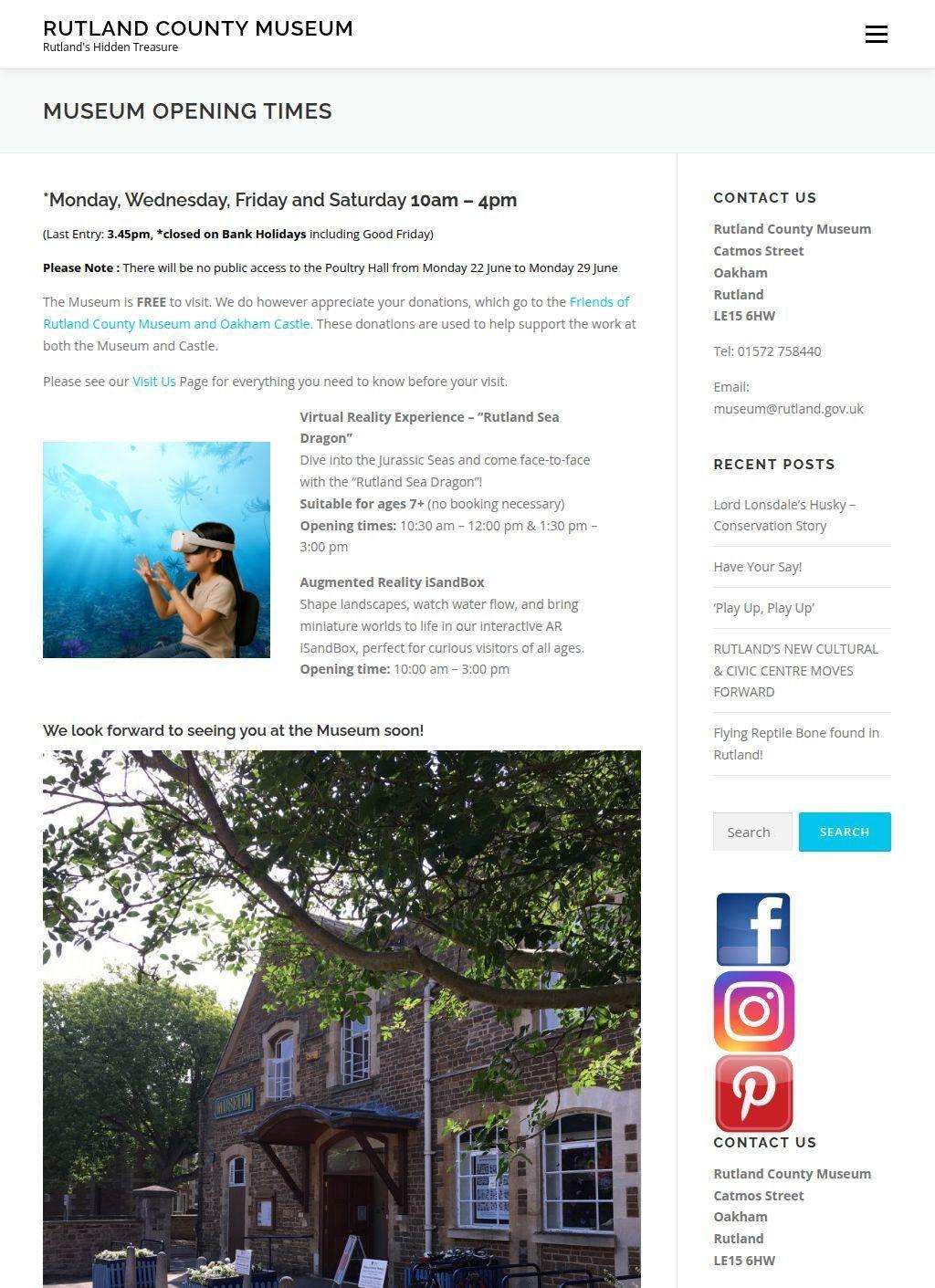
Archaeology and palaeontology give the place a second gear. The county made headlines for the Rutland Sea Dragon, a remarkably complete ichthyosaur, and that discovery has been turned into a Virtual Reality experience aimed at ages 7 and up, running in timed sessions late morning and early afternoon. There is also an Augmented Reality iSandBox, the kind of hands-in feature that tends to hold a child's attention longer than a wall of labels. I went in expecting the usual glass-case civic museum and found the tech sitting more comfortably beside the old farm gear than I assumed it would. Rutland County Museum also takes part in the Portable Antiquities Scheme, which is the system for recording finds the public turns up, so the local-archaeology focus is grounded in real, ongoing work rather than a one-off display.
Search the online collection
For anyone who wants to do more than browse, the website carries an online collection search, so it is possible to look up what the museum holds before setting out. That is a genuinely useful thing for a small institution to offer, and it points to cataloguing behind the scenes that is in decent order. The permanent displays cover local archaeology and palaeontology, the agricultural collection, and the broader cultural record of the area, which together make a coherent visit instead of a scattering of unrelated bits.
What happens in the VR session?
The Sea Dragon strand is plainly the headline draw at the moment, and the VR session is the way Rutland County Museum has chosen to bring a fossil that most people only know from a news photograph into something you can stand inside. Tying a national-news find to a permanent, repeatable visitor experience is a smart move for a venue this size, and it gives a return visit a reason to exist beyond the static cabinets. The sessions are timed and pitched at children of seven and up, so it works as a planned event in a visit instead of something you stumble across, which is worth knowing if you are travelling with a specific child in mind.
Workshops, exhibitions, school loan boxes
This is set up as a place to spend part of a day, not a ten-minute stop. The programme at Rutland County Museum runs to temporary special exhibitions, children's workshops during the school holidays, cinema screenings, and family events, so the calendar changes through the year. Schools are served directly through dedicated sessions and loan boxes, the latter being collections of objects teachers can borrow and take into the classroom, which extends what the museum does well beyond its own walls.
Facilities for visitors
The practical side is sensibly covered. There is a gift shop stocking locally made and museum-related items, a small walled garden to step into, a Visitor Information area, and a Local Studies Library for anyone chasing family or parish history in the area. Rutland County Museum holds VisitEngland's VAQAS quality accreditation, an external assessment of how a visitor attraction is run and presented, which is a fair bit more than a smaller county museum needs to bother with and a reasonable proxy for the standard of the visit.
Admission, opening days
Admission costs nothing, which lowers the stakes considerably for families weighing up a wet afternoon. One thing to plan around: the doors open on Monday, Wednesday, Friday and Saturday from 10am to 4pm, with last entry at 3:45pm and a close on bank holidays, so it pays to check the day before turning up instead of assuming a standard week.
Local focus over a national collection
What you do not get is a sprawling national collection, and that is the right call. Rutland County Museum stays tightly local, and the depth comes from how thoroughly it works one place and its history instead of spreading outward. The mix of serious archaeology, working farm history, a genuinely good fossil hook and a steady run of children's activity covers a wide age range without feeling padded. Free entry and a well-maintained accreditation mean Rutland County Museum is a low-risk choice for most visitors to Oakham, and the Sea Dragon angle alone makes it worth the detour for families with young children.
Business address
Rutland County Museum
Catmos Street,
Oakham,
Rutland
LE15 6HW
United Kingdom
Contact details
Phone: 01572 758440