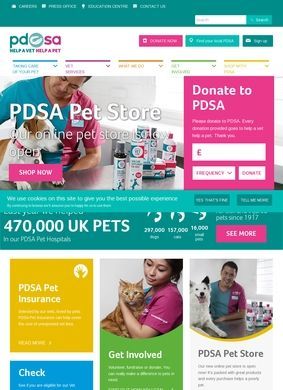
Pet owners who cannot afford private vet fees face a narrow set of options, and the Peoples Dispensary for Sick Animals has been filling that gap for over a century. It is a UK veterinary charity that provides free and low-cost treatment for animals belonging to people in financial hardship, and the site covers clinical care, health education, insurance, retail, fundraising and published research. That is a wide brief, and the front page reflects it honestly before you have scrolled far.
Clinical care across the UK network
The clinical work is the centre of what the Peoples Dispensary for Sick Animals does. Treatment and trauma care happen at a network of Pet Hospitals and clinics spread across the UK, and the site offers a locator so you can check whether one is within reach. For anyone weighing whether the Peoples Dispensary for Sick Animals can help in their part of the country, that tool answers the first practical question quickly: is there a clinic near me, and what does it handle. The focus is firmly on owners in financial hardship, which keeps the scope honest. This is not a general-access vet chain dressed up as a cause.
Finding a Pet Hospital or clinic near you
Around that core sits a layer of advice that anyone with a pet can use without ever needing a clinic. The Pet Health Hub carries health guidance, symptom information and educational material covering dogs, cats and rabbits, and on through guinea pigs and gerbils. I find that kind of plain symptom guidance more useful than the glossy wellness content most pet sites push, because it tells a worried owner whether something warrants a vet visit tonight or can safely wait a day. The PetWise programme extends this into preventive health, the stuff that keeps an animal out of the clinic in the first place. Read together, the advice content and the clinical service describe the same idea from two ends: catch problems early, treat them properly when they arrive.
Pet Health Hub for dogs, cats, rabbits
Free treatment has to be paid for somehow, and the Peoples Dispensary for Sick Animals is unusually transparent about how. A charity shop network, both physical branches and an online store, channels retail income into the cause. There is a weekly PDSA Lottery that turns regular play into a funding stream. Donation processing runs throughout the site, and legacy giving (gifts left in a will) and corporate partnership programmes are spelled out for people and organisations who want to give at a larger scale. None of this is hidden behind vague support-us language; the routes are named and distinct.
Preventive health through the PetWise programme
Two commercial arms also feed back into the mission. PDSA Pet Insurance is sold directly through the site, and the PDSA Pet Store stocks vet-developed health products. A reader could reasonably wonder whether a charity selling insurance and merchandise muddies the charitable line, and that is a fair thing to sit with. The framing throughout is that the margins serve the veterinary work, so buying a policy or a product becomes another way of funding the clinics. Whether that sits comfortably is a personal call, but the logic is at least stated openly instead of buried in footnotes.
Funding streams from retail, lottery, donations
For supporters who want involvement beyond giving money, there is volunteering sign-up and a MyPDSA member account portal that pulls a person's activity into one place. The account layer tells you that the Peoples Dispensary for Sick Animals treats supporters as ongoing members of something rather than one-off donors to be re-approached.
Pet Insurance and the PDSA Pet Store
The part that pushed my opinion of the site upward is the research. The Peoples Dispensary for Sick Animals publishes the PAW Report and the Pet Health Inequality Report, both substantial documents on pet welfare across the UK. A charity that gathers and publishes evidence about the problem it works on is doing more than soliciting donations. The PAW Report in particular has a track record as a reference point for how British pets are living, fed, exercised and housed, and a directory visitor who came only for clinic locations might leave having found something with real substance. That research footprint separates the Peoples Dispensary for Sick Animals from outfits that fundraise without measuring anything.
Published research on pet welfare in Britain
There is also an outward-facing education strand. The Education Centre offers resources aimed at schools and young people, which fits a charity that wants the next generation of owners to understand animal welfare before they take on a pet. It is a modest piece of the site next to the hospitals and the published reports, but it is consistent with the wider approach: the Peoples Dispensary for Sick Animals keeps returning to prevention and understanding, giving crisis treatment its proper place rather than treating it as the whole story.
Education resources for schools and young people
The Peoples Dispensary for Sick Animals is one of the few charities of this type that makes that distinction consistently across every section of the site. Across the clinical care, the advice hub, the insurance and shop, the fundraising network and the published research, the pieces genuinely reinforce one another instead of sitting as unrelated tabs.
If there is a caution worth voicing, it is the sheer span. A first-time visitor lands on something that is at once a hospital network, a publisher, a retailer, an insurer, a lottery and a volunteering hub, and the navigation has to work hard to keep all of that legible. Most people will arrive with one job in mind: find a clinic, read up on a symptom, make a donation, leave a gift in a will. The site does point those journeys clearly enough. But the catalogue is large, and someone browsing without a specific goal could underestimate how much is here.
Set against a private veterinary chain such as Vets4Pets, the comparison clarifies what the Peoples Dispensary for Sick Animals is for. A commercial practice serves owners who can pay and runs on that revenue; the Peoples Dispensary for Sick Animals exists precisely for the owners those practices price out, and it funds the difference through shops, the lottery, legacy gifts and its insurance and retail arms. The two address different situations entirely. The published research, the free clinical network and the transparent funding structure together give the Peoples Dispensary for Sick Animals a credibility that goes beyond what the treatment figures alone would suggest.
Business address
PDSA
7 Warwick Road Street,
Manchester,
GreaterManchester
M160JW
United Kingdom
Contact details
Phone: 0161 881 0222