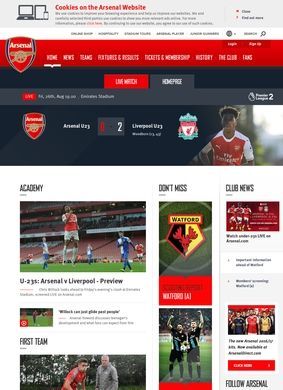
A supporter wakes up on a match morning wanting three things at once: where the team stands after the last result, whether any tickets remain, and what time kickoff actually is. The official site of Arsenal Football Club puts all three within a click or two of the front page, and that immediacy is the whole point of the place. News sits up top, fixtures and results run alongside it, and the ticketing routes are never buried.
For anyone who follows the team from London or from the other side of the world, this is the primary tap, and it opens fast.
What makes the site work is breadth handled without clutter. The men's first team gets the loudest coverage, but the women's side is treated as a genuine equal, with Women's Super League fixtures, results and squad pages given real space instead of a token corner. The academy and youth setup has its own footprint too, so a parent tracking a young player's development pathway can find the program details there.
Match reports land after the whistle, player profiles carry squad information that stays current, and the video and media library holds interviews and highlights for people who missed the live broadcast.
That range is the strongest argument for using the source Arsenal Football Club runs itself instead of piecing coverage together from several places. Three teams, one consistent structure, no gaps where a lesser site would simply stop at the senior men.
Following the club without a ticket in hand
Plenty of visitors will never set foot in north London, and the site is built with that in mind.
For the remote fan, the reading experience does most of the work. Club news is frequent and match-focused, honours and history pages give newcomers a way to catch up on why the club matters, and the media content fills the hours between games. International fan initiatives and the fan zone material acknowledge that a large share of the audience is watching from abroad, which is an honest reflection of who actually reads a Premier League club's website.
The mobile app and the official social links extend the same content onto a phone, so following Arsenal Football Club does not depend on sitting at a desk. A fan in a different time zone can pick up the thread of a season from a bus stop, and the pages hold up on a small screen without dropping the detail that makes them useful in the first place.
There is a commercial layer running through all of it, and Arsenal Football Club does not pretend otherwise. The club shop sells kits, memorabilia and general merchandise, and it is one of the more prominent destinations in the navigation. Membership and season ticket information sits nearby, along with hospitality packages for people who want the premium matchday experience. None of this feels tacked on. A modern football club is a retail and membership operation as much as a sporting one, and the pages present that side plainly next to the football.
The balance mostly holds. A reader after the score is never more than a moment from it, even with the shop and membership prompts sharing the screen.
Matchday logistics and the stadium itself
Getting to a game is its own small project, and the practical pages address it directly. Match tickets and hospitality options are laid out for the men's and women's fixtures, and Emirates Stadium gets dedicated coverage that goes past a seating map. Stadium tours are bookable through the site, which turns the ground into a visitor attraction on non-match days as well.
The stadium information is the sort of detail that saves a first-time visitor a lot of guesswork. Someone travelling in for a single fixture can work out the essentials before they leave home, and that reduces the friction that so often surrounds a big-club matchday. Arsenal Football Club clearly understands that a chunk of its audience is doing this for the first time, and the pages read accordingly.
Community programs and the wider club
Arsenal in the Community and the Arsenal Foundation both have a place on the site, and neither is hidden away as an afterthought. The community section covers the charitable and outreach work, and the pages give enough substance for a prospective participant or partner to understand what is on offer instead of just reading a mission statement.
This is where Arsenal Football Club quietly signals that it sees itself as more than a football team. Sponsorship and partnership information sits in the same broad area, aimed at a business audience, while the community programs speak to local residents and young people. Two very different readers, served from the same well-organised structure. A prospective academy player and a corporate partner are looking for opposite things, and both are accounted for.
The squad and player pages deserve a mention on their own. They pull together the first team, the women's team and the academy under a consistent format, so moving from a senior international to an academy prospect does not mean relearning how the pages work. For a fan who wants to know who just came on as a substitute, that consistency is worth more than any flashy feature. It is a quiet piece of discipline that runs across everything Arsenal Football Club publishes here.
Search across the site is generally quick to surface the news item or fixture a reader is after, and the navigation groups things the way supporters actually think: news, matches, tickets, shop, club. It is a lot of content, and it holds together. This entry represents a club operation that has clearly invested in keeping the whole thing coherent rather than letting sections drift apart.
If there is a limit to what the site does, it is that the sheer volume can feel like a lot on a first visit. Someone arriving only to check a kickoff time passes several retail and membership prompts on the way. That is the trade a club of this size makes, and it is a mild one, but a casual visitor should expect the shop and hospitality to sit as visible companions to the football. Arsenal Football Club has chosen reach over minimalism, and on balance that is the right call for an audience this large and this varied.
The honours and history material also rewards a slower read. For a supporter who came to the game recently, the club history pages of Arsenal Football Club give the context that turns a name on a shirt into something with weight behind it, and that background is presented without the sort of self-congratulation you might brace for. It is one more corner where Arsenal Football Club treats a curious visitor as someone worth informing, ahead of someone to sell to.
A search for independent reviews of the official site turns up nothing worth citing: no Trustpilot page, no forum thread grading the web copy, nothing beyond the odd complaint about queueing for tickets, which is a ticketing problem rather than a website one. That is normal for a football club's own domain, closer to a museum's site than an entry in a business directory, and it is not a mark against the place; supporters rate performances on the pitch, not the CMS behind the fixture list.
Weighed against the third-party route many fans default to, the BBC Sport football pages, the difference is one of depth against neutrality. BBC Sport gives the score, the table and a tidy report with no commercial pull, and for a quick check it is genuinely hard to beat. What it cannot give is the women's team squad in full, the academy pathway, bookable stadium tours, the shop, or the community program detail. Arsenal Football Club's own pages are the ones built for a reader who wants the whole club, headline eleven and everything around it, within easy reach.