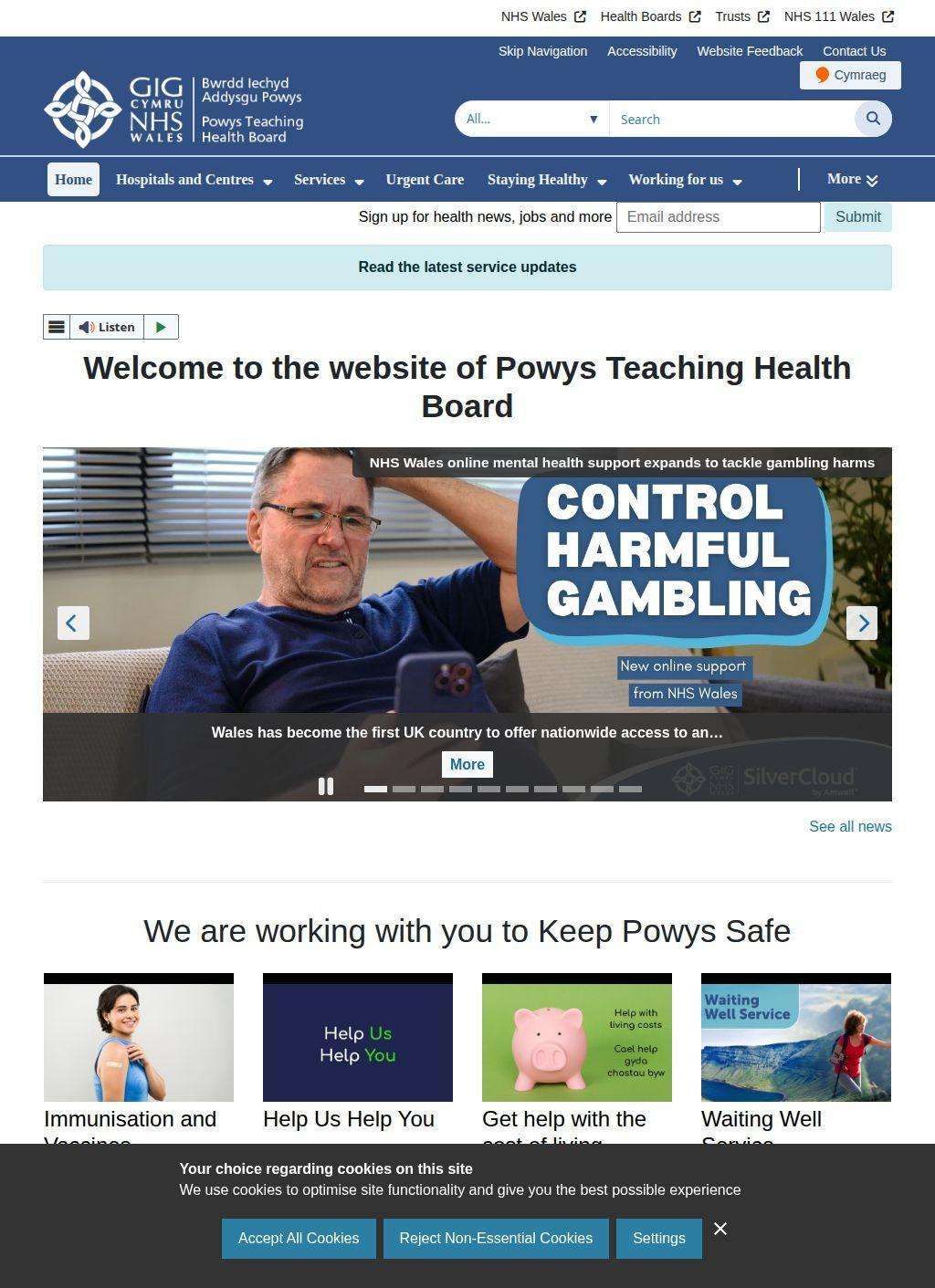
Who actually runs the NHS in the most sparsely populated county in Wales, and where does a resident go to understand what care is on offer? Powys Teaching Health Board answers that, and the site does a workmanlike job of laying it out. Powys is the largest Welsh county by area, mostly rural, with no district general hospital of its own, so the way care is organised here looks different from the urban boards most people picture when they think of the NHS. The site is built around that reality, and the navigation reflects how care is spread across North, Mid, and South Powys.
Service categories offered by the board
The clearest way to read the offering is through the service categories, of which there are more than seventeen. Powys Teaching Health Board covers adult and older people's community care, which is the backbone of healthcare in a county where keeping people well at home and close to home is the central priority. There is mental health support, maternity and women's services, and a separate children's community services strand. Powys Teaching Health Board also gives learning disabilities and neurodiversity services their own area, which is worth noting because those needs are often folded awkwardly into other sections elsewhere.
Urgent care and bereavement support
Urgent and primary care, pharmacy and medicines management, and bereavement and carer support round out the picture. That last pairing, bereavement and carer support, is easy to overlook on a health site, and putting it on equal footing with clinical services tells you something about how the board frames its remit.
Referring patients to specialist care
This is the structural fact that shapes everything else, and the site is honest about it. For specialist hospital care not available locally, Powys Teaching Health Board refers residents to tertiary centres in England and other parts of Wales. That is not a gap so much as a commissioning model: the board operates hospitals and community health centres across the county for the care that can be delivered locally, and buys in the rest from larger neighbours. A reader trying to work out whether a particular treatment happens in Powys or further afield will find the framing they need, even if the precise referral pathways live deeper in the relevant service pages.
Community health centre network
The community health centre network is the practical answer to the geography. The population is dispersed over a wide area, so the model leans on centres and community teams rather than a single hub. Someone in Mid Powys and someone in the south are not expected to travel to the same place for routine care, and the site's regional structure mirrors that. It is a sensible way to present services when distance is the defining constraint, and it avoids pretending the county works like a compact urban patch.
Staying healthy resources
The site also carries staying-healthy information, which sits alongside the clinical listings as a preventive layer. For a rural board, prevention reduces the number of long journeys and acute episodes that the referral model would otherwise have to absorb. Pairing that public-health material with the service directory is a coherent choice, and Powys Teaching Health Board puts it forward without dressing it up as anything more than what it is.
Recruitment and working for us
Recruitment gets its own space under Working for Us, which is more telling than it first appears. Staffing a rural health service is a perennial difficulty, and a board that puts careers front and centre is signalling where one of its real pressures lies. Potential clinical or support staff will find the entry point without hunting for it.
Governance and strategy documents
Governance and strategy documentation lives under About Us, and this is where Powys Teaching Health Board behaves like the statutory authority it is. As an NHS body planning and delivering care for a defined population, Powys Teaching Health Board is accountable for how decisions get made and money gets spent, and publishing that material openly is part of the job. For a curious resident, a journalist, or someone scrutinising local services, that documentation is the substantive part of the site. It is not glossy, and it is not meant to be.
Keeping people informed runs through two channels worth mentioning. On the communications side, Powys Teaching Health Board publishes free email news bulletins, which is a low-friction way for residents to follow changes to services without checking the site repeatedly. It also maintains social media presence on Facebook and Twitter under the pthbhealth handle. For a dispersed rural population, these push channels do real work, because not everyone is going to land on a service page at the moment a notice goes up.
Communication channels for residents
Outside the site itself, Powys Teaching Health Board has a presence on NHS Wales review platforms, where patient feedback tends to reflect the particular pressures of rural care: long travel times, referral waits, and the gaps that come with a commissioning model. The volume of public reviews is modest compared to large urban trusts, which is expected given the population size. What feedback exists gives texture to the patient experience and is consistent with the pressures Powys Teaching Health Board describes on the site itself.
One thing the site does well is treat the less visible parts of healthcare as first-class. Carer support, neurodiversity services, and bereavement provision are each given their own categories instead of being buried, and that breadth is the most telling indicator of what Powys Teaching Health Board sees as its responsibility. Few NHS boards lay this out so plainly, and Powys Teaching Health Board is more readable for it. A health board could present itself purely through hospitals and clinics. This one presents itself through the full span of community need, and the structure of the site backs that up.
Patient reviews on NHS Wales platforms
If there is a limitation, it is the one built into the model itself. Because so much specialist care is delivered elsewhere, a resident cannot treat the Powys Teaching Health Board site as a single complete map of every treatment they might need; some of the journey leads outward to other providers. The site is upfront about this, so it reads as an accurate account of how care works in the county rather than an oversell. A reader who understands that going in will find the navigation matches reality.
Set against a neighbouring board such as Hywel Dda University Health Board, which serves the adjoining counties of west Wales and does run district general hospitals, the contrast clarifies what to expect here. Hywel Dda's site can point to acute facilities it directly operates; Powys Teaching Health Board cannot, because its model is community-led with specialist work commissioned outward. For a resident weighing where their care happens, that difference is the whole point. The site gives an accurate, unvarnished account of an unusual NHS structure, and for most purposes that is a reasonable measure of what Powys Teaching Health Board should be delivering online. It is not the most comprehensive picture of every treatment pathway available to Powys residents, but it is honest about that limitation, and honest tends to be more useful than complete.
Business address
Powys Teaching Health Board
Headquarters, Bronllys Hospital, Bronllys,
Brecon,
Powys
LD3 0LY
United Kingdom
Contact details
Phone: 01874 711661