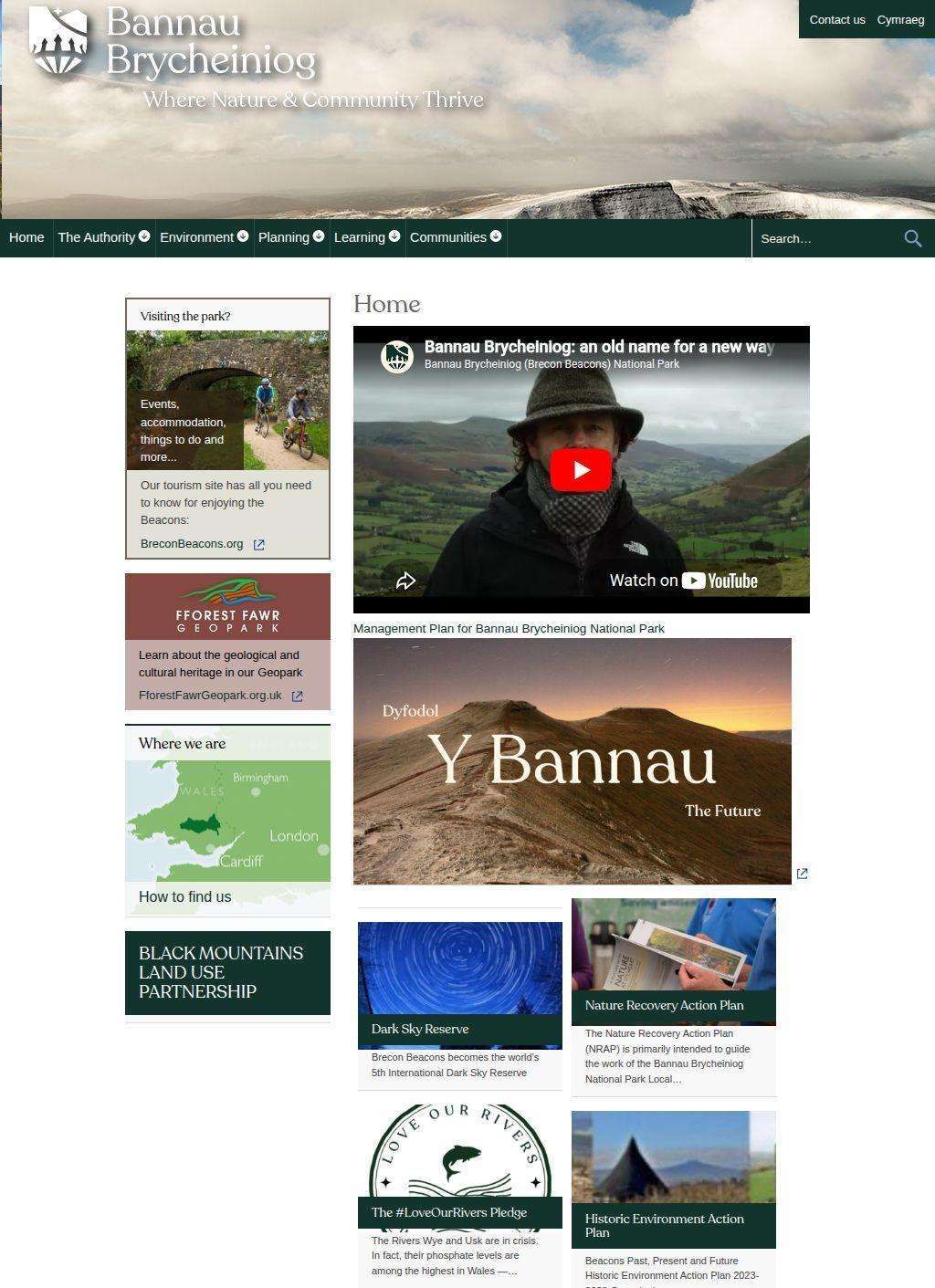
Bannau Brycheiniog National Park Authority is the statutory body responsible for the national park that most people in Britain still know as the Brecon Beacons. In 2023 the authority adopted Bannau Brycheiniog as its primary name, reclaiming the Welsh title by which the area was long known, and its website now operates under bannau.cymru while the established beacons-npa.gov.uk domain remains the working address for much of its official content. The park covers a large upland area of mid and south Wales, the bulk of which sits within Powys, and the authority's role is to look after that protected area while helping people enjoy and understand it.
Balancing conservation with public access
National park authorities in England and Wales have two statutory purposes: to conserve and enhance the natural beauty, wildlife and cultural heritage of the area, and to promote opportunities for the public to understand and enjoy its special qualities. Where those two purposes conflict, conservation takes priority under the long-standing principle known as the Sandford Principle. The authority also has a duty to have regard for the social and economic wellbeing of the communities living within the park. Much of what appears on the website flows directly from these duties, and the structure of the site reflects the balance the authority has to strike between protection, public access and the needs of residents.
Planning applications inside the park boundary
Planning is one of the authority's most significant functions and one of the busiest parts of the site. Within the national park boundary, the authority is the local planning authority rather than the county council, which means anyone wanting to build, extend or change the use of a property inside the park deals with Bannau Brycheiniog rather than Powys County Council. The website provides access to the planning application register, the local development plan, guidance on what does and does not need consent, and the means to comment on live applications. For homeowners, farmers and businesses inside the boundary, getting this right matters, and the planning pages are written with that audience in mind.
For visitors, the site is a practical planning tool. It carries information on walking and cycling routes, the main honeypot sites such as the area around Pen y Fan, waterfall country near Ystradfellte, and the network of reservoirs and uplands that draw walkers year round. There is guidance on car parks, public transport, accessibility, and the Mountain Centre near Libanus, which acts as a gateway for many first-time visitors. Safety messaging features strongly, with advice on weather, navigation and the real risks of the high ground, reflecting the authority's experience of how quickly conditions change on the tops and how often unprepared visitors get into difficulty.
Walking routes and safety advice
Conservation and land management content sets out the authority's work on habitats, peatland restoration, water quality and biodiversity, much of it delivered in partnership with farmers, landowners and conservation bodies. The park is also an International Dark Sky Reserve, one of the qualities the authority actively protects, and the site explains what that designation means and where to go for stargazing. Cultural heritage is covered too, from historic sites and the Welsh language to the living agricultural traditions that have shaped the uplands over centuries. This breadth makes the website a useful reference for researchers, educators and anyone using a business directory to understand the protected status of the area before approaching organisations that operate within it.
The authority runs a ranger and warden service, and the site explains what these teams do, how to report problems such as path erosion or fly-tipping, and how volunteers can get involved. There is information on the various grants and partnership schemes the authority supports, on its work with local communities, and on education visits for schools. Businesses operating in or around the park, particularly in tourism, can find guidance on sustainable tourism, the Sustainable Tourism Charter, and how to align with the authority's conservation goals, which is increasingly relevant as visitor numbers put pressure on popular sites.
Upland ranges across the protected area
The scale and variety of the park help explain the breadth of the website. The protected area covers roughly 1,340 square kilometres and takes in four main upland ranges, from the central Beacons crowned by Pen y Fan, the highest point in southern Britain at 886 metres, through the Black Mountains in the east, the wilder uplands of Fforest Fawr in the centre, and the confusingly named Black Mountain in the west. Within those bounds sit market towns, working farms, reservoirs, show caves, waterfalls and long-distance trails such as the Beacons Way. The authority has to care for all of it, which is why the site moves between subjects as different as upland ecology, dark sky tourism, geology and the practicalities of where to leave a car.
Public access and rights of way form another core duty. The authority maintains and signs a large network of footpaths, bridleways and open access land, and the website carries guidance on the countryside code, dog control, wild camping rules and how to use the land responsibly. Open access here does not mean a right to camp or light fires anywhere, and the site is clear about the limits, which matters given the pressure that popular spots come under in good weather. There is practical material on reporting blocked or damaged paths, on accessibility for visitors with limited mobility, and on the routes best suited to families or to those wanting a gentler day out than the high tops demand.
Governance and transparency are handled through a dedicated authority section covering the members, committee papers, the management plan, annual reports and consultations. As a public body, the authority publishes its decisions and financial information, and members of the public can find out how it is run and how to engage with it. The website also explains the authority's response to climate and nature emergencies, a theme that runs through its recent strategy and its decision to lead with the Welsh name as part of a wider repositioning around sustainability and cultural identity.
Contact details and office location
The head office is at Plas y Ffynnon, Cambrian Way, Brecon, LD3 7HP, with a main telephone number of 01874 624437. Brecon sits centrally for the park and is the natural administrative base, with the Mountain Centre and various visitor points distributed across the wider area. Contact details for specific teams, including planning and rangers, are provided separately, which helps direct enquiries to the right place rather than through a single overloaded channel. The bilingual nature of the site, available in Welsh and English, is consistent with the authority's identity and its statutory language obligations, and the recent rebrand has made the Welsh name and culture more central to how the organisation presents itself.
A couple of honest caveats apply. The rebrand and the move toward bannau.cymru mean that some older links, third-party references and printed materials still point to the Brecon Beacons name and the beacons-npa.gov.uk domain, which can briefly confuse visitors who are unsure whether they have reached the right organisation. The two names refer to the same body, but the transition is not yet complete everywhere, and occasional mismatches between old and new branding turn up across the wider web. Users should treat both names as interchangeable for the same authority.
The second caveat is that the website tries to serve very different audiences at once, from a day-tripper looking for a car park to a developer studying planning policy to a researcher reading the management plan. That breadth is unavoidable given the authority's remit, but it does mean the site occasionally feels like several sites stitched together, and the route to a specific document is not always the most direct. Most visitors find what they came for, and the core visitor and planning information is sound. For this business directory, Bannau Brycheiniog National Park Authority is listed as the authoritative public body for the national park: the definitive source on planning within the boundary, conservation, visitor access and the protected status of one of the best known upland areas in Wales.
Business address
Bannau Brycheiniog National Park Authority
Plas y Ffynnon, Cambrian Way,
Brecon,
Powys
LD3 7HP
United Kingdom
Contact details
Phone: 01874 624437