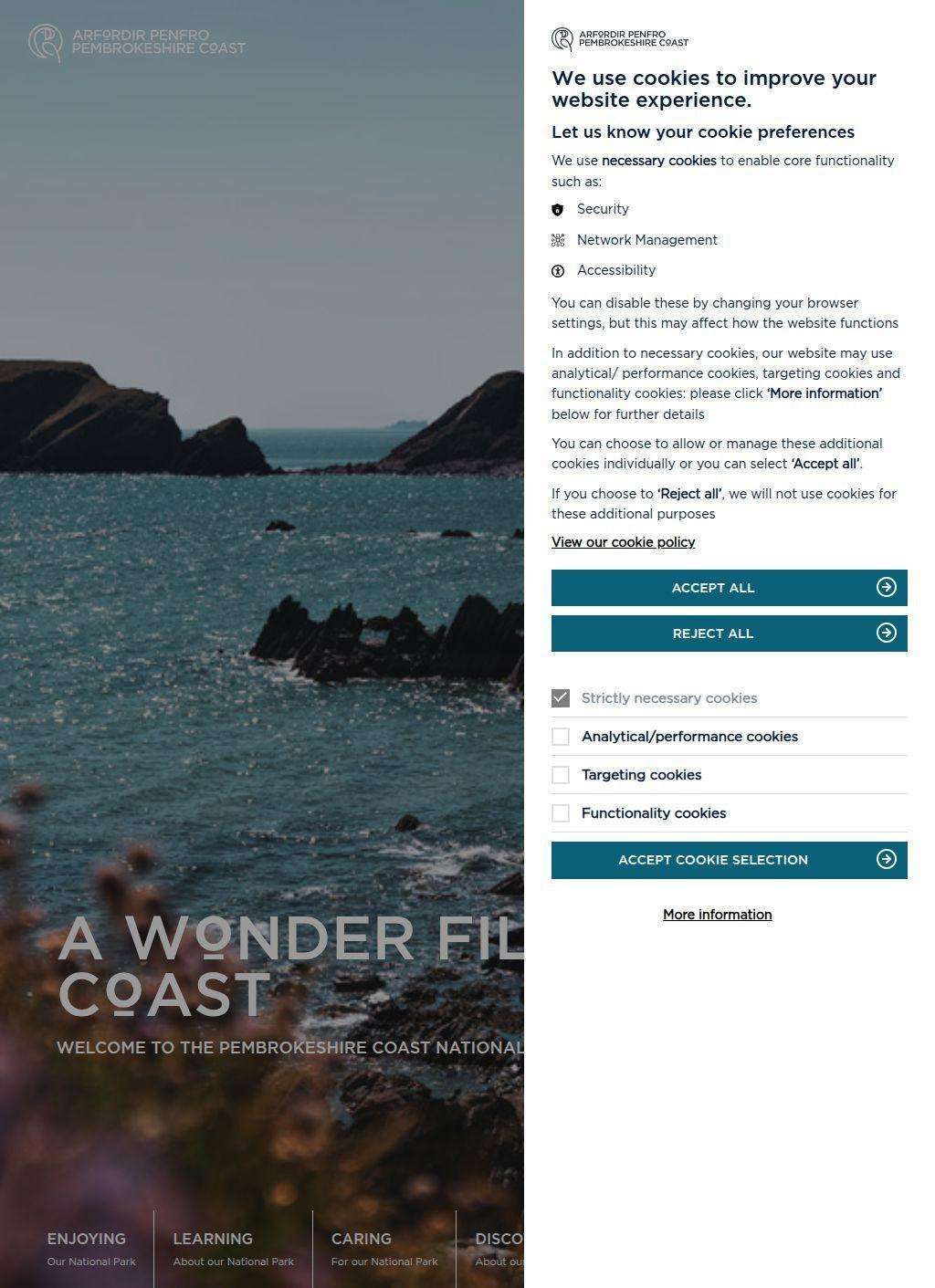
Someone has to look after the cliffs, footpaths and planning decisions across one of Britain's only coastal national parks. That job falls to the Pembrokeshire Coast National Park Authority, and the website is where most of its public-facing work lives. The Pembrokeshire Coast National Park Authority is a statutory body, so the site is less a marketing exercise than a working tool: part visitor planner, part planning office, part conservation record. Spend a few minutes on it and you get a fair sense of how much ground this one organisation is asked to cover.
Walking trails and accessibility features
The recreation side is the easiest entry point, and it is genuinely useful. The headline asset is the Pembrokeshire Coast Path, a 186-mile National Trail that hugs the coastline, backed by more than 600 miles of public footpaths inland. The site does not name-drop the trail and move on; it gets into practical territory with guided walks, beach wheelchair hire and accessible viewpoints, which is the sort of provision that often gets skipped on outdoor sites that assume every visitor can manage a clifftop scramble.
Coverage extends to surfing, coasteering and star-gazing. The dark-sky angle is a reminder that the park is as much a night-time draw as a daytime one. I found the accessibility detail more persuasive than any amount of scenic description would have been, because it shows the Pembrokeshire Coast National Park Authority has thought about who turns up and how, beyond the scenic draw. Beach wheelchairs and graded viewpoints are the difference between a park that is open in principle and one that is open in practice.
Three heritage attractions under one roof
Three visitor attractions sit under the same roof, and they are worth separating out because they pull in different crowds. Carew Castle and Tidal Mill pairs a historic ruin with a restored mill and runs events including jousting, which leans into the family-day-out market. Castell Henllys Iron Age Village is a reconstructed settlement with a cafe and a programme aimed at school groups and anyone curious about how people lived on this coast thousands of years ago. Oriel y Parc in St Davids works as a discovery centre with a gallery, rotating exhibitions and its own cafe, so it doubles as a wet-weather option and a cultural stop. Having all three managed by the Pembrokeshire Coast National Park Authority gives the site a coherence you do not always find when attractions are run by separate trusts pulling in separate directions.
Checking planning applications online
This is the part of the Pembrokeshire Coast National Park Authority that most casual visitors never think about, and it is where the site earns its keep as a reference. As the planning authority for the park, it processes development applications through a public-access portal, so residents and agents can track what is being proposed and decided.
The advice pages run through permitted development, building control, protected species and tree management, which are exactly the questions a homeowner or small builder inside the park boundary needs answered before they spend money on plans that might never be approved. Protected species and tree controls have real consequences in a landscape like this, where a single bat roost or a stand of mature trees can reshape what a project is allowed to do. Setting that guidance out plainly, ahead of any application, is the sort of practical service that saves both sides a lot of wasted effort, and it is good to see it given proper space instead of being buried in legalese.
Sitting above all of that is the Local Development Plan 2, the document that governs land-use policy across the park. It is a dry read by nature, but its presence matters: it is the framework that decides what gets built, where, and on what terms in a protected landscape where the default answer to development is often no. For anyone with property or a project in Pembrokeshire, this section is arguably the most consequential thing on the whole site, even if it never gets the attention the coast path does.
Protecting habitats through farming partnerships
Conservation work runs in parallel. The Pembrokeshire Coast National Park Authority documents invasive species control, woodland and coastal habitat management, and a wider push for ecological resilience through a framework it calls Ffermio Bro. That last one is an attempt to work with the farming community across the park instead of around it, which tends to be where conservation efforts either succeed or quietly fall apart. Coastal habitats and woodland do not respect property lines, so getting landowners on side is less a nicety than the whole game, and the framing here suggests someone in the organisation understands that. The site treats these programmes as ongoing operations with real activity behind them, not a page of aspirations, and that distinction comes through.
The Pembrokeshire Coast National Park Authority also runs a community layer that rounds the picture out. Volunteering opportunities, youth committees, family education and public consultations on how the park is run all get their own space. A youth committee in particular is the kind of thing that is easy to announce and hard to sustain, so seeing it listed alongside the consultation mechanisms is a reasonable indication that the Pembrokeshire Coast National Park Authority is at least trying to bring local and younger voices into decisions that will outlast the current staff. Whether that participation translates into real influence is something only the people who take part can judge.
Balancing five roles in one website
If there is a fair criticism, it is the sheer breadth. The Pembrokeshire Coast National Park Authority is asked to be a trail manager, a heritage operator, a planning office, a conservation agency and a community convener all at once, and a website carrying all five jobs can feel like several different sites stitched together. A visitor hunting for jousting dates and a builder hunting for tree-protection rules are not the same person, yet they land in the same place. The navigation mostly copes, though you do have to know roughly which of the Pembrokeshire Coast National Park Authority's hats you are looking for before you start.
What lifts the whole thing is the specificity. Concrete mileage, named attractions, an actual planning portal, a named development plan and a named conservation framework: these are verifiable facts, not vague promises about stewardship. The Pembrokeshire Coast National Park Authority comes across as an organisation that knows precisely what it is responsible for and has documented it in a way the public can use, whether that public is planning a coastal walk or contesting a planning decision.
The practical value of the Pembrokeshire Coast National Park Authority site depends almost entirely on why you arrive. A holidaymaker gets a well-organised plan for a few days on the coast, complete with accessibility provision that many similar bodies overlook. A resident or developer gets the policy and process detail that governs what they can do with land inside the park. A volunteer or student gets a route in. Each of those audiences is served properly, which is more than a sprawling remit usually allows, and the site covers enough ground that most people will find what they came for once they know which direction to look.
Business address
Pembrokeshire Coast National Park Authority
Llanion Park,
Pembroke Dock,
Pembrokeshire
SA72 6DY
United Kingdom
Contact details
Phone: 01646 624800