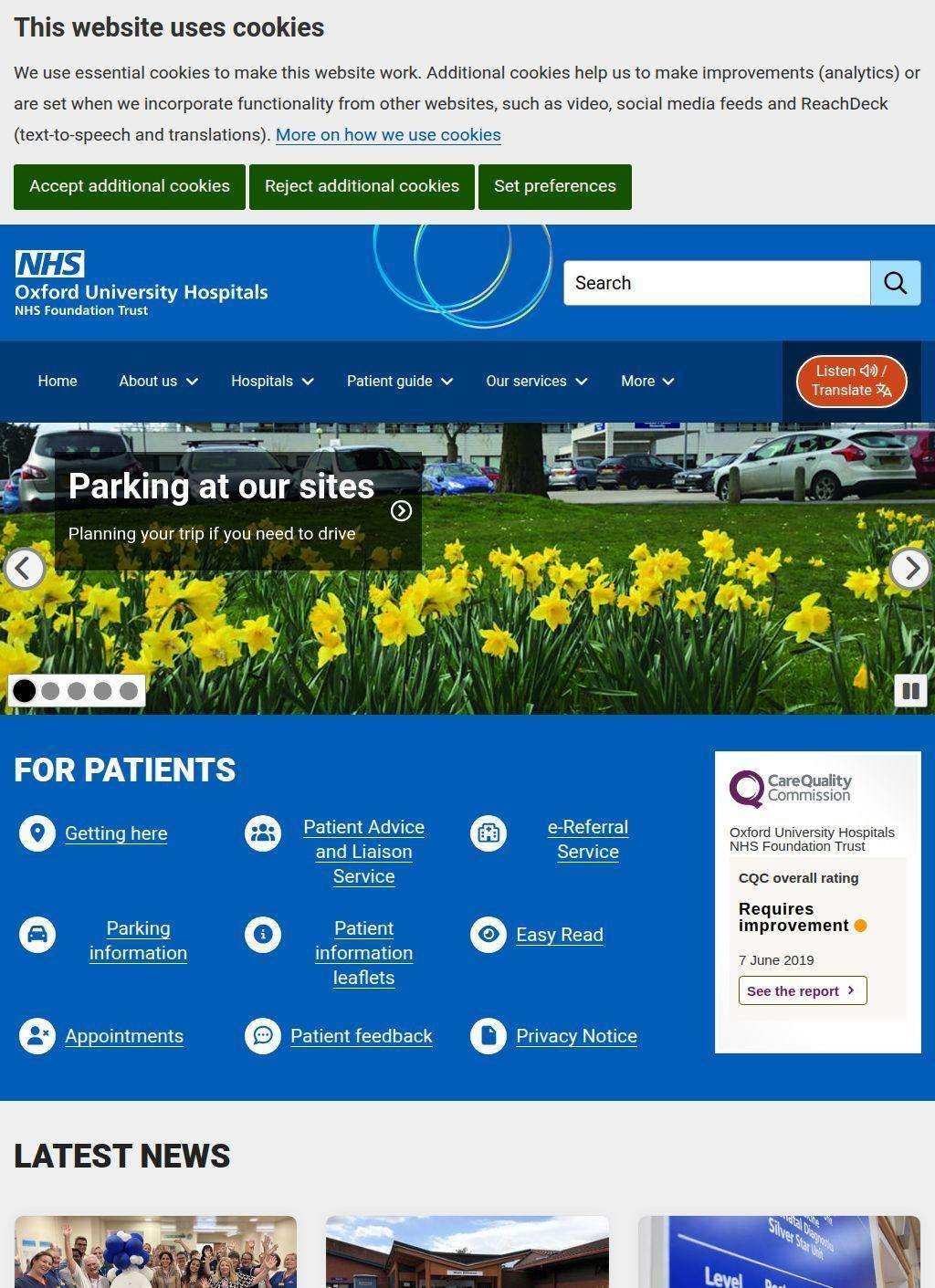
Someone arrives at an emergency department at three in the morning with a child running a high fever, or waiting on a cancer referral, or trying to work out which of several hospitals in Oxfordshire handles the procedure their GP mentioned. That moment of needing to know exactly where to go, and for what, is where Oxford University Hospitals NHS Foundation Trust does its most useful work as a website. The site is organised around four hospital sites and the long list of specialties spread across them, and it answers the practical question of "which building, which department, what do I bring" with a directness that counts when a person is anxious.
Four hospitals and their specialties
Oxford University Hospitals NHS Foundation Trust runs the John Radcliffe Hospital and the Churchill Hospital in Oxford, the Nuffield Orthopaedic Centre also in Oxford, and the Horton General Hospital up in Banbury. Each of those gets its own visitor guidance, which is the right structure, because the experience of going to an acute hospital with an emergency department is nothing like turning up to a centre built around orthopaedic and planned care. A reader can land on the site cold and find parking notes, ward information and directions for the specific place they have been told to attend. That site-by-site split is a small thing on paper and a large thing when you are the one driving an unfamiliar route under stress.
Finding your way to each site
On the clinical side, the range is genuinely broad. Oxford University Hospitals NHS Foundation Trust covers emergency care and intensive care, cancer services, maternity, cardiothoracic surgery, neurosciences, ophthalmology, urology and orthopaedics. It operates as a full secondary and tertiary centre, not a single-discipline unit. The department directory lets you go from a vague sense of "something to do with the heart" or "an eye problem" to the actual team that deals with it. For someone trying to understand their own referral, or a relative trying to follow what is happening to a family member, that mapping from symptom to specialty to physical location is the part of the site that does the most work.
Clinical services by department
Oxford University Hospitals NHS Foundation Trust serves a wide geography. Patients come from across Oxfordshire and the broader Thames Valley, and several of the more specialised services pull from a region larger than the county, which is the usual pattern for a trust of this size. Oxford University Hospitals NHS Foundation Trust reflects that reach in how it separates routine local attendance from the tertiary services people travel further to reach. The cancer and neurosciences sections are clearer than expected for material that has to serve both a frightened patient and a referring clinician at the same time, and that dual audience is genuinely hard to write for without one group getting lost.
Research programs and private care
Oxford University Hospitals NHS Foundation Trust places its research identity alongside the clinical one, and it is substantive. The trust is an academic medical centre with active programmes, including work in genomics and in applying artificial intelligence to clinical problems. For a patient, that backdrop explains why a complex case might be managed here, and the site does describe where research and care overlap, so the word "academic" is doing real work rather than sitting there as a label. The genomics and AI strands are described in enough plain terms that a non-specialist gets the gist without needing a background in the field.
Academic medicine and genomics
There is also a practical split between NHS-funded treatment and private healthcare options, both of which Oxford University Hospitals NHS Foundation Trust provides, and the site keeps the distinction visible. Anyone weighing a private route for a specific procedure can find that path without it crowding out the core NHS information, which is the right balance. The patient information resources fill out the rest: preparation notes, what to expect, the ordinary logistics of being treated that nobody thinks about until they are in the middle of it.
Separate pathways for staff recruitment
Two audiences beyond patients are served deliberately by Oxford University Hospitals NHS Foundation Trust. Visitors get the per-site guidance already mentioned, and staff and job seekers get their own section, with recruitment and working-here material kept apart from clinical content so that neither group has to wade through the other's pages. For a regional employer of this scale, treating careers as a first-class part of the site rather than a buried footnote is sensible, and it keeps the patient-facing pages uncluttered.
If there is a limit to what the website can do, it is the inherent one: a site this large, covering four hospitals and dozens of specialties, asks the visitor to know roughly what they are looking for before the navigation fully pays off. The department directory helps with that, and the site-specific entry points help, but a first-time user with only a hazy sense of their problem may still need a click or two more than they would like. That is the trade-off of comprehensiveness, and on balance Oxford University Hospitals NHS Foundation Trust handles it about as well as the scale allows.
What Oxford University Hospitals NHS Foundation Trust does best is reduce the friction between a worried person and the information they need at a hard moment. The structure mirrors the real institution, the clinical breadth is laid out honestly, and the research and private-care strands are present without overwhelming the basics. Oxford University Hospitals NHS Foundation Trust is one of the larger acute trusts in the country, and its web presence holds together without becoming a maze. That is harder to pull off than it looks for an organisation this complicated. The maternity and emergency pages in particular read as if someone thought about the state of mind of the person reading them.
The value here is less about discovery and more about orientation. A person who already knows they are headed to the John Radcliffe, or who has a Churchill appointment letter in hand, or who needs to understand what the Horton General in Banbury covers, will get what they came for quickly. Oxford University Hospitals NHS Foundation Trust has built the kind of reference that rewards a clear question, and the breadth of its services across those four sites is the substance behind the listing.
Business address
Oxford University Hospitals NHS Foundation Trust
John Radcliffe Hospital, Headley Way, Headington,
Oxford,
Oxfordshire
OX3 9DU
United Kingdom
Contact details
Phone: 0300 304 7777