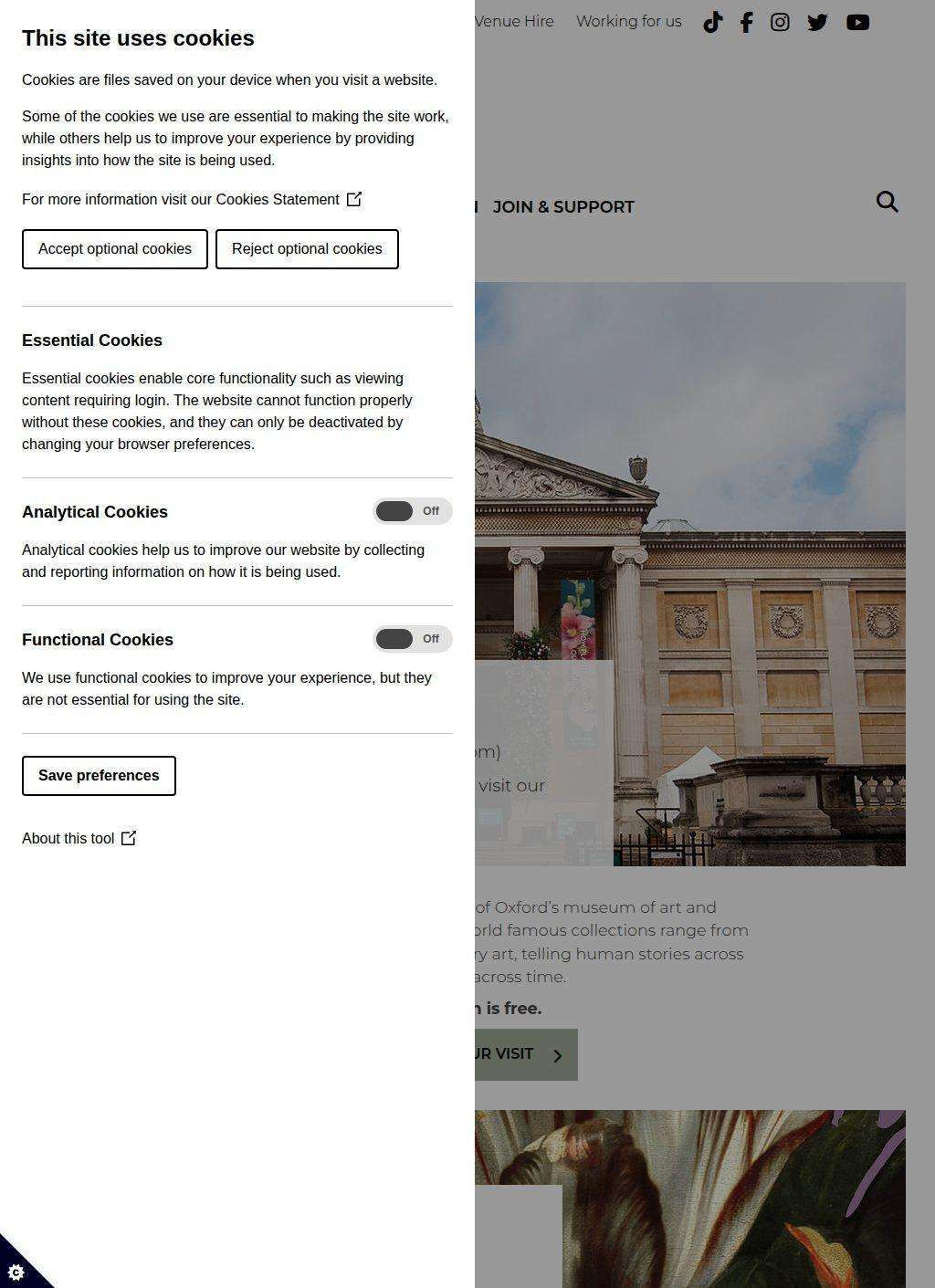
What can you actually do with a museum that has been collecting since 1683 and charges nothing at the door? Quite a lot. The Ashmolean Museum is the University of Oxford's public collection and the oldest university museum anywhere, and its site reflects holdings that run past 300,000 objects spread across six departments: Antiquities, the Cast Gallery, the Heberden Coin Room, Eastern Art, Western Art, and Conservation. Free admission and daily opening from 10am to 5pm, with last entry at 4:45pm, mean the practical barrier to walking in is close to nothing. On TripAdvisor the Ashmolean Museum carries well over ten thousand reviews and scores consistently near the top of Oxford's attractions, which at least confirms the experience lives up to what the site promises.
Two ways to explore the museum
The site is built around two clear modes of use. One is planning a physical visit, the other is browsing the collection from wherever you happen to be. For the first, there is an interactive floor guide, downloadable audio guides, and a full accessibility section that goes beyond a single line of reassurance. For the second, the Ashmolean Museum's collections portal at collections.ashmolean.org opens the whole catalogue to anyone curious enough to type in a name or a culture, which is the part I kept returning to because it turns a single building in central Oxford into something you can study from a kitchen table.
Exhibitions and rotating displays
The Ashmolean Museum's current ticketed headline is "In Bloom: How Plants Changed Our World," running from 19 March to 16 August 2026, and it sits alongside free rotating displays doing genuinely interesting work: Colonial Views of India, the Soma Surovi Jannat installation on climate, culture and care, and a room of Chinese Paintings. The mix of one paid flagship against several free changing shows is honest about where the money goes and keeps the permanent galleries from feeling static.
Workshops, tours, festival dates
The Ashmolean Museum's events calendar is where the breadth shows. Botanical workshops, regular gallery tours, and the Festival of Archaeology on 18 July 2026 give the place a rhythm across the year rather than a single seasonal push. None of it reads as padding. Each strand connects back to an actual department or collection, and that makes the difference between a real programme and a list of things to fill dates.
Family and school programs
Families and schools are clearly a deliberate audience, not an afterthought. The Ashmolean Museum runs gallery trails, explorer packs, and hands-on coin sessions for younger visitors, and the education side reaches primary and secondary schools, university teaching partnerships, adult groups, and home learners. That last category is easy to ignore and the fact that it appears at all tells you someone thought about who else turns up on a weekday.
Restaurant, shop, membership tiers
Practical comfort is covered without fuss. There is a Rooftop Restaurant and Terrace that takes reservations, a separate cafe for something quicker, and a gift shop that also runs an online store, so the trip can stretch into a meal or end with something carried home. Membership comes in individual, gift, and corporate tiers, with donation and volunteering routes for people who want to give time or money back, and the social presence spans Twitter, Facebook, Instagram, YouTube, and TikTok for anyone who prefers to follow along between visits.
Limits of an encyclopaedic collection
If there is a limitation worth naming, the Ashmolean Museum faces the same constraint every encyclopaedic collection does. Six departments and 300,000 objects cannot all be on show at once, so a first-time visitor walking in cold may see a fraction of what the catalogue promises. The online portal softens this, and the rotating displays mean a second trip rarely repeats the first, but anyone arriving to see one specific famous piece would do well to check the floor guide before they set out.
Where the Ashmolean Museum really separates itself is the combination of depth and openness. A coin room, a cast gallery, and a dedicated Eastern Art department under one roof is unusual. The conservation work sitting on the same footing as the curatorial departments points to a place that takes the long care of objects seriously. The full catalogue being searchable online rather than locked behind a visit extends that seriousness to people who will never make it to Oxford.
Comparing Ashmolean to Pitt Rivers
Set against the Pitt Rivers Museum a short walk away, the choice comes down to temperament. The Pitt Rivers is famously dense and atmospheric, a single crowded ethnographic hall that rewards slow wandering. The Ashmolean Museum is broader, lighter, and easier to navigate in stages, with a far deeper online catalogue and a steadier events programme. Of the two, the Ashmolean Museum is the more structured and the more extensible: the visit does not end at the door.
Business address
Ashmolean Museum of Art and Archaeology
Beaumont Street,
Oxford,
Oxfordshire
OX1 2PH
United Kingdom
Contact details
Phone: 01865 278000