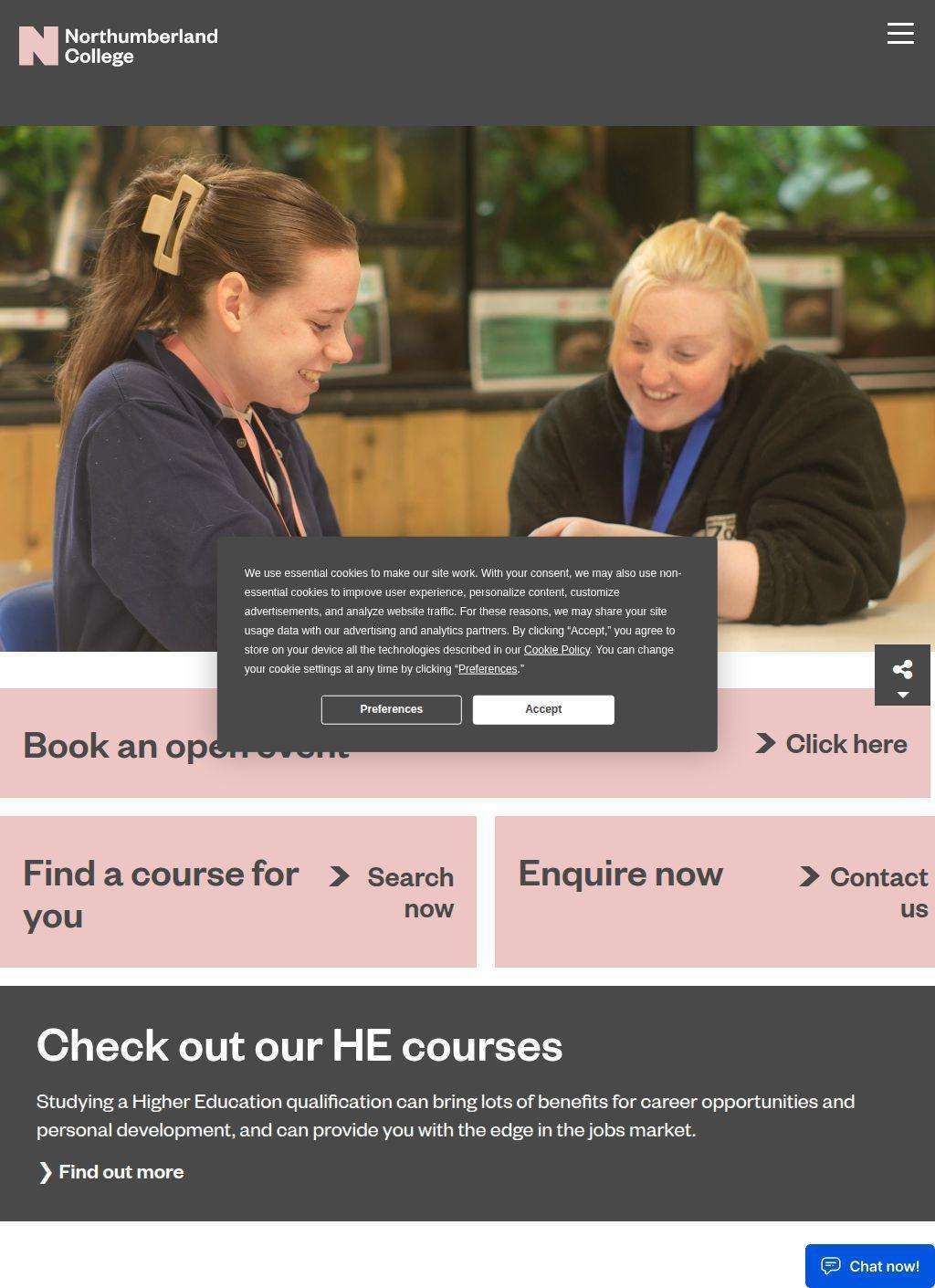
A sixteen-year-old in Ashington who already knows they want to work with horses, or fix machinery, or arrange flowers for a living, faces a fork that a sixth form cannot really answer. Northumberland College is built for exactly that learner. It runs vocational and technical qualifications, T Levels and apprenticeships tied to actual employers, so the question of what comes after the classroom is baked into the course from the start. For a teenager who learns by doing, that practical focus is the whole point.
Vocational learning tied to employers
The three-campus setup tells you a lot about how the place works. Ashington is the main site, currently expanding with a new campus build, and it is where most general further education sits. Berwick covers the far north of the county. Kirkley Hall is the one that gives Northumberland College its distinct character: land-based study in equine, floristry and agriculture, with residential accommodation and an on-site zoo where students get hands-on time with animals most colleges can only show on a screen. The college describes itself as the top land-based provider in the North East, and the facilities behind that claim are substantial, not a marketing line.
Three campuses with distinct specialisms
Beyond the school-leaver route, the provision widens out considerably. Adult learners get skills bootcamps, functional skills, free courses for jobs and virtual learning, all of which speak to people retraining or topping up qualifications around work and family. The bootcamps in particular target sectors with local labour shortages, which is the sort of design choice that only makes sense when a college pays attention to who is hiring nearby.
Skills bootcamps for local job sectors
Higher education runs through Access to HE and degree-level courses, so a learner can move from a level two start right up to a degree without leaving the institution. ESOL courses serve people learning English, and there is dedicated support for students with additional needs. International students are part of the mix too. Few colleges this size carry a ladder that complete, and the lack of a hard break between the further-education and higher-education tiers is genuinely useful for someone who is not sure how far they want to go when they enrol.
Pathways from level two through degree study
What gives the offering weight is the record behind it. Northumberland College earned an Outstanding rating from Ofsted in 2024, which is the top grade the inspectorate hands out and not one given lightly. Northumberland College reports sitting in the top quarter nationally for student achievement, and says 95 percent of its students go on to university or employment after leaving. I tend to read progression figures with a raised eyebrow, but a 95 percent destination rate sitting alongside an Outstanding inspection is a coherent picture, not a number floating on its own. The two reinforce each other.
Outstanding Ofsted rating and progression outcomes
It helps to be clear about who this suits and who it does not. Someone set on a purely academic path toward a research university might find a traditional sixth form a closer fit, since the gravity here pulls toward applied and technical learning. But for the apprentice, the career-changer, the adult chasing a specific job-ready skill, or the young person drawn to land-based work, the spread of routes at Northumberland College is hard to match locally. The Future Ready programmes and the employer links in the apprenticeship side show the college thinking past the qualification to what happens when the student walks into a workplace.
Who benefits most from this college
The land-based strand deserves a second look because it is so unusual. Running a working zoo, stables and an agricultural setup is expensive and demanding, and most institutions simply do not bother. Northumberland College does, and it means an equine or animal-care student trains on live animals in real conditions instead of leaning on theory and the occasional field trip. The residential accommodation at Kirkley Hall matters here as well, because land-based work does not keep classroom hours, and a student who can live on site is closer to the early starts and late checks that the animals demand. That kind of immersion is what employers in those fields want to see on a leaver's record, and it is an advantage few local alternatives can offer.
Inside Kirkley Hall's land-based facilities
The picture at Northumberland College, taken whole, is one of genuine breadth backed by verifiable results. It covers a wide age and ability range, from a nervous sixteen-year-old to an adult returning to study after years away, and it backs that breadth with an inspection grade and outcome figures that are hard to dismiss. The specialist land-based offer at Kirkley Hall sets Northumberland College apart from the standard further education menu, and the apprenticeship and adult routes connect study to paid work in a region where that connection carries real consequence. If the match is right, the evidence says it is worth pursuing.
Business address
Northumberland College
College Road,
Ashington,
Northumberland
NE63 9RG
United Kingdom
Contact details
Phone: 0300 770 6000