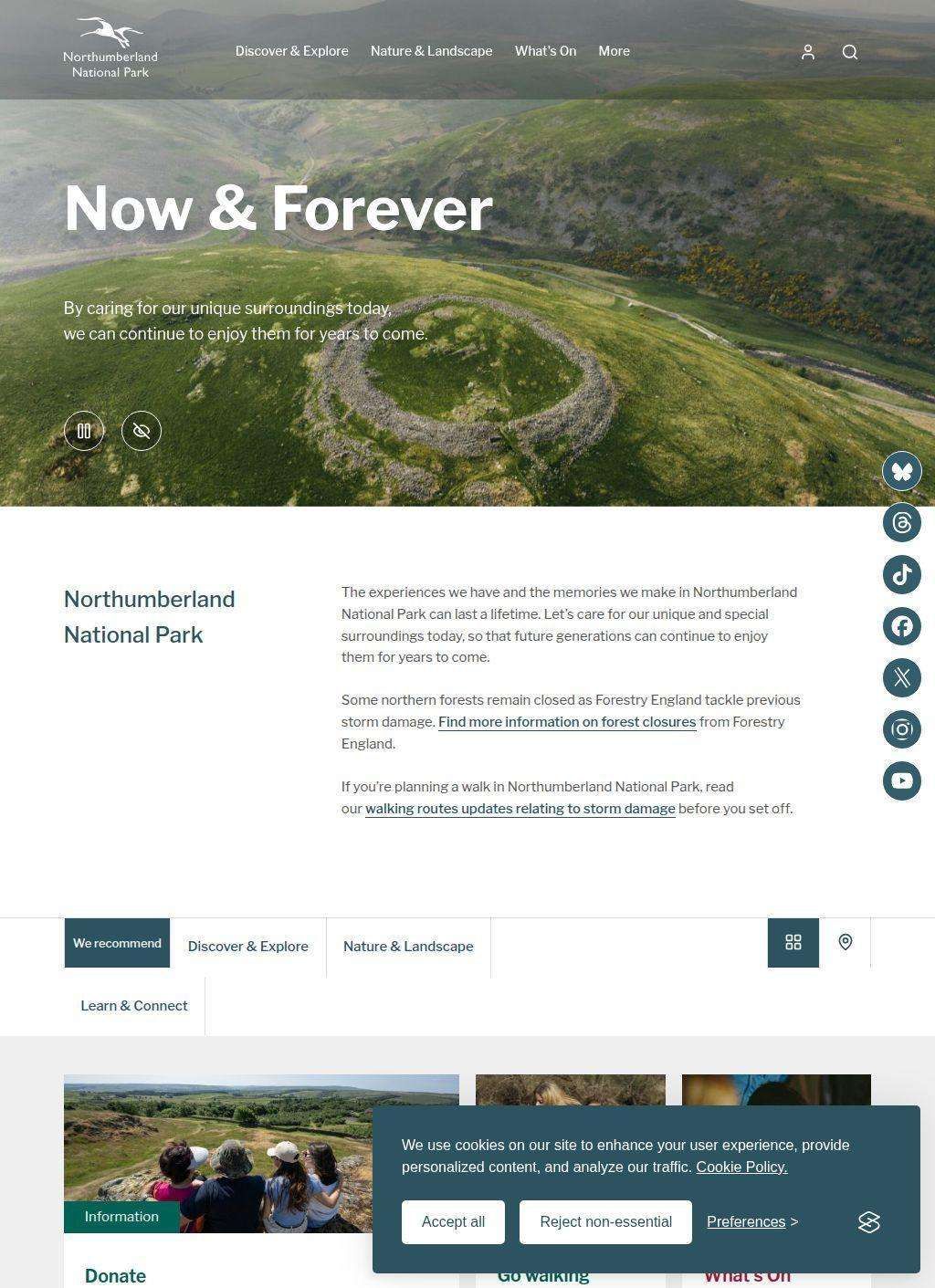
Planning a weekend in the far north of England usually starts with a short list of practical questions: where to walk without getting lost, whether the sky is really dark enough to see the Milky Way, and what to do with children when the rain sets in. The site run by Northumberland National Park Authority answers all three in fairly direct terms, and the useful pages are reachable without working through marketing layers first. The Discover and Explore section is where most people land first, built around what the park is known for: walking routes graded by difficulty, cycling trails, and the Dark Skies experiences that have drawn visitors who have never seen a properly black sky.
Walking routes, cycling trails, dark skies
The park stretches across a large and thinly populated stretch of northern England, taking in Hadrian's Wall to the south and the Cheviot Hills along the Scottish border. Northumberland National Park Authority is the statutory body charged with looking after that ground, which means the website carries a double job. It has to work as a trip planner for a day visitor and as an administrative front door for residents, farmers, and anyone with business inside the park. That dual purpose shapes the whole thing, and the navigation manages to keep the two audiences from tripping over each other.
On the visitor side, the depth is genuine. Walking routes come with specifics that let you judge a trail before setting off, and the cycling content has its own space instead of being buried in a single catch-all outdoors page. The Dark Skies material is the most distinctive part, and rightly so: this is one of the largest protected night-sky areas in the country, and Northumberland National Park Authority leans into that with experiences and guidance built around stargazing. There is a real centrepiece here too, The Sill, a national landscape discovery centre at Bardon Mill that doubles as an exhibition space and a starting point for the wider area.
Wildlife, heritage, farming, landscape management
The nature content goes past scenery photography with captions. The Nature and Landscape pages cover wildlife, culture and heritage, and the working life of the park, including farming, which tourism-first sites tend to ignore. There is coverage of climate work and a specific restoration project, the Hadrian's Wall Wetlands scheme, which shows Northumberland National Park Authority treating the landscape as something to be managed actively, beyond what a tourist season demands. A reader trying to understand what makes this place ecologically particular will come away with more than a postcard impression.
Events, festivals, guided activities
The What's On section pulls the calendar together in one place, and it is current enough to reflect the programming a living park produces: a walking festival tied to a seventieth anniversary, guided activities, and exhibitions. Event booking is handled on the site itself, so the path from reading about something to securing a place does not throw you out to a third-party tool with no explanation. For a visitor with limited patience and a fixed weekend, that continuity is worth more than it sounds on paper.
Planning applications, development management, enforcement
The other half of the site is where most casual visitors will never go, and it is the half that tells you whether Northumberland National Park Authority is doing its statutory job properly. The Planning section is substantial. Development management, a searchable planning application system, policy documents, enforcement, and appeals are all present, which is exactly what you would expect from a planning authority with real power over what gets built inside its boundary. The application search tool stands out because it turns an otherwise opaque process into something a resident or an objector can actually follow.
Governance, committees, finances
The About Us material is similarly unglamorous and similarly important. Governance, committees, finances, and the associated Foundation charity are all documented, which is the right posture for a public body spending public money. Northumberland National Park Authority is accountable in ways a private attraction is not, and the willingness to publish committee structures and financial information openly reflects how the organisation sees its relationship with the people it serves. I would sooner read this than a glossier site that hides its workings.
Education, volunteering, skills training, jobs
Learn and Connect rounds out the practical side. Educational programmes, volunteering routes, a skills training scheme called Green Pathways, health and wellness activities, and job listings sit together here. This section turns a park from a place you visit into a place you can take part in, and the breadth of it suggests Northumberland National Park Authority is trying to build something with local people that lasts beyond a single day trip. Volunteering gets proper treatment, with specific routes and commitments described.
Search tools, booking, shop, donations
Online tools are threaded through the whole site: the planning application search, event booking, a newsletter signup, a donation platform, and an online shop. None are flashy, and that is the point. They are the working parts of an organisation that has to fundraise, communicate, and let people transact without friction. The shop and donation platform acknowledge that Northumberland National Park Authority cannot run on statutory funding alone, and both are handled plainly, without a hard sell.
Balancing visitor content with administrative pages
A fair criticism is that the sheer scope of what Northumberland National Park Authority does can make the site feel like several websites stitched together, because in a sense it is. A first-time visitor looking only for a Sunday walk has to ignore planning policy and governance material that has nothing to do with them, and the reverse is true for a farmer or a planning agent who has to scroll past visitor content to reach administrative pages. The structure handles this well enough, but the breadth is a genuine demand on the reader.
From planning searches to trip planning
Taken as a whole, this is a serious and well-organised resource that earns trust through substance rather than polish. The visitor planning is detailed enough to rely on, the Dark Skies and Hadrian's Wall material gives Northumberland National Park Authority a clear identity, and the administrative side is open in a way that reflects well on how the organisation operates. The wetlands restoration and climate work show Northumberland National Park Authority thinking past the next tourist season. The application search tool in the Planning section is probably the single most practically useful thing Northumberland National Park Authority publishes, and that says something about what this organisation actually is: a statutory body that also happens to run a good trip-planning site.
Business address
Northumberland National Park Authority
Eastburn, South Park,
Hexham,
Northumberland
NE46 1BS
United Kingdom
Contact details
Phone: 01434 605555