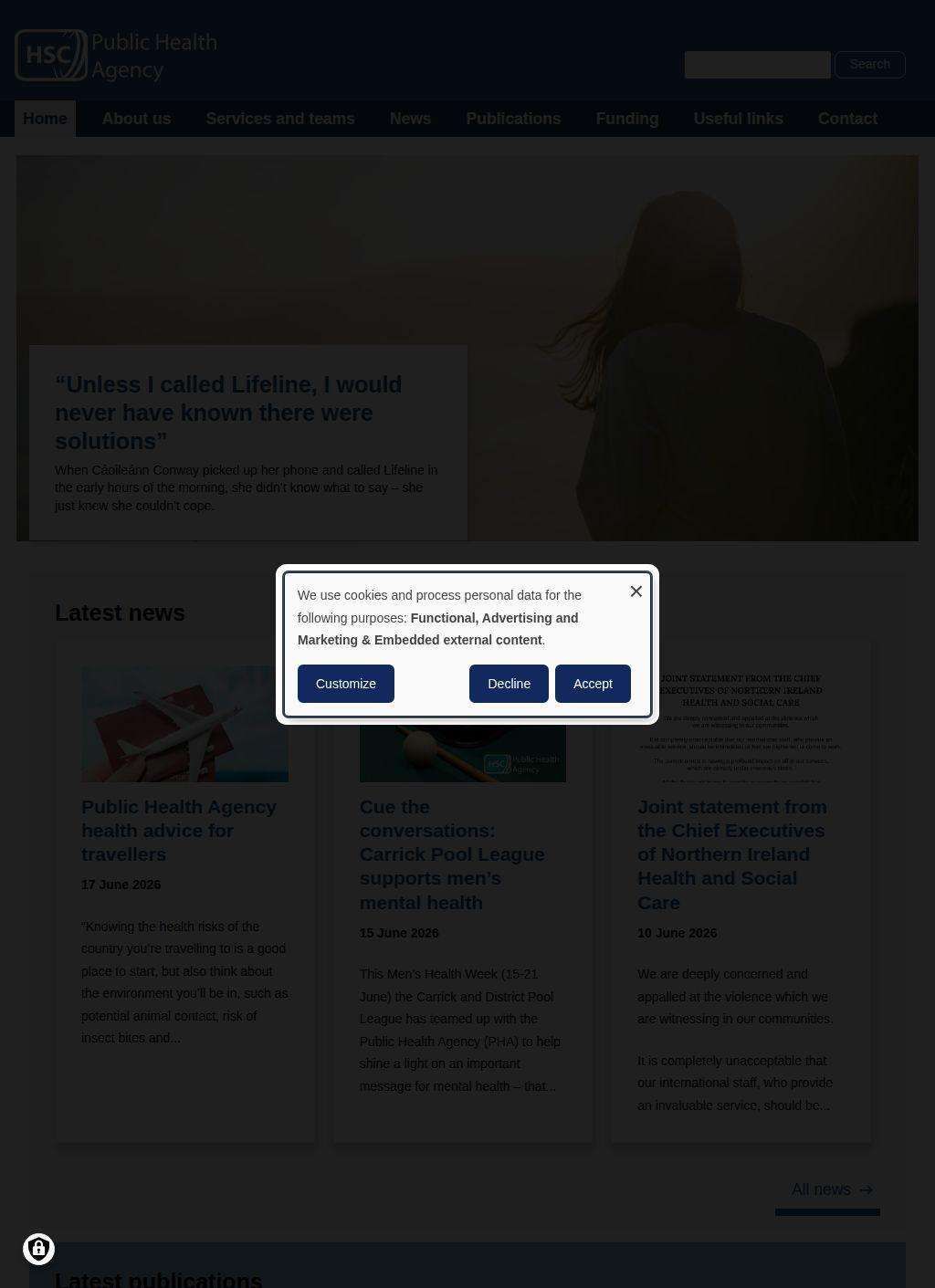
Northern Ireland's regional body for health protection and health improvement is the Public Health Agency Northern Ireland, sitting inside the wider Health and Social Care structure that runs the province's public services. Its website is the public front for that remit, and it reads exactly as you would expect a working agency site to read: dense with programmes, guidance, and the machinery of surveillance and screening. There is very little marketing gloss here, which suits the job.
Infectious disease surveillance and vaccination
Start with health protection, because that is the part most people will collide with during a bad flu winter or a measles scare. The Public Health Agency Northern Ireland handles infectious disease surveillance, runs the vaccination programmes, and publishes travel health guidance alongside its emergency preparedness material. If something is spreading, this is the organisation quietly tracking case numbers and issuing the advice that filters down to GP surgeries and pharmacies. The site presents all of that as ongoing operational work, not a one-off campaign, and that distinction comes through in how the pages are written. Emergency preparedness in particular is the sort of function that stays invisible until it is suddenly the only thing anyone cares about, and the Public Health Agency Northern Ireland treats it as a standing responsibility, not an afterthought.
Screening programmes for early detection
Screening is the other pillar that touches ordinary lives directly. Through its Service Development and Screening function, the Public Health Agency Northern Ireland coordinates breast, cervical, bowel, and diabetic eye screening, plus general health checks. These are national programmes with real recall systems behind them, and the website acts as the reference point that explains who is eligible, what each test involves, and why the invitation letter arrived. For anyone who has ever received one of those letters and wondered what it means, having a single authoritative page to consult is more useful than it might first appear. The screening pages avoid the trap of overselling: they describe benefits and limits together, which is the honest way to talk about tests that carry both.
Health improvement and population health services
It is a fair thing to ask, because the remit is wide. Beyond protection and screening, the Public Health Agency Northern Ireland runs a Health and Wellbeing Improvement stream that covers mental health services, smoking cessation, organ donation, and nutrition work. Then there is Population Health, which sits over nursing, midwifery, and allied health professional services, and a Data and Intelligence function producing research, statistics, and health analytics. On paper that is a sprawl, and a lesser site would let it turn into a directory of disconnected leaflets.
What holds it together is the stated method: evidence-based practice and partnership with the health trusts and community organisations that do delivery on the ground. The agency is not pretending to run every clinic itself. It sets direction, funds and coordinates, and measures outcomes, with a declared aim of reducing health inequalities across Northern Ireland. Reading through the sections, I kept noticing how consistently that inequalities theme surfaces, which tells you the framing is deliberate rather than decorative. The breadth is the point, because population health is broad by nature.
Research and published health data
The data side deserves a specific mention. A lot of public bodies bury their statistics or never publish them at all. Here the Data and Intelligence work is treated as a named function with its own output, so journalists, students, and other health workers can find Northern Ireland figures they can actually cite. The Public Health Agency Northern Ireland positioning of research as a first-class part of the operation, sitting level with the clinical programmes, is one of the more credible things about the whole setup.
Specialist topic sites for targeted support
There is also a network of affiliated, topic-specific sites that the agency maintains around cancer awareness, mental health support, substance misuse services, sexual health, and stopping smoking. This is a sensible structure. Someone in crisis over drink or drugs does not want to navigate an organisational chart, or a business directory, to find help, and a dedicated destination site meets them where they are instead. The parent Public Health Agency Northern Ireland presence then works as the hub that ties those specialist arms back to a single accountable body, so the branching does not fragment into orphaned microsites.
If I have a reservation, it is the one common to sites of this type. The volume of material is large, and the organising logic follows the agency's internal directorates more than a member of the public's likely question. A parent worried about a screening invitation and a nurse looking for professional guidance land in the same architecture, and the second group is clearly better served by it. That is a usability observation, not a failing of substance, because the substance is plainly there. A little more signposting for the worried-parent path would lift the whole experience, and it would cost the Public Health Agency Northern Ireland nothing in accuracy to add it.
The Public Health Agency Northern Ireland site is best understood as a working reference rather than a reading experience, and judged on that basis it holds up well. The functions are real, the programmes named are the ones that genuinely run in the province, and nothing about the content feels padded to look busier than it is. Where the writing is dry, it is dry because vaccination schedules and screening eligibility are dry subjects that reward precision over flourish.
For its intended purpose the resource is solid, and I would send someone here without hesitation for authoritative guidance on any of the health topics it covers in Northern Ireland. The Public Health Agency Northern Ireland offering is comprehensive on protection, screening, and improvement, and it backs that up with a visible commitment to evidence and published data. The verdict, then, is a confident one with a single practical caveat: come knowing roughly what you are looking for, because the depth that makes the Public Health Agency Northern Ireland valuable is also what makes casual browsing slow. As a destination for accurate, province-specific public health information, it does the job it exists to do, and does it without fuss.
Business address
Public Health Agency
12-22 Linenhall Street,
Belfast,
Northern Ireland
BT2 8BS
United Kingdom
Contact details
Phone: 0300 555 0114