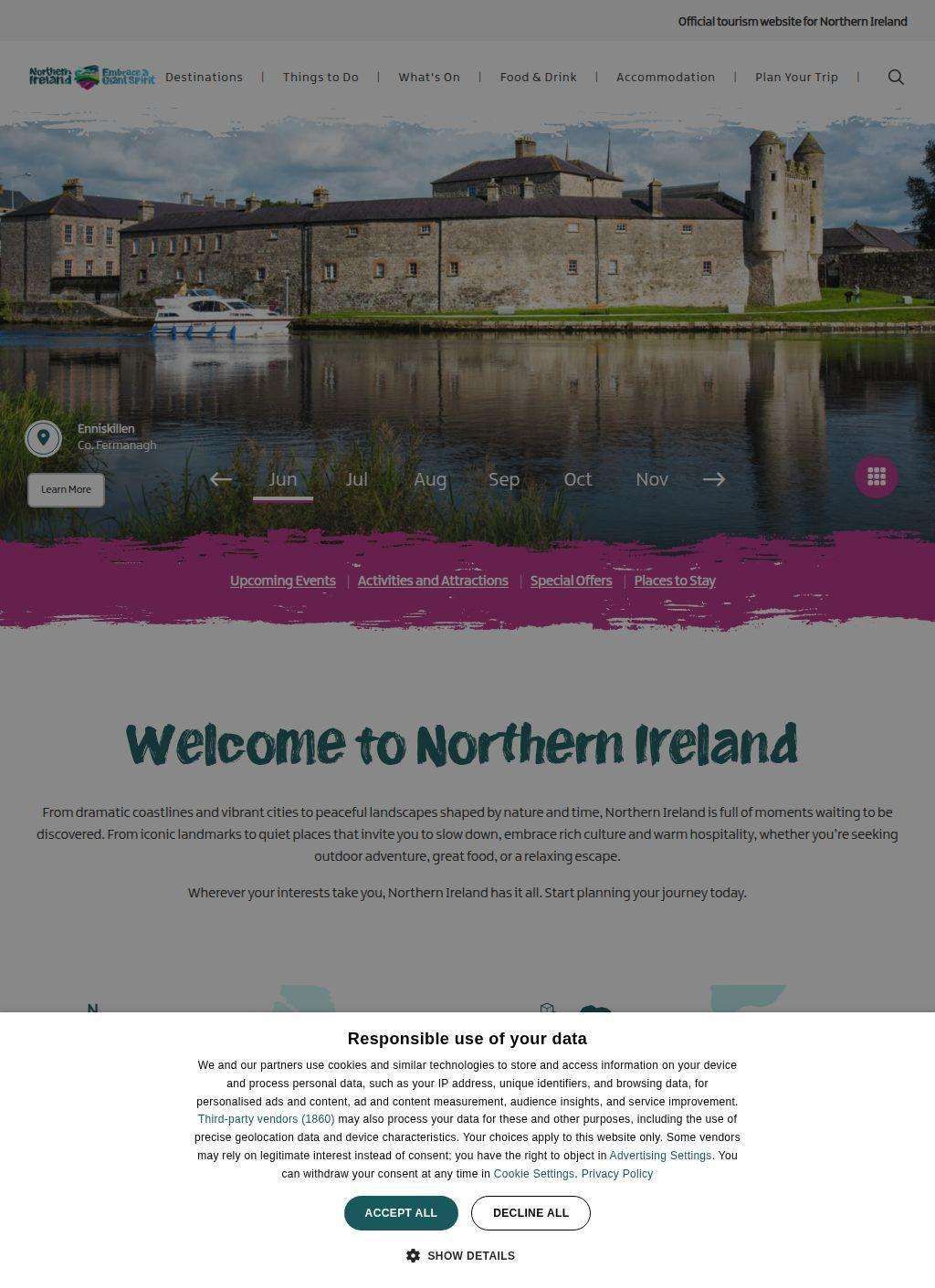
Discover Northern Ireland is the official tourism website for the region, operated by Tourism Northern Ireland, the public body responsible for developing and promoting the local visitor economy. Where a private travel site is trying to sell a particular product, this one exists to present Northern Ireland as a whole and to send visitors towards the businesses, attractions and events that make up a trip. That public-body status is the reason it can cover the region evenly rather than favouring whichever operator pays the most, and it is what makes the site a sensible reference point in any business directory that deals with travel and leisure in the area.
Organizing content by county and theme
The site is built around the things visitors actually plan: where to go, where to stay, what to eat, and what is happening while they are there. It organises content by the six counties, Antrim, Armagh, Down, Fermanagh, Londonderry and Tyrone, and by theme, so a traveller can approach it either through a place or through an interest such as walking, family days out, food and drink, or film locations. Each of those routes leads to listings of specific attractions and providers, with practical detail rather than just photographs.
Headline attractions across the region
The headline attractions are given the prominence they deserve. The Giant's Causeway on the north Antrim coast, a UNESCO World Heritage Site, is the single best-known draw, and the site covers it alongside the wider Causeway Coastal Route, the Carrick-a-Rede rope bridge and the Dark Hedges. Inland it points visitors to the Mourne Mountains in County Down, the lakes of Fermanagh around Lough Erne, the walled city of Derry, and the Titanic Belfast experience built on the slipways where the ship was constructed. The strength of the site is that it sets these famous names within a fuller picture, so a visitor planning around the Causeway also discovers the smaller harbours, distilleries and walking trails nearby.
Specialist tourism strands covered
Several distinctive strands of tourism are handled well. The region's screen-tourism trade, much of it driven by the television series filmed across Northern Ireland, has its own dedicated coverage that maps locations to places people can actually visit. Ancestral and heritage tourism is given real attention too, reflecting how many overseas visitors come to trace family roots. Peace tourism, covering the political murals and the history of the area, is presented carefully and without sensationalism, which is the appropriate tone for a public body. Food and drink coverage runs from traditional pubs to the growing number of distilleries and fine-dining rooms.
The intended users are mainly leisure visitors, both from within the United Kingdom and Ireland and from further afield, along with the people planning trips on their behalf. Travel trade professionals, event organisers and journalists also use the wider Tourism NI organisation for data, imagery and business support, though that work mostly sits on its corporate site rather than this consumer-facing one. For a member of the public, the value is in having one neutral, well-maintained place to assemble an itinerary before booking the individual pieces elsewhere.
Practical features for planning a trip
Practical features make the site genuinely usable rather than merely attractive. The events calendar is kept current and is one of the better reasons to check the site close to a visit, since festivals and seasonal openings change throughout the year. Accommodation listings span hotels, guesthouses, self-catering and campsites, and attraction pages typically carry opening information and a link through to the operator. The writing is informative and avoids the overheated tone that some destination marketing falls into, which makes the recommendations easier to trust.
Caveats on bookings and reviews
A couple of honest caveats apply. As a promotional site its job is to encourage visits, so the framing is positive throughout; travellers wanting candid, warts-and-all reviews will still want to cross-check independent review sites for individual hotels and restaurants. Booking is generally not completed on Discover Northern Ireland itself, which acts as a directory and hands the visitor over to operators or third-party booking platforms to finalise a stay or a ticket, so it is a planning tool rather than a one-stop checkout. And because coverage aims to be even across the region, a very specialist interest may be served better by a dedicated local site once the broad shape of a trip is set.
Planning trips around outdoor activities
The site also rewards visitors who arrive with a particular kind of trip in mind. Walkers will find the major routes set out, from the coastal paths of Antrim to the high ground of the Mournes and the gentler trails around the Fermanagh lakes, with grading and distance information that helps with planning. Cyclists, anglers and golfers are catered for through dedicated sections, the last of these reflecting the strength of the region's links courses, including the championship venue at Royal Portrush on the north coast. Families get itineraries built around activity centres, beaches and wildlife, and the site flags which attractions are indoor, which is a practical touch given the local climate.
Seasonality runs through the whole offer, and the site is good at reflecting it. The long summer evenings open up the coast and the open-air attractions, while autumn and winter shift the emphasis towards food festivals, Christmas markets and indoor culture. Hallowe'en is treated as a genuine highlight, with Derry's celebrations among the largest in Europe given their own coverage. Because Tourism NI updates the events listings throughout the year, the site stays useful in a way that a printed guide cannot, and checking it shortly before travelling tends to surface things a static source would miss.
Fitting into wider island travel patterns
It is worth understanding how Discover Northern Ireland relates to the rest of the islands as a destination. The site sensibly acknowledges that many visitors combine a trip to Northern Ireland with the Republic of Ireland or with Great Britain, and it positions the region within that wider travel pattern rather than pretending it exists in isolation. Cross-border touring routes, ferry and air connections, and the practicalities of moving between jurisdictions are all addressed, which is exactly the sort of neutral, joined-up information a public tourism body is well placed to provide and a single commercial operator is not.
Practical pages on getting here by air through Belfast's two airports and the City of Derry, by ferry from Scotland and elsewhere, and by road from Dublin, give first-time visitors the confidence to plan independently. The site also gathers visitor information centre locations across the towns, which remain useful for picking up local advice, maps and last-minute bookings once a traveller has actually arrived in the region.
Contact details are clear. Tourism Northern Ireland is based at Floors 10-12, Linum Chambers, Bedford Square, Bedford Street, Belfast BT2 7ES, with a general line on 028 9044 1545 and a textphone on 028 9044 1522 for visitors who are deaf or have hearing loss. The organisation handles consumer queries, trade support and quality assurance schemes for accommodation from that head office, and the website carries online enquiry forms for more specific requests.
For a business directory pointing readers towards the institutions that shape Northern Ireland, Discover Northern Ireland is the authoritative starting point for anyone planning to visit. It covers places thoroughly and even-handedly across the counties, it is kept up to date by the public body charged with the job, and it is free to use. It works best as the place to research and shape a trip rather than to complete bookings, but for assembling a sense of where to go and what is on, it is the natural reference and a dependable companion to the region's accommodation and attraction operators.
Business address
Tourism Northern Ireland
Floors 10-12, Linum Chambers, Bedford Square, Bedford Street,
Belfast,
Northern Ireland
BT2 7ES
United Kingdom
Contact details
Phone: 028 9044 1545