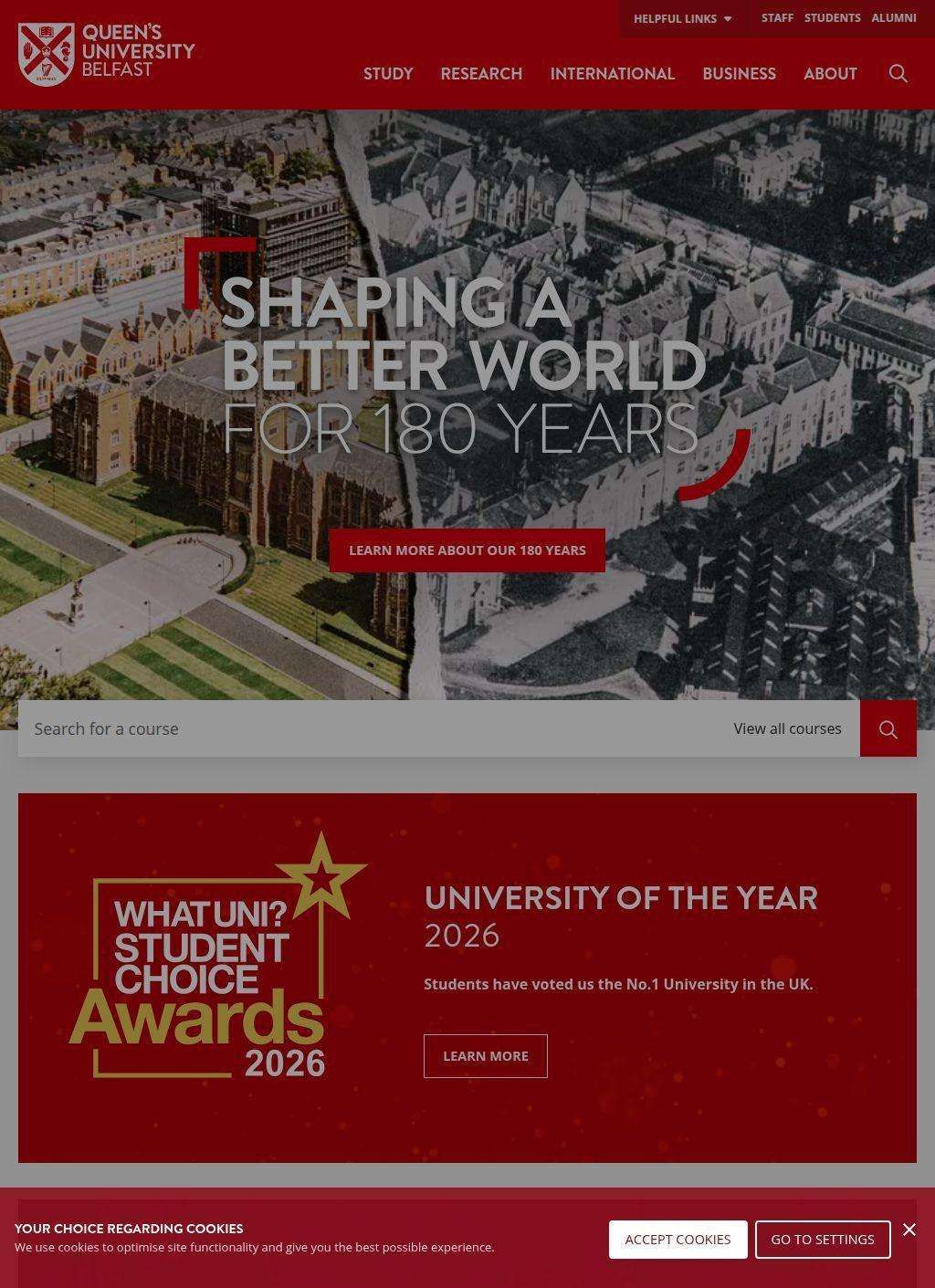
Students themselves voted Queen's University Belfast the number one university in the UK, a distinction it carries into 2026 as University of the Year. That sort of accolade lands differently when it comes from the people sitting in the lecture halls, and it sets the tone for an institution roughly 180 years old that sits at 174th in the QS World University Rankings for 2027. The site reads like the front door of a place that knows exactly what it does and has the breadth to back it.
Study routes for different circumstances
The teaching side is laid out the way you would hope for a research university of this scale. Undergraduate and postgraduate programmes run across multiple faculties and schools, and the routes in are not limited to the standard three or four years of campus study. There is open learning for people who cannot relocate, and short courses for those who want a single skill or subject without committing to a full degree. Queen's Business School sits within this, running an MBA alongside executive education aimed at working professionals. The layering of study modes is more useful than a glossy prospectus shot, because it tells a prospective applicant immediately whether their situation actually fits. Few institution pages make the entry routes this legible, and Queen's University Belfast does it without burying the detail.
Support tailored to international students
International applicants get a section that does real work. Instead of a single welcome page, Queen's University Belfast breaks guidance down by what an overseas student genuinely needs to sort out: English language requirements, scholarships earmarked for international students, preparation courses that bridge into degree study, and exchange or study abroad arrangements. It goes further with country and region-specific pages covering China, India, the USA, the Middle East, South East Asia, and Sub-Saharan Africa. Anyone applying from outside the UK knows the process is rarely uniform, and seeing the university acknowledge that with tailored advice is reassuring in a practical, unglamorous way.
Research investments and clinical projects
The research output is where the institution shows its weight, and the examples on the site are specific enough to be worth naming. Maternal health features as part of a fifty million pound investment, which is a serious figure for a single thematic area. Other work spans the genetics of anxiety, end of life health services, and critical care pharmacology, the kind of clinical territory where findings feed directly into how people are treated. None of it is described in the generic language a lot of universities fall back on, and Queen's University Belfast names the projects clearly enough that an interested reader could chase down the specifics.
Partnerships that span sport and business
One project caught my attention more than the rest: cycling injury prevention carried out in partnership with the Union Cycliste Internationale, the sport's world governing body. That is a concrete external collaboration with a recognisable name attached, not a vague gesture toward impact. Queen's University Belfast also runs funded PhD studentships and operates a Graduate School for postgraduate researchers, so the research culture is built to bring new people in rather than rest on existing staff alone. Pairing a global sport body with a clinical injury question is the sort of cross-sector work that gives a research claim some teeth.
Commercial engagement and economic impact
For businesses, there is a separate route. The university frames its commercial engagement around five things: commercialisation of research, talent recruitment, collaborative projects, access to specialist expertise, and use of its facilities. Alongside this it publishes economic impact data putting its contribution to the UK economy in the billions. Figures like that can read as self-congratulation, but they at least give a company some sense of the scale it would be dealing with. A firm looking to recruit graduates or licence a piece of research can see at a glance that Queen's University Belfast treats this as a defined service, not an afterthought bolted onto the academic side.
Campus life is covered without it overwhelming the academic material. Accommodation and student services are documented, and Queen's Sport provides the athletic facilities for those enrolled at Queen's University Belfast. The library has its own presence on the site, there is a virtual tour for people who cannot visit in person, and a professional services directory points internal users to the right department. A Postgraduate Summer Fair is scheduled for August 2026, which is the sort of dated, actionable detail that helps someone weighing a postgraduate application plan a visit.
What I keep coming back to is how little of the site is padding. A university homepage can easily collapse into mission statements and stock photography, yet most of what Queen's University Belfast surfaces is checkable: named partnerships, specific research investments, defined study pathways, and concrete student services. The teaching, research, and business arms are each given enough room to be understood on their own terms, and the international guidance in particular goes deeper than other institutions I have looked at.
If there is a gap worth naming, it is that the headline rankings and the student vote do a lot of the persuading up front, and a reader has to dig past those to reach the substance underneath. The substance is there, which counts for something, but the framing leans on accolades before it leans on detail. For a prospective student or a research partner, the deeper pages reward the effort. The cycling partnership, the fifty million pound maternal health investment, and the region-specific international support are the parts that tell you what Queen's University Belfast is genuinely built to do, and they sit a layer below the front page noise.
The MBA and executive education strand inside the business school is worth flagging separately for anyone past the undergraduate stage. It points to Queen's University Belfast reaching past school leavers toward mid-career professionals and corporate training, which broadens who the place is for. Combined with open learning and short courses, the overall picture is of an institution trying to serve several quite different audiences from the same base, and largely succeeding at describing how each one gets in. The executive education line in particular indicates Queen's University Belfast wants ongoing relationships with companies, beyond a single one-off intake every September.
Organising research by thematic area
A quick word on the research themes is warranted because they are organised rather than scattered. Work is grouped into thematic areas instead of being listed school by school, which makes it easier for an outside researcher or funder to find the cluster relevant to them. The funded studentships hang off these themes, so the recruitment pipeline and the research priorities are visibly connected. End of life services and critical care pharmacology sitting next to maternal health points to a health research base with real depth across the clinical lifespan, and it is one of the clearer indicators on the site of where Queen's University Belfast puts its money.
Taken together, the pages give a fair and detailed account of a large public research university in Belfast, with the strongest material being the named research projects, the staged study options, and the genuinely segmented international support. The August 2026 Postgraduate Summer Fair and the virtual tour are the small, dated touches that turn browsing into a next step.
Business address
Queen's University Belfast
University Road,
Belfast,
Northern Ireland
BT7 1NN
United Kingdom
Contact details
Phone: +44 (0)28 9024 5133