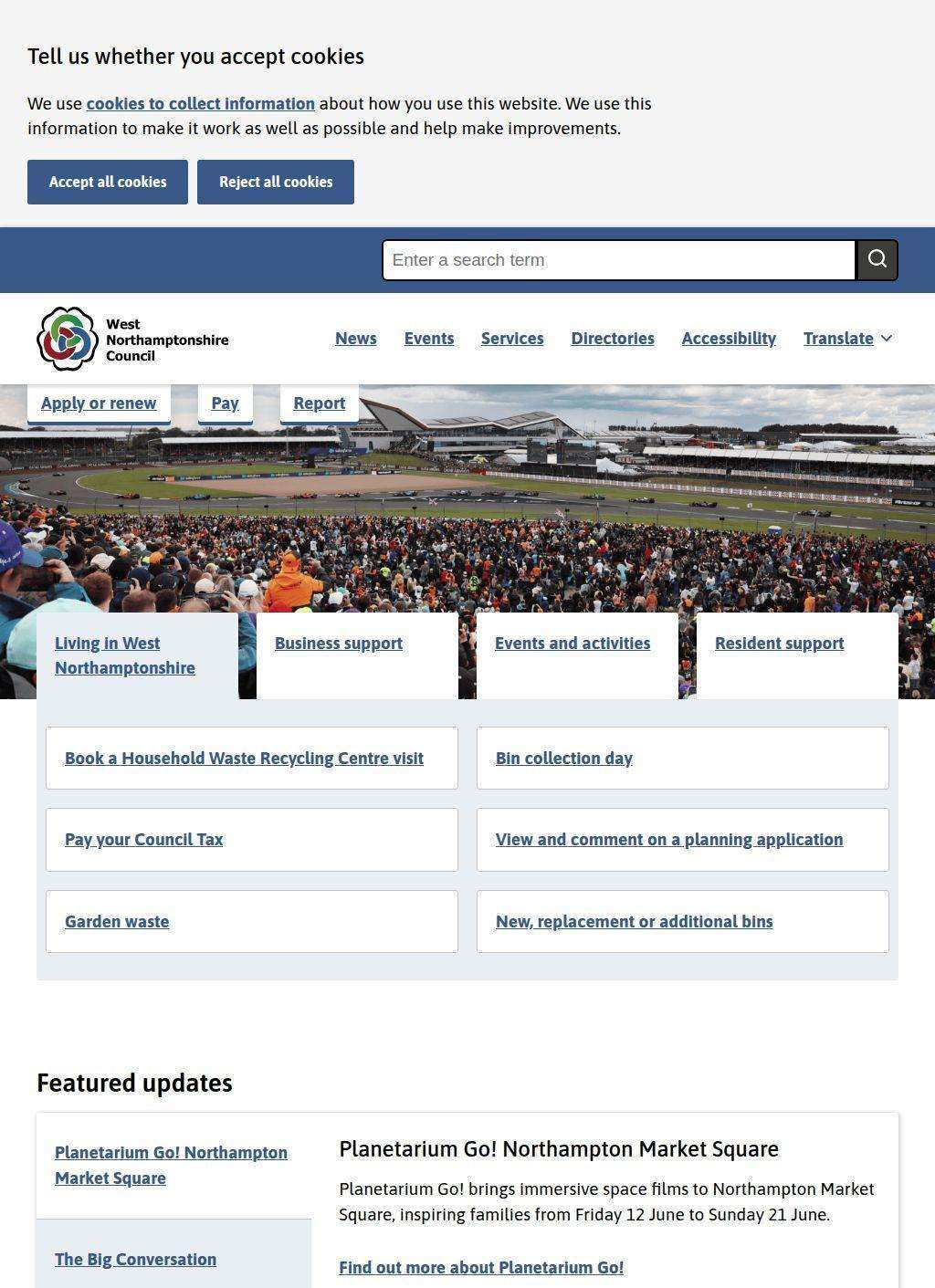
Three buttons sit near the top of the homepage, marked Apply, Pay and Report, and that trio tells you most of what the site is built to do. A resident who needs to settle a Council Tax bill, flag a missed bin, or log a pothole on a road they drive every day can start that task within a click or two. West Northamptonshire Council runs the full slate of statutory local government work for the unitary area created in April 2021, pulling together Northampton, Daventry, Towcester and the surrounding towns and villages under one authority.
Check council tax, bins and road reports
The Council Tax section is the part most people reach for first. It handles payments and account access, and it covers the less obvious things too: discounts, exemptions, and the breakdown of how the charge is set. That same pay-apply-report logic runs through bins and recycling, where you can check a collection schedule, report a bin that was missed, or arrange a bulky waste pickup for items that do not fit a normal round. Highways and transport sits alongside it, taking reports of potholes, road faults and parking issues. These are the everyday frictions of living somewhere, and West Northamptonshire Council has clearly built the site around getting them dealt with online rather than by phone queue.
Applying for planning and housing benefits
Planning is given real room. Residents can submit an application, track one already in the system, and comment on proposals affecting their street or neighbourhood. The public-facing access is worth having when a development goes up nearby. Housing and benefits is another substantial strand, with housing applications, housing benefit, and discretionary payments grouped together for people who often need more than one of those at once.
Registering births, deaths, marriages
Past the quick actions, the depth of what West Northamptonshire Council carries becomes clearer. Registration services for births, deaths and marriages are here, the legal milestones that send people to a council office whether they think of it as local government or not. Family and children services run wide: school admissions and appeals, early years provision, the Family Hubs support network, and a route for reporting concerns about a child's welfare. That last one is not a transaction so much as a safeguarding duty, and it is placed where a worried neighbour or relative can find it.
Adult care, public health, business support
Adult social care is handled with similar seriousness, covering care assessments, supported living arrangements, and mental health referrals. Public health sits next to it with programmes such as stop-smoking support and healthy weight guidance, the preventive side of the same remit. Businesses get their own track: Business Rates, licensing, commercial waste arrangements, Trading Standards enforcement, and a free business support programme aimed at firms based in the area. This is where a local business directory approach would fall short, because West Northamptonshire Council integrates Trading Standards enforcement directly alongside the registration and licensing steps, keeping the compliance picture in one place. The offering is genuinely broad, and the site does not pretend any one audience is the only one it serves.
Parks, libraries and emergency planning
Community and cultural services round it out. Parks and green spaces, sports facilities, libraries, local events and cultural heritage all have a place, and emergency planning and flood management information is hosted for the times when the ordinary services are not the point. For an area prone to flooding in parts, having that material on the same domain as everything else makes sense. Social channels are linked across Twitter, Facebook, Instagram, YouTube and LinkedIn, giving people a second route to service updates and announcements when something disrupts a collection or a road.
What the site reveals about local life
What the scale of West Northamptonshire Council's site quietly reveals is how much of local life a unitary authority touches. A single domain moves from paying a tax bill to registering a death, from commenting on a planning proposal to checking whether the local pool is open. The authority is still young, formed in 2021, yet the site already behaves like a settled front door for a large slice of the East Midlands. Someone new to the area could land on it knowing nothing about how their council is structured and still find the school admissions form, the bin calendar and the business rates page without much hunting.
Organizing services around resident tasks
There is a practical logic running through the structure. Grouping housing and benefits together, children's and family services in one cluster, business obligations in another. This mirrors how people's needs arrive, not how a council org chart is drawn. West Northamptonshire Council has arranged the material around the resident's task, and the prominent quick-action buttons are the clearest sign of that intent. For the day-to-day business of running a household or a small firm in Northampton, Daventry or Towcester, this is where those tasks get done.
Finding deeper services through search
One thing worth knowing for anyone browsing for the first time: the volume of services on West Northamptonshire Council's domain is large enough that the search box and the A-to-Z listings do a lot of work, because the top-level buttons cover common errands but the deeper material (flood plans, Trading Standards, mental health referrals) sits a few layers down. West Northamptonshire Council treats the site as an operational hub, and for the routine jobs, Council Tax, bins, potholes, planning comments, the path stays short. That is where most visits begin and end, and the site delivers on that promise reliably. West Northamptonshire Council has built something that functions as real infrastructure for the people living and working in the area.
Business address
West Northamptonshire Council
One Angel Square, Angel Street,
Northampton,
Northamptonshire
NN1 1ED
United Kingdom
Contact details
Phone: 0300 126 7000