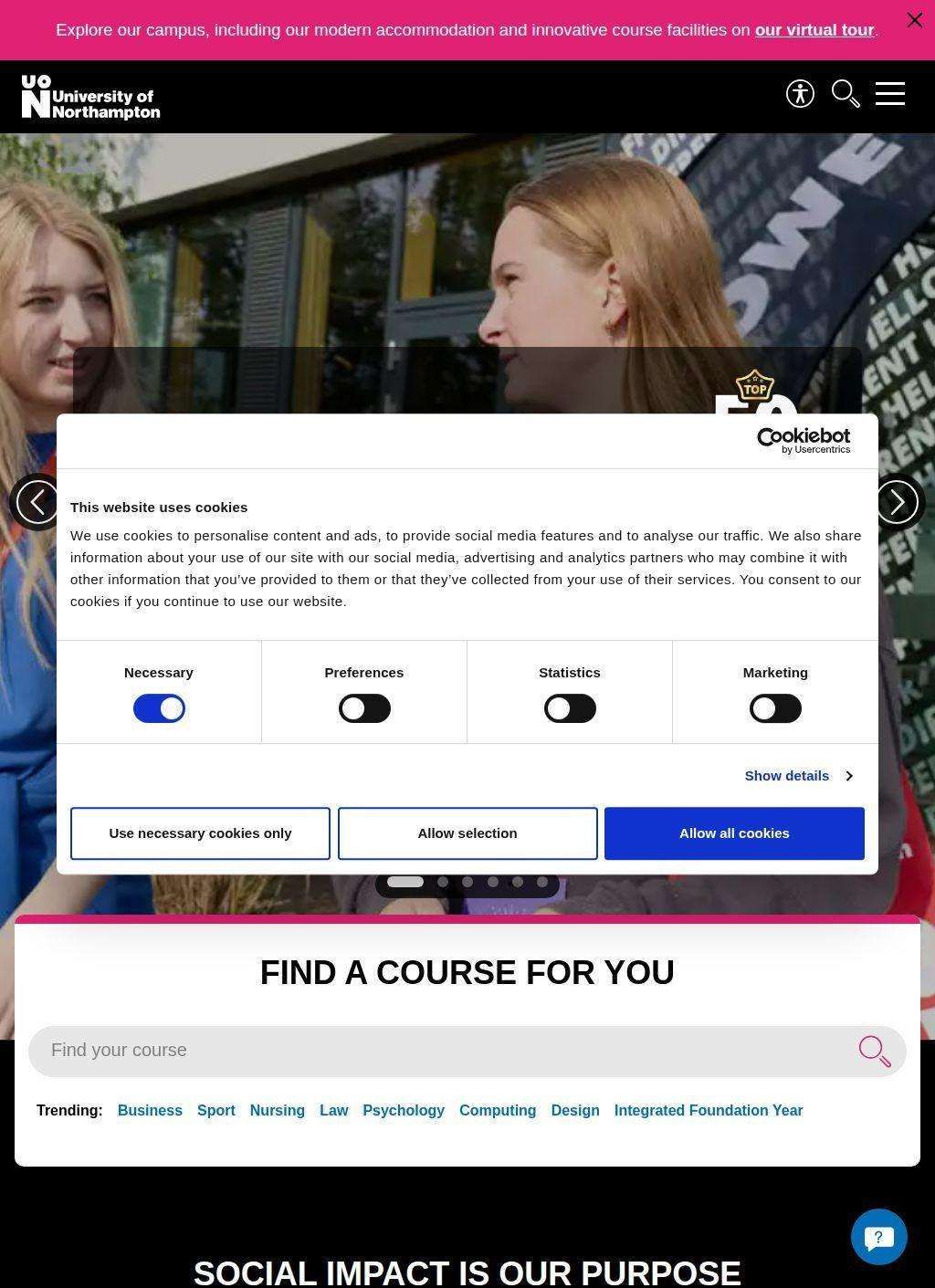
University of Northampton is a public university in Northampton, England. It teaches from its Waterside Campus on the river Nene close to the town centre. The site opens as a recruitment tool first and a reference second, which fits its job: it wants prospective students to find a course, picture living there, and apply. Undergraduate degrees sit at the front, with postgraduate and master's programmes, an Integrated Foundation Year route for applicants who need a year to build up to degree study, and Continuing Professional Development for people already working who want shorter, targeted qualifications.
Subject areas the university pushes hardest
Subject coverage is broad without pretending to be comprehensive. Business, Sport Sciences, Nursing, Law, Psychology, Computing, and Art and Design are the areas the University of Northampton pushes hardest, and those choices tell you something about who walks through the door: a mix of vocational and professional fields alongside the traditional academic ones. Nursing and Law point toward regulated careers with clear destinations. Computing and Art and Design pull a different applicant entirely. The spread is wide enough that the course search, not the homepage, becomes the part of the site most people actually use.
What course pages tell applicants
The course pages are the most useful part of the site. Each programme entry is built to answer the questions an applicant needs answered before they sign up for three years and a lot of money: what modules you take, what the entry requirements are, how the year is structured, and what the qualification leads to afterward. The Integrated Foundation Year deserves a specific mention because it widens access in a concrete way, letting someone whose grades or background fall short of direct entry start a degree with an extra preparatory year folded in rather than applying separately to a college first.
CPD sits slightly apart from the degree machinery and serves a different visitor. These are the short courses and professional updates aimed at people who already have a job and need a credential or a skill refresh, not a full return to student life. It is a sensible thing for a modern institution to run, and the University of Northampton gives it a clear place of its own on the site. Postgraduate study gets the same structured treatment as the undergraduate side, and that consistency counts for something with the international audience the university clearly courts.
Check the virtual campus tours
I found the virtual campus tours genuinely useful, since the University of Northampton built Waterside recently and a lot of applicants will never visit in person before deciding. Being able to walk the buildings on screen fills a gap for anyone applying from another country or another part of the UK. Online open days do similar work, giving distance applicants a scheduled way to ask questions instead of guessing from photographs.
Support services beyond the classroom
The University of Northampton leans heavily on what it wraps around the teaching, and the support package is unusually generous. New students are offered a laptop, and the site lists funded trips, internships, academic help, and personal support services as part of the standard deal rather than extras you pay for or chase down yourself. Accommodation gets its own detailed section covering the halls of residence, which is the practical information a first-year and their parents want long before they care about module lists.
The "Employment Promise" is the University of Northampton's named employability programme, and it is pitched as a commitment tied to getting graduates into work. Naming it and building a programme around it gives applicants something concrete to hold the university to, though the substance of any such promise only shows in the graduate figures, which a prospectus page is never the place to judge honestly. Orientation for new starters is set out clearly, and the personal and academic support services are described in enough detail that an anxious applicant can see there is a structure to lean on.
Services for international applicants
International students get a dedicated set of services from the University of Northampton, which is the right call given how much of the postgraduate market now comes from abroad. Visa guidance, arrival support, and the online open days aimed at that group are separated out so an overseas applicant is not left digging through pages written for a domestic school-leaver. That separation is a small thing that saves a lot of confusion.
Business consultancy and recruitment links
There is a business-facing side too, which is easy to miss if you arrive as a prospective student. The University of Northampton offers consultancy and runs talent and graduate recruitment programmes that connect employers with its students and research staff. For a local firm in Northamptonshire, that is a direct route into the graduate pool and into whatever expertise the academic departments hold. It also quietly reinforces the employability pitch, since a university that brokers recruitment is invested in the outcomes it advertises.
Social impact as institutional identity
Running through the site is a "social impact" theme and a habit of citing student positivity rankings. The University of Northampton has made social impact part of its institutional identity, and it will resonate with applicants who care about it. The positivity rankings are the softer sort of measure that universities pick when they read well, so they are worth weighing lightly against the course-specific detail. That is not a knock on the University of Northampton so much as a reminder that every prospectus chooses its flattering numbers.
What holds the whole thing together is that the University of Northampton has organised the site around decisions, not around itself. A domestic undergraduate, an international master's applicant, a working professional after CPD, and a local employer each have a lane that leads somewhere useful. The Foundation Year, the accommodation detail, and the employment programme are the parts a serious applicant will return to, because they answer the questions that actually decide where someone spends the next few years.
The Waterside Campus itself is worth understanding before applying, since it consolidated the university onto one riverside site and shapes the whole student experience the pages describe. A prospective student weighing the University of Northampton against a larger, older institution is effectively choosing between a compact single campus and a sprawling multi-site one, and the virtual tour is the fastest way to feel that difference. The site gives you the material to make that call. Course depth on one side, the support scaffolding on the other, and a campus you can walk through your screen before you ever set foot in Northampton.
Business address
The University of Northampton
University Drive, Waterside Campus,
Northampton,
Northamptonshire
NN1 5PH
United Kingdom
Contact details
Phone: 0300 303 2772